

TESTBANKS BY NURSINGNERD
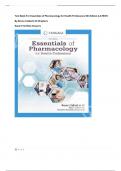
Test Bank For Essentials of Pharmacology for Health Professions 9th Edition (LATEST)
By Bruce Colbert| All Chapters
Expert Verified Answers
1|Page
,TESTBANKS BY NURSINGNERD
Chapter 1 Consumer Safety and Drug Regulations
1. A client calls her primary care provider requesting a prescription for an antidepressant
medication. She tells the nurse that she is severely depressed and would like the prescription called
in to her local pharmacy. How should the nurse respond?
a. The nurse encourages the client to see a psychiatric professional for an evaluation to obtain
the prescription.
b. The nurse tells the client to ask the pharmacist to recommend an over-the-counter
antidepressant.
c. The nurse can offer to write the client a prescription if it is a refill.
d. The nurse offers to give the client a few samples to use until her next appointment.
ANSWER: a
FEEDBACK: a. The client should be encouraged to seek a psychiatric professional evaluation to
obtain the prescription.
b. Antidepressants are not sold as over-the-counter medications; a prescription is required.
Try again.
c. The nurse cannot write a prescription without evaluating the client. Try again.
d. Samples are not given out to a client who has not been evaluated by a practitioner. Try
again.
POINTS: 1
QUESTION TYPE: Multiple Choice
HAS VARIABLES: False
DATE CREATED: 11/26/2017 8:16 PM
DATE MODIFIED: 11/26/2017 8:32 PM
2. A client visits her health care provider for her annual physical. She questions the nurse
regarding the use of an herbal supplement that she saw advertised on television for weight loss.
What information can the nurse share with her client?
a. The production of herbal medicines is not regulated by the FDA.
b. Under the Dietary Supplement Health and Education Act of 1994 (DSHEA), the FDA is
responsible for ensuring that a dietary supplement is safe before it is marketed.
c. Herbal medicines are tested by the FDA to determine if they have interactions with
prescribed medications.
2|Page
,TESTBANKS BY NURSINGNERD
d. Herbal medicines, while not approved by the FDA, are considered harmless.
ANSWER: a
FEEDBACK: a. The production of herbal medicines is not regulated by the FDA.
b. Under the Dietary Supplement Health and Education Act of 1994 (DSHEA), the dietary
manufacturer is responsible for ensuring that a dietary supplement is safe before it is marketed.
Try again.
c. The FDA does not test supplements. Try again.
d. There are documented interactions with specific herbal supplements and prescribed
medications. Try again.
POINTS: 1
QUESTION TYPE: Multiple Choice
HAS VARIABLES: False
DATE CREATED: 11/26/2017 8:22 PM
DATE MODIFIED: 11/26/2017 8:32 PM
3. Upon leaving the exam room, a client tells the nurse that she is confused regarding her
prescription. She asks the nurse if a cheaper, generic drug will be weaker than her current
prescription. How should the nurse respond?
a. Drug standards assure consumers that the same drug must be of uniform strength, quality,
and purity.
b. The prescribed medication is of better quality but will cost more.
c. The insurance companies mandate there are different strengths between generic and brand
name prescriptions.
d. Every drug has a different chemical composition that cannot be duplicated.
ANSWER: a
FEEDBACK: a. Drug standards assure consumers that the same drug must be of uniform
strength, quality, and purity.
b. Generic and trade drugs are the same medication. Generic is the name that is assigned to a
new drug. The trade name is the name the pharmaceutical company assigns to that drug to have
exclusive rights to market it. Try again.
c. Insurance companies have no control over the production of medication. Try again.
3|Page
, TESTBANKS BY NURSINGNERD
d. The laws regulating drugs state that consumers can be assured that all preparations with
the same name have the same uniform strength, quality, and purity. Try again.
POINTS: 1
QUESTION TYPE: Multiple Choice
HAS VARIABLES: False
DATE CREATED: 11/26/2017 8:23 PM
DATE MODIFIED: 11/26/2017 8:31 PM
4. The FDA, under the direction of the Department of Health and Human Services, mandates
which of the following?
a. Prescription and nonprescription drugs must be shown to be effective as well as safe.
b. All labels must include a listing of active ingredients; some labels require a listing of inactive
ingredients as well.
c. All new products must be tested by the FDA before being released to the public.
d. All drugs must have "warning" labels.
ANSWER: a
FEEDBACK: a. Prescription and nonprescription drugs must be shown to be effective as well as
safe.
b. All labels must be accurate and must include a listing of all active and inactive ingredients.
Try again.
c. The FDA must approve all new products before they are released to the public. Try again.
d. Warning labels must be present on certain preparations. Try again.
POINTS: 1
QUESTION TYPE: Multiple Choice
HAS VARIABLES: False
DATE CREATED: 11/26/2017 8:26 PM
DATE MODIFIED: 11/26/2017 8:30 PM
4|Page
Test Bank For Essentials of Pharmacology for Health Professions 9th Edition (LATEST)
By Bruce Colbert| All Chapters
Expert Verified Answers
1|Page
,TESTBANKS BY NURSINGNERD
Chapter 1 Consumer Safety and Drug Regulations
1. A client calls her primary care provider requesting a prescription for an antidepressant
medication. She tells the nurse that she is severely depressed and would like the prescription called
in to her local pharmacy. How should the nurse respond?
a. The nurse encourages the client to see a psychiatric professional for an evaluation to obtain
the prescription.
b. The nurse tells the client to ask the pharmacist to recommend an over-the-counter
antidepressant.
c. The nurse can offer to write the client a prescription if it is a refill.
d. The nurse offers to give the client a few samples to use until her next appointment.
ANSWER: a
FEEDBACK: a. The client should be encouraged to seek a psychiatric professional evaluation to
obtain the prescription.
b. Antidepressants are not sold as over-the-counter medications; a prescription is required.
Try again.
c. The nurse cannot write a prescription without evaluating the client. Try again.
d. Samples are not given out to a client who has not been evaluated by a practitioner. Try
again.
POINTS: 1
QUESTION TYPE: Multiple Choice
HAS VARIABLES: False
DATE CREATED: 11/26/2017 8:16 PM
DATE MODIFIED: 11/26/2017 8:32 PM
2. A client visits her health care provider for her annual physical. She questions the nurse
regarding the use of an herbal supplement that she saw advertised on television for weight loss.
What information can the nurse share with her client?
a. The production of herbal medicines is not regulated by the FDA.
b. Under the Dietary Supplement Health and Education Act of 1994 (DSHEA), the FDA is
responsible for ensuring that a dietary supplement is safe before it is marketed.
c. Herbal medicines are tested by the FDA to determine if they have interactions with
prescribed medications.
2|Page
,TESTBANKS BY NURSINGNERD
d. Herbal medicines, while not approved by the FDA, are considered harmless.
ANSWER: a
FEEDBACK: a. The production of herbal medicines is not regulated by the FDA.
b. Under the Dietary Supplement Health and Education Act of 1994 (DSHEA), the dietary
manufacturer is responsible for ensuring that a dietary supplement is safe before it is marketed.
Try again.
c. The FDA does not test supplements. Try again.
d. There are documented interactions with specific herbal supplements and prescribed
medications. Try again.
POINTS: 1
QUESTION TYPE: Multiple Choice
HAS VARIABLES: False
DATE CREATED: 11/26/2017 8:22 PM
DATE MODIFIED: 11/26/2017 8:32 PM
3. Upon leaving the exam room, a client tells the nurse that she is confused regarding her
prescription. She asks the nurse if a cheaper, generic drug will be weaker than her current
prescription. How should the nurse respond?
a. Drug standards assure consumers that the same drug must be of uniform strength, quality,
and purity.
b. The prescribed medication is of better quality but will cost more.
c. The insurance companies mandate there are different strengths between generic and brand
name prescriptions.
d. Every drug has a different chemical composition that cannot be duplicated.
ANSWER: a
FEEDBACK: a. Drug standards assure consumers that the same drug must be of uniform
strength, quality, and purity.
b. Generic and trade drugs are the same medication. Generic is the name that is assigned to a
new drug. The trade name is the name the pharmaceutical company assigns to that drug to have
exclusive rights to market it. Try again.
c. Insurance companies have no control over the production of medication. Try again.
3|Page
, TESTBANKS BY NURSINGNERD
d. The laws regulating drugs state that consumers can be assured that all preparations with
the same name have the same uniform strength, quality, and purity. Try again.
POINTS: 1
QUESTION TYPE: Multiple Choice
HAS VARIABLES: False
DATE CREATED: 11/26/2017 8:23 PM
DATE MODIFIED: 11/26/2017 8:31 PM
4. The FDA, under the direction of the Department of Health and Human Services, mandates
which of the following?
a. Prescription and nonprescription drugs must be shown to be effective as well as safe.
b. All labels must include a listing of active ingredients; some labels require a listing of inactive
ingredients as well.
c. All new products must be tested by the FDA before being released to the public.
d. All drugs must have "warning" labels.
ANSWER: a
FEEDBACK: a. Prescription and nonprescription drugs must be shown to be effective as well as
safe.
b. All labels must be accurate and must include a listing of all active and inactive ingredients.
Try again.
c. The FDA must approve all new products before they are released to the public. Try again.
d. Warning labels must be present on certain preparations. Try again.
POINTS: 1
QUESTION TYPE: Multiple Choice
HAS VARIABLES: False
DATE CREATED: 11/26/2017 8:26 PM
DATE MODIFIED: 11/26/2017 8:30 PM
4|Page


