TEST BANK
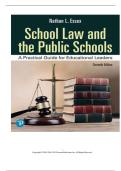
SCHOOL LAW AND THE PUBLIC SCHOOLS: A
PRACTICAL GUIDE FOR EDUCATIONAL LEADERS
i
Copyright © 2026, 2016, 2012 Pearson Education, Inc. All Rights Reserved.
,Test Bank For
School Law And The Public Schools A Practical Guide For Educational Leaders, 7th
Edition Nathan L. Essex
Chapter 1-13 Answers Are At The End Of Each Chapter
Application Exercises
To Accompany
School Law And The Public Schools: A Practical Guide
For Educational Leaders 7th Edition
Nathan L. Essex
School Law And The Public Schools (7th Edition) Includes
40 Scenario-Based Application Exercises.
Purpose:
The Exercises Are Designed To Advance Your Students
Professional Development By Taking Them Into Educational
Settings Through Authentic Scenarios That Provide Them
With Significant Legal Challenges And Problems That
Principals And Superintendents Most Likely Will Encounter
During Their Professional Careers.
Structure:
Each Exercise Is Structured With The Following Components:
1. Title Of The Exercise
2. A One Or Two Paragraph Overview That Establishes The Context
For The Exercise
3. A Scenario That Presents A Legal Challenge Or Problem
4. A Series Of Higher-Order Thinking Constructed-Response
Questions That Prompt Students To Reflect On How They Would Deal With The
Challenge Or Problem Presented
5. A Model Response For Each Question (You Have The Option Of
Inserting These Responses Into The Feedback Mechanism In Your Lms.)
Assigning The Exercises:
The Exercises Can Be Assigned In Three Or More Ways, Such As:
1. Assigning Them For Homework After A Chapter Has Been
Covered In Class
2. Using Them As Focal Points For Small-Group Discussions
3. Using Them As Focal Points For Whole-Class Discussions
Each Exercise Should Take Approximately 15-25 Minutes To Complete.
The Exercises:
The Following Is A List Of The Exercises, By Title.
Chapter 1:
ii
Copyright © 2026, 2016, 2012 Pearson Education, Inc. All Rights Reserved.
, Application Exercise 1.1: A Political School Board Member Makes An
Employment Request
Application Exercise 1.2: Formulation Of Legally Defensible Policies
Application Exercise 1.3: A New State Board Of Education Member
Faces New Challenges
Chapter 2:
Application Exercise 2.1: Prayer And Bible Reading In Schools
Application Exercise 2.2: Religious Displays In Schools
Application Exercise 2.3: Legal Risks Of Holding A Graduation
Ceremony In A Church
Chapter 3:
Application Exercise 3.1: The Constitutional Rights Of Students
Application Exercise 3.2: The Due Process Rights Of Students
Application Exercise 3.3: Student Search Involving A Protruding
Object
Chapter 4:
Application Exercise 4.1: Bullying In Public Schools
Application Exercise 4.2: Hazing In Public Schools
Application Exercise 4.3: Responding To Gangs In School Settings
Chapter 5:
Application Exercise 5.1: Do Not Attempt Resuscitation Request
Application Exercise 5.2: Harassment: A Student With Disabilities
Withdrawn From School
Application Exercise 5.3: Disciplining Students With Disabilities
Chapter 6:
Application Exercise 6.1: Supervision At A Saturday Volleyball
Program
Application Exercise 6.2: Teacher Liability And Playground
Supervision
Application Exercise 6.3: Supervision Before School
Chapter 7:
Application Exercise 7.1: Section 504 And Ferpa Violations Reports:
Medical Records
Application Exercise 7.2: Section 504 And Ferpa Violations Reports:
Disciplinary Records
Application Exercise 7.3: Educational Records, Student Injury And
School Liability
Application Exercise 7.4: A Video Involved In A School Fight
Chapter 8:
Application Exercise 8.1: A Teacher’s Use Of The ―N‖ Word In Class
iii
Copyright © 2026, 2016, 2012 Pearson Education, Inc. All Rights Reserved.
, Application Exercise 8.2: Teachers Sharing Cell Phone Numbers With
Students
Application Exercise 8.3: Teacher Freedom Of Expression And Racial
Epithets
Chapter 9:
Application Exercise 9.1: Employment Discrimination Lawsuit
Application Exercise 9.2: Sexual Harassment Lawsuit Against A
School Principal
Application Exercise 9.3: A Teacher’s Refusal To Use A Student’s
Personal Pronoun
Chapter 10:
Application Exercise 10.1: Inappropriate Conduct: Caught In The Act
Application Exercise 10.2: Dismissal Based On Grounds Of
Incompetency
Application Exercise 10.3: Prohibited Speech By Teachers In
Classrooms
Chapter 11:
Application Exercise 11.1: Book Ban Demanded By School Board
Member
Application Exercise 11.2: School Voucher Debate
Application Exercise 11.3: Barriers To School Attendance Involving
Undocumented Students
Chapter 12:
Application Exercise 12.1: Impact Of Segregation On Black Children
Application Exercise 12.2: Complying With Equal Opportunity
Challenges
Application Exercise 12.3: School Integration And A Diverse Student
Body
Chapter 13:
Application Exercise 13.1: The Plight Of Children Living In Poverty
Application Exercise 13.2: Impact Of Adequacy And Equity Funding On
Students In Public Schools
Application Exercise 13.3: Budget Reduction In Public School
Districts
iv
Copyright © 2026, 2016, 2012 Pearson Education, Inc. All Rights Reserved.
, Chapter 1
Test Item File
School Law And The Public
Schools: A Practical Guide For
Educational Leaders
Seventh Edition
Nathan L. Essex
University Of Memphis
Table Of Contents
Chapter 1: Legal Framework Affecting Public Schools 1
Learning Objective Quizzes 1
Application Exercise 7
Test Items 14
Test Answer Key 16
v
Copyright © 2026, 2016, 2012 Pearson Education, Inc. All Rights Reserved.
, Chapter 1: Legal Framework Affecting Public Schools
Chapter 1 Learning Objective Quizzes
[Q1]
Individual Rights Are Those That Are Essential To Live A Free And Equitable Life. These
Rights Cannot Be Denied By Other Individuals Or The Government. The Primary Source Of
Individual Rights Stems From The:
1. Fourteenth Amendment
2. Bill Of Rights (Correct)
3. Fifth Amendment
4. State Constitutions
[Feedback For Answer Choice 1]
This Choice Is Incorrect Because The Fourteenth Amendment, Specifically Its Due Process And
Equal Protection Clauses, Is Significant In Applying The Bill Of Rights To The States. However,
It Is Not The Original Source Of The Rights Themselves.
[Feedback For Correct Answer 2]
This Response Is Correct. The Bill Of Rights, Which Comprises The First Ten Amendments To The
U.S. Constitution, Is The Primary Source Of Individual Rights. These Amendments Expressly
Protect Certain Rights And Liberties For Individuals From Government Interference Such As
Freedom Of Speech And The Right To Bear Arms While Other Components Of The
Constitution, Including The Fourteenth And Fifth Amendments As Well As State Constitutions,
Protect Individual Rights, As The Bill Of Rights Is Specifically Designed To Limit The Powers
Of The Federal Government And Protect The Rights Of Individuals.
[Feedback For Answer Choice 3]
This Option Is Incorrect. The Fifth Amendment Provides Specific Protection Including The
Right Against Self-Incrimination, But It Is A Component Of The Bill Of Rights And Not The
Sole Source Of Individual Rights.
[Feedback For Answer Choice 4]
This Option Is Incorrect. While State Constitutions Can And Do Protect Individual Rights, The
Bill Of Rights At The Federal Level Is The Foundational Document That Enumerates These
Rights For All Citizens, Irrespective Of State Laws.
[Q2]
The Fourteenth Amendment Granted Citizenship To All Individuals Born Or Naturalized In The
United States And Provided All Citizens Equal Protection Under The Laws. Which Of The
Following Statements Most Accurately Describes The Impact Of The Fourteenth Amendment?
1. Each State’s Bill Of Rights Is Protected By Its Equal Protection Of The Law Provision. (Correct)
2. The Concept Of Due Process Is Applied To State Laws And Enforced By State Courts.
3. School Officials Must Respect The Constitutional Rights Of Students And School Personnel.
4. The Responsibility For Public Schooling Resides With The States.
[Feedback For Correct Answer 1]
1
Copyright © 2026, 2016, 2012 Pearson Education, Inc. All Rights Reserved.
,This Choice Is Correct Based On The Tenets Of The Fourteenth Amendment Which States ―No
State Shall Make Or Enforce Any Law That Abridge The Privileges Or Immunity Of Citizens
Of The United States Nor Shall Any State Deprive Any Person Of Life, Liberty Or Property
Without Due Process Of The Laws Or Deny Any Person Within Its Jurisdiction The Equal
Protection Of The Laws.‖
[Feedback For Answer Choice 2]
This Choice Is Not Totally Correct. While The Concept Of Due Process Is Applied To State
Laws And Can Be Enforced By State Courts, Due Process Challenges Are Also Enforced By
Federal Courts.
[Feedback For Answer Choice 3]
This Answer Is Correct But Does Not Represent The Strongest Impact Of The Fourteenth Amendment.
[Feedback For Answer Choice 4]
This Answer Is Correct But Has No Bearing On The Impact Of The Fourteenth Amendment To
States. The Responsibility For Public Schooling Resides With The State Based On The Tenth
Amendment Provision To The U.S. Constitution.
[Q3]
The U.S. Constitution Is The Supreme Law Of The Land. The First Ten Amendments Of The
Constitution Are Viewed As Fundamental Liberties Of Free People. The U.S. Constitution Is
Not:
1. A Framework Of Law In Which Orderly Governmental Processes Operate
2. The Primary Source Of Law
3. Subordinate To State Constitutions, Local Regulations, And Case Law (Correct)
4. The Basic Law Of The Land
[Feedback For Answer Choice 1]
This Response Is Incorrect. The Constitution Does, In Fact, Provide The Framework For The
Operation Of The U.S. Government.
[Feedback For Answer Choice 2]
This Option Is Incorrect. The Constitution Is The Foundational Legal Document From Which
All Other Laws In The United States Derive Their Authority.
[Feedback For Correct Answer 3]
This Choice Is Correct. The U.S. Constitution Is The Supreme Law Of The United States And
Is Not Subordinate To Any Other Form Of Law Within The Country. According To The
Supremacy Clause (Article
Vi , Clause 2), The Constitution, Federal Laws,
Made Pursuant To It, And Treaties Made Under Its Authority Constitute The Supreme Law
Of The Land. This Means That State Courts Are Bound By And State Constitutions Are
Subordinate To The U.S. Constitution. [Feedback For Answer Choice 4]
This Choice Is Incorrect. The Constitution Is Commonly Referred To As The Basic Law Of
The Land Establishing The Federal Government And Fundamental Laws While Guaranteeing
2
Copyright © 2026, 2016, 2012 Pearson Education, Inc. All Rights Reserved.
,Certain Basic Rights For Its Citizens.
3
Copyright © 2026, 2016, 2012 Pearson Education, Inc. All Rights Reserved.
,[Q4]
State Constitutions Represent The Basic Source Of Law For Individual States And Generally
Require Legislative Bodies To Perform A Number Of Important Functions. State
Constitutions Perform A Number Of Functions With One Exception:
1. Establishes A System Of Public Education
2. Guarantees Absolute Personal Rights (Correct)
3. Prescribes Funding And Operational Schemes For Public Schools
4. Restricts Power Of Legislative Bodies
[Feedback For Answer Choice 1]
This Option Is Incorrect. State Constitutions Often Include Provisions That Establish And
Regulate The System Of Public Education Within The State.
[Feedback For Correct Answer 2]
This Response Is Correct. State Constitutions Perform A Variety Of Functions, But Do Not
Guarantee Absolute Personal Rights. The Rights Enumerated In State Constitutions, Like Those
In The U.S. Constitution, Are Subject To Certain Limitations And Interpretations By The
Courts. For Example, Rights Such As Freedom Of Speech Or Religion Can Be Limited Under
Certain Circumstances For Public Safety Reasons.
[Feedback For Answer Choice 3]
This Response Is Incorrect. State Constitutions Typically Outline The Funding Methods And
Operational Guidelines For Public Schools.
[Feedback For Answer Choice 4]
This Response Is Incorrect. State Constitutions Define The Scope And Limits Of Power By
Legislative Bodies Within The State Ensuring A Balance Of Power Among The Branches Of
Government.
[Q5]
Statutes Represent Laws Passed By The Legislature. Federal Statutes Are Laws Passed By
Congress With Approval Of The President. A Statute Represents:
1. An Act Of The Legislative Branch Of Government (Correct)
2. The Most Abundant Source Of Law
3. The Most Viable Source Of New Laws Or Revisions Of Existing Law
4. A Law Enacted By The Judicial Branch Of Government
[Feedback For Correct Answer 1]
This Response Is Correct. Statutes Are Also Referred To As Acts, Such As The Civil Rights Act
Of 1964 And The Individuals With Disabilities Education Act. These Acts Set Forth General
Principles Of Law That Courts Apply To Specific Situations. They May Forbid Certain Action
Or Direct Certain Action.
[Feedback For Answer Choice 2]
This Option Is Incorrect. While Statutes Are A Significant Source Of Law, This Option Does Not
Define What A Statute Is.
[Feedback For Answer Choice 3]
4
Copyright © 2026, 2016, 2012 Pearson Education, Inc. All Rights Reserved.
, This Response Is Incorrect. This Option Describes A Characteristic Of Statutes But Does Not
Define Them.
[Feedback For Answer Choice 4]
This Option Is Incorrect Because Statutes Are Enacted By The Legislative Branch, Not The
Judicial Branch.
[Q6]
Case Law Is Based On Judicial Decisions As Opposed To Laws Based On The Constitution, Statutes, Or
Regulations. Case Law Is Not Based On:
1. Judge-Made Or Common Law
2. Local Ordinances (Correct)
3. Judgments, Opinions, And Decisions Of Courts
4. Frequent Reliance On Precedents
[Feedback For Answer Choice 1]
This Response Is Incorrect. Case Law Is, In Fact, Based On Judge-Made Law Or Common Law
Which Is Developed Over A Period Of Time Through Court Decisions.
[Feedback For Correct Answer 2]
This Option Is Correct. Case Law Also Known As Common Law Is Based On Judicial
Decisions From Previous Cases Rather Than On Constitutions, Statutes, Or Regulations. It
Incorporates Specific Facts Of A Legal Case That Have Been Decided By The Courts. Case
Law Is Fundamentally Judge-Made Law That Is Derived From The Decisions In Previous
Cases And Relies On Precedents.
[Feedback For Answer Choice 3]
This Option Is Incorrect. These Are The Very Essence Of Case Law As It Is The Product Of
Judgments, Opinions, And Decisions Of The Courts.
[Feedback For Answer Choice 4]
This Option Is Incorrect. Reliance On Precedents Is An Essential Aspect Of Case Law Where
Past Decisions Inform The Rulings On Current Cases.
[Q7]
Common Law Is Derived From Custom And Judicial Precedent Rather Than Statutes Which Is In
Dire Contrast With Statutory Law. Common Law Precedents Are Driven By:
1. State Constitutions
2. Legislatures
3. Federal Constitution
4. Courts (Correct)
[Feedback For Answer Choice 1]
This Option Is Incorrect. While State Constitutions Can Influence The Application Of Common
Law, They Are Not The Source Of Common Law Precedents.
[Feedback For Answer Choice 2]
This Choice Is Incorrect. Legislatures Create Statutes And Legislation Rather Than Common
Law Precedents.
5
Copyright © 2026, 2016, 2012 Pearson Education, Inc. All Rights Reserved.
SCHOOL LAW AND THE PUBLIC SCHOOLS: A
PRACTICAL GUIDE FOR EDUCATIONAL LEADERS
i
Copyright © 2026, 2016, 2012 Pearson Education, Inc. All Rights Reserved.
,Test Bank For
School Law And The Public Schools A Practical Guide For Educational Leaders, 7th
Edition Nathan L. Essex
Chapter 1-13 Answers Are At The End Of Each Chapter
Application Exercises
To Accompany
School Law And The Public Schools: A Practical Guide
For Educational Leaders 7th Edition
Nathan L. Essex
School Law And The Public Schools (7th Edition) Includes
40 Scenario-Based Application Exercises.
Purpose:
The Exercises Are Designed To Advance Your Students
Professional Development By Taking Them Into Educational
Settings Through Authentic Scenarios That Provide Them
With Significant Legal Challenges And Problems That
Principals And Superintendents Most Likely Will Encounter
During Their Professional Careers.
Structure:
Each Exercise Is Structured With The Following Components:
1. Title Of The Exercise
2. A One Or Two Paragraph Overview That Establishes The Context
For The Exercise
3. A Scenario That Presents A Legal Challenge Or Problem
4. A Series Of Higher-Order Thinking Constructed-Response
Questions That Prompt Students To Reflect On How They Would Deal With The
Challenge Or Problem Presented
5. A Model Response For Each Question (You Have The Option Of
Inserting These Responses Into The Feedback Mechanism In Your Lms.)
Assigning The Exercises:
The Exercises Can Be Assigned In Three Or More Ways, Such As:
1. Assigning Them For Homework After A Chapter Has Been
Covered In Class
2. Using Them As Focal Points For Small-Group Discussions
3. Using Them As Focal Points For Whole-Class Discussions
Each Exercise Should Take Approximately 15-25 Minutes To Complete.
The Exercises:
The Following Is A List Of The Exercises, By Title.
Chapter 1:
ii
Copyright © 2026, 2016, 2012 Pearson Education, Inc. All Rights Reserved.
, Application Exercise 1.1: A Political School Board Member Makes An
Employment Request
Application Exercise 1.2: Formulation Of Legally Defensible Policies
Application Exercise 1.3: A New State Board Of Education Member
Faces New Challenges
Chapter 2:
Application Exercise 2.1: Prayer And Bible Reading In Schools
Application Exercise 2.2: Religious Displays In Schools
Application Exercise 2.3: Legal Risks Of Holding A Graduation
Ceremony In A Church
Chapter 3:
Application Exercise 3.1: The Constitutional Rights Of Students
Application Exercise 3.2: The Due Process Rights Of Students
Application Exercise 3.3: Student Search Involving A Protruding
Object
Chapter 4:
Application Exercise 4.1: Bullying In Public Schools
Application Exercise 4.2: Hazing In Public Schools
Application Exercise 4.3: Responding To Gangs In School Settings
Chapter 5:
Application Exercise 5.1: Do Not Attempt Resuscitation Request
Application Exercise 5.2: Harassment: A Student With Disabilities
Withdrawn From School
Application Exercise 5.3: Disciplining Students With Disabilities
Chapter 6:
Application Exercise 6.1: Supervision At A Saturday Volleyball
Program
Application Exercise 6.2: Teacher Liability And Playground
Supervision
Application Exercise 6.3: Supervision Before School
Chapter 7:
Application Exercise 7.1: Section 504 And Ferpa Violations Reports:
Medical Records
Application Exercise 7.2: Section 504 And Ferpa Violations Reports:
Disciplinary Records
Application Exercise 7.3: Educational Records, Student Injury And
School Liability
Application Exercise 7.4: A Video Involved In A School Fight
Chapter 8:
Application Exercise 8.1: A Teacher’s Use Of The ―N‖ Word In Class
iii
Copyright © 2026, 2016, 2012 Pearson Education, Inc. All Rights Reserved.
, Application Exercise 8.2: Teachers Sharing Cell Phone Numbers With
Students
Application Exercise 8.3: Teacher Freedom Of Expression And Racial
Epithets
Chapter 9:
Application Exercise 9.1: Employment Discrimination Lawsuit
Application Exercise 9.2: Sexual Harassment Lawsuit Against A
School Principal
Application Exercise 9.3: A Teacher’s Refusal To Use A Student’s
Personal Pronoun
Chapter 10:
Application Exercise 10.1: Inappropriate Conduct: Caught In The Act
Application Exercise 10.2: Dismissal Based On Grounds Of
Incompetency
Application Exercise 10.3: Prohibited Speech By Teachers In
Classrooms
Chapter 11:
Application Exercise 11.1: Book Ban Demanded By School Board
Member
Application Exercise 11.2: School Voucher Debate
Application Exercise 11.3: Barriers To School Attendance Involving
Undocumented Students
Chapter 12:
Application Exercise 12.1: Impact Of Segregation On Black Children
Application Exercise 12.2: Complying With Equal Opportunity
Challenges
Application Exercise 12.3: School Integration And A Diverse Student
Body
Chapter 13:
Application Exercise 13.1: The Plight Of Children Living In Poverty
Application Exercise 13.2: Impact Of Adequacy And Equity Funding On
Students In Public Schools
Application Exercise 13.3: Budget Reduction In Public School
Districts
iv
Copyright © 2026, 2016, 2012 Pearson Education, Inc. All Rights Reserved.
, Chapter 1
Test Item File
School Law And The Public
Schools: A Practical Guide For
Educational Leaders
Seventh Edition
Nathan L. Essex
University Of Memphis
Table Of Contents
Chapter 1: Legal Framework Affecting Public Schools 1
Learning Objective Quizzes 1
Application Exercise 7
Test Items 14
Test Answer Key 16
v
Copyright © 2026, 2016, 2012 Pearson Education, Inc. All Rights Reserved.
, Chapter 1: Legal Framework Affecting Public Schools
Chapter 1 Learning Objective Quizzes
[Q1]
Individual Rights Are Those That Are Essential To Live A Free And Equitable Life. These
Rights Cannot Be Denied By Other Individuals Or The Government. The Primary Source Of
Individual Rights Stems From The:
1. Fourteenth Amendment
2. Bill Of Rights (Correct)
3. Fifth Amendment
4. State Constitutions
[Feedback For Answer Choice 1]
This Choice Is Incorrect Because The Fourteenth Amendment, Specifically Its Due Process And
Equal Protection Clauses, Is Significant In Applying The Bill Of Rights To The States. However,
It Is Not The Original Source Of The Rights Themselves.
[Feedback For Correct Answer 2]
This Response Is Correct. The Bill Of Rights, Which Comprises The First Ten Amendments To The
U.S. Constitution, Is The Primary Source Of Individual Rights. These Amendments Expressly
Protect Certain Rights And Liberties For Individuals From Government Interference Such As
Freedom Of Speech And The Right To Bear Arms While Other Components Of The
Constitution, Including The Fourteenth And Fifth Amendments As Well As State Constitutions,
Protect Individual Rights, As The Bill Of Rights Is Specifically Designed To Limit The Powers
Of The Federal Government And Protect The Rights Of Individuals.
[Feedback For Answer Choice 3]
This Option Is Incorrect. The Fifth Amendment Provides Specific Protection Including The
Right Against Self-Incrimination, But It Is A Component Of The Bill Of Rights And Not The
Sole Source Of Individual Rights.
[Feedback For Answer Choice 4]
This Option Is Incorrect. While State Constitutions Can And Do Protect Individual Rights, The
Bill Of Rights At The Federal Level Is The Foundational Document That Enumerates These
Rights For All Citizens, Irrespective Of State Laws.
[Q2]
The Fourteenth Amendment Granted Citizenship To All Individuals Born Or Naturalized In The
United States And Provided All Citizens Equal Protection Under The Laws. Which Of The
Following Statements Most Accurately Describes The Impact Of The Fourteenth Amendment?
1. Each State’s Bill Of Rights Is Protected By Its Equal Protection Of The Law Provision. (Correct)
2. The Concept Of Due Process Is Applied To State Laws And Enforced By State Courts.
3. School Officials Must Respect The Constitutional Rights Of Students And School Personnel.
4. The Responsibility For Public Schooling Resides With The States.
[Feedback For Correct Answer 1]
1
Copyright © 2026, 2016, 2012 Pearson Education, Inc. All Rights Reserved.
,This Choice Is Correct Based On The Tenets Of The Fourteenth Amendment Which States ―No
State Shall Make Or Enforce Any Law That Abridge The Privileges Or Immunity Of Citizens
Of The United States Nor Shall Any State Deprive Any Person Of Life, Liberty Or Property
Without Due Process Of The Laws Or Deny Any Person Within Its Jurisdiction The Equal
Protection Of The Laws.‖
[Feedback For Answer Choice 2]
This Choice Is Not Totally Correct. While The Concept Of Due Process Is Applied To State
Laws And Can Be Enforced By State Courts, Due Process Challenges Are Also Enforced By
Federal Courts.
[Feedback For Answer Choice 3]
This Answer Is Correct But Does Not Represent The Strongest Impact Of The Fourteenth Amendment.
[Feedback For Answer Choice 4]
This Answer Is Correct But Has No Bearing On The Impact Of The Fourteenth Amendment To
States. The Responsibility For Public Schooling Resides With The State Based On The Tenth
Amendment Provision To The U.S. Constitution.
[Q3]
The U.S. Constitution Is The Supreme Law Of The Land. The First Ten Amendments Of The
Constitution Are Viewed As Fundamental Liberties Of Free People. The U.S. Constitution Is
Not:
1. A Framework Of Law In Which Orderly Governmental Processes Operate
2. The Primary Source Of Law
3. Subordinate To State Constitutions, Local Regulations, And Case Law (Correct)
4. The Basic Law Of The Land
[Feedback For Answer Choice 1]
This Response Is Incorrect. The Constitution Does, In Fact, Provide The Framework For The
Operation Of The U.S. Government.
[Feedback For Answer Choice 2]
This Option Is Incorrect. The Constitution Is The Foundational Legal Document From Which
All Other Laws In The United States Derive Their Authority.
[Feedback For Correct Answer 3]
This Choice Is Correct. The U.S. Constitution Is The Supreme Law Of The United States And
Is Not Subordinate To Any Other Form Of Law Within The Country. According To The
Supremacy Clause (Article
Vi , Clause 2), The Constitution, Federal Laws,
Made Pursuant To It, And Treaties Made Under Its Authority Constitute The Supreme Law
Of The Land. This Means That State Courts Are Bound By And State Constitutions Are
Subordinate To The U.S. Constitution. [Feedback For Answer Choice 4]
This Choice Is Incorrect. The Constitution Is Commonly Referred To As The Basic Law Of
The Land Establishing The Federal Government And Fundamental Laws While Guaranteeing
2
Copyright © 2026, 2016, 2012 Pearson Education, Inc. All Rights Reserved.
,Certain Basic Rights For Its Citizens.
3
Copyright © 2026, 2016, 2012 Pearson Education, Inc. All Rights Reserved.
,[Q4]
State Constitutions Represent The Basic Source Of Law For Individual States And Generally
Require Legislative Bodies To Perform A Number Of Important Functions. State
Constitutions Perform A Number Of Functions With One Exception:
1. Establishes A System Of Public Education
2. Guarantees Absolute Personal Rights (Correct)
3. Prescribes Funding And Operational Schemes For Public Schools
4. Restricts Power Of Legislative Bodies
[Feedback For Answer Choice 1]
This Option Is Incorrect. State Constitutions Often Include Provisions That Establish And
Regulate The System Of Public Education Within The State.
[Feedback For Correct Answer 2]
This Response Is Correct. State Constitutions Perform A Variety Of Functions, But Do Not
Guarantee Absolute Personal Rights. The Rights Enumerated In State Constitutions, Like Those
In The U.S. Constitution, Are Subject To Certain Limitations And Interpretations By The
Courts. For Example, Rights Such As Freedom Of Speech Or Religion Can Be Limited Under
Certain Circumstances For Public Safety Reasons.
[Feedback For Answer Choice 3]
This Response Is Incorrect. State Constitutions Typically Outline The Funding Methods And
Operational Guidelines For Public Schools.
[Feedback For Answer Choice 4]
This Response Is Incorrect. State Constitutions Define The Scope And Limits Of Power By
Legislative Bodies Within The State Ensuring A Balance Of Power Among The Branches Of
Government.
[Q5]
Statutes Represent Laws Passed By The Legislature. Federal Statutes Are Laws Passed By
Congress With Approval Of The President. A Statute Represents:
1. An Act Of The Legislative Branch Of Government (Correct)
2. The Most Abundant Source Of Law
3. The Most Viable Source Of New Laws Or Revisions Of Existing Law
4. A Law Enacted By The Judicial Branch Of Government
[Feedback For Correct Answer 1]
This Response Is Correct. Statutes Are Also Referred To As Acts, Such As The Civil Rights Act
Of 1964 And The Individuals With Disabilities Education Act. These Acts Set Forth General
Principles Of Law That Courts Apply To Specific Situations. They May Forbid Certain Action
Or Direct Certain Action.
[Feedback For Answer Choice 2]
This Option Is Incorrect. While Statutes Are A Significant Source Of Law, This Option Does Not
Define What A Statute Is.
[Feedback For Answer Choice 3]
4
Copyright © 2026, 2016, 2012 Pearson Education, Inc. All Rights Reserved.
, This Response Is Incorrect. This Option Describes A Characteristic Of Statutes But Does Not
Define Them.
[Feedback For Answer Choice 4]
This Option Is Incorrect Because Statutes Are Enacted By The Legislative Branch, Not The
Judicial Branch.
[Q6]
Case Law Is Based On Judicial Decisions As Opposed To Laws Based On The Constitution, Statutes, Or
Regulations. Case Law Is Not Based On:
1. Judge-Made Or Common Law
2. Local Ordinances (Correct)
3. Judgments, Opinions, And Decisions Of Courts
4. Frequent Reliance On Precedents
[Feedback For Answer Choice 1]
This Response Is Incorrect. Case Law Is, In Fact, Based On Judge-Made Law Or Common Law
Which Is Developed Over A Period Of Time Through Court Decisions.
[Feedback For Correct Answer 2]
This Option Is Correct. Case Law Also Known As Common Law Is Based On Judicial
Decisions From Previous Cases Rather Than On Constitutions, Statutes, Or Regulations. It
Incorporates Specific Facts Of A Legal Case That Have Been Decided By The Courts. Case
Law Is Fundamentally Judge-Made Law That Is Derived From The Decisions In Previous
Cases And Relies On Precedents.
[Feedback For Answer Choice 3]
This Option Is Incorrect. These Are The Very Essence Of Case Law As It Is The Product Of
Judgments, Opinions, And Decisions Of The Courts.
[Feedback For Answer Choice 4]
This Option Is Incorrect. Reliance On Precedents Is An Essential Aspect Of Case Law Where
Past Decisions Inform The Rulings On Current Cases.
[Q7]
Common Law Is Derived From Custom And Judicial Precedent Rather Than Statutes Which Is In
Dire Contrast With Statutory Law. Common Law Precedents Are Driven By:
1. State Constitutions
2. Legislatures
3. Federal Constitution
4. Courts (Correct)
[Feedback For Answer Choice 1]
This Option Is Incorrect. While State Constitutions Can Influence The Application Of Common
Law, They Are Not The Source Of Common Law Precedents.
[Feedback For Answer Choice 2]
This Choice Is Incorrect. Legislatures Create Statutes And Legislation Rather Than Common
Law Precedents.
5
Copyright © 2026, 2016, 2012 Pearson Education, Inc. All Rights Reserved.