

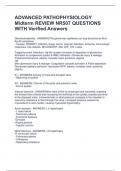
ADVANCED PATHOPHYSIOLOGY
Midterm REVIEW NR507 QUESTIONS
WITH Verified Answers
Glomerulonephritis - ANSWERSThe glomerular-capillaries can trap blood-borne Ab &
Ag-Ab complexes
- Causes: PRIMARY: infection, drugs, toxins, vascular disorders, ischemia, immunologic
responses, free radicals. SECONDARY: DM, CHF, HIV, Lupus
Triggering event (infection)- Ag-Ab complex formation & deposition in glomerulus-
Activation of complement system & WBC infiltration- Glomerular injury & leakage-
Proteinuria/hematuria- edema, increase creat, azotemia, oliguria
OR
after glomerular injury & leakage- Coagulation cascade activation & FIbrin deposition-
Decreased capillary perfusion- decreased GFR- edema, increase creat, azotemia,
oliguria
S1 - ANSWERS-Closing of mitral and tricuspid valve
- Beginning of systole
S2 - ANSWERS- Closure of the aortic and pulmonic valve
- End of systole
Valvular stenosis - ANSWERSthe valve orifice is constricted and narrowed, impeding
the forward flow of blood and increasing the workload of the cardiac chamber proximal
to the diseased valve. Intraventricular or atrial pressure increases in the chamber to
overcome resistance to flow through the valve. Increased pressure causes the
myocardium to work harder, causing myocardial hypertrophy.
Aortic stenosis - ANSWERS- LV hypertrophy
- L heart failure
- Pulmonary edema
- Exertional dyspnea
-Syncope
-Angina pectoris
- Systolic murmur
Mitral Stenosis - ANSWERS- LA hypertrophy
-R ventricular failure
- Pulmonary edema
- Orthopnea
- Respiratory infections
, - PH
-Edema
-Atypical chest pain
- Diastolic murmur
Stroke volume - ANSWERSThe volume of blood ejected per bear during systole
Cor Pulmonale - ANSWERSright ventricular hypertrophy and heart failure due to
pulmonary hypertension
Cardiac output - ANSWERSHR x SV
-Normal= 5Lpm
-Preload, afterload, contractility, heart rate
Preload - ANSWERSThe volume inside the ventricle at the end of diastole
Determined by:
- Amount of venous blood returning to the ventricle during diastole
- The amount of blood in the ventricle after systole
Afterload - ANSWERSThe resistance to ejection of blood from the ventricle
total peripheral resistance (TPR)
Systemic vascular resistance (SVR)
Contractility - ANSWERSsympathetic nervous system, epi and norepi) + inotropes
Acetylcholine released from vagus nerve - inotrope
Cytokines released during sepsis impair contractility
O2 < 50% decreased contractility
Troponin - ANSWERSRelaxing protein
Troponin T- aids in binding the troponin complex to actin and tropomyosin
Troponin I- Inhibits the ATPhase of actomyosin
Troponin C- Binding sites for the calcium ions involved in contraction.
I & T and released into the blood during myocardial injury
calcium binding and troponin - ANSWERSIn resting muscle the myosin-binding sites are
covered by troponin and tropomyosin. The calcium ions released into the sarcoplasm as
Midterm REVIEW NR507 QUESTIONS
WITH Verified Answers
Glomerulonephritis - ANSWERSThe glomerular-capillaries can trap blood-borne Ab &
Ag-Ab complexes
- Causes: PRIMARY: infection, drugs, toxins, vascular disorders, ischemia, immunologic
responses, free radicals. SECONDARY: DM, CHF, HIV, Lupus
Triggering event (infection)- Ag-Ab complex formation & deposition in glomerulus-
Activation of complement system & WBC infiltration- Glomerular injury & leakage-
Proteinuria/hematuria- edema, increase creat, azotemia, oliguria
OR
after glomerular injury & leakage- Coagulation cascade activation & FIbrin deposition-
Decreased capillary perfusion- decreased GFR- edema, increase creat, azotemia,
oliguria
S1 - ANSWERS-Closing of mitral and tricuspid valve
- Beginning of systole
S2 - ANSWERS- Closure of the aortic and pulmonic valve
- End of systole
Valvular stenosis - ANSWERSthe valve orifice is constricted and narrowed, impeding
the forward flow of blood and increasing the workload of the cardiac chamber proximal
to the diseased valve. Intraventricular or atrial pressure increases in the chamber to
overcome resistance to flow through the valve. Increased pressure causes the
myocardium to work harder, causing myocardial hypertrophy.
Aortic stenosis - ANSWERS- LV hypertrophy
- L heart failure
- Pulmonary edema
- Exertional dyspnea
-Syncope
-Angina pectoris
- Systolic murmur
Mitral Stenosis - ANSWERS- LA hypertrophy
-R ventricular failure
- Pulmonary edema
- Orthopnea
- Respiratory infections
, - PH
-Edema
-Atypical chest pain
- Diastolic murmur
Stroke volume - ANSWERSThe volume of blood ejected per bear during systole
Cor Pulmonale - ANSWERSright ventricular hypertrophy and heart failure due to
pulmonary hypertension
Cardiac output - ANSWERSHR x SV
-Normal= 5Lpm
-Preload, afterload, contractility, heart rate
Preload - ANSWERSThe volume inside the ventricle at the end of diastole
Determined by:
- Amount of venous blood returning to the ventricle during diastole
- The amount of blood in the ventricle after systole
Afterload - ANSWERSThe resistance to ejection of blood from the ventricle
total peripheral resistance (TPR)
Systemic vascular resistance (SVR)
Contractility - ANSWERSsympathetic nervous system, epi and norepi) + inotropes
Acetylcholine released from vagus nerve - inotrope
Cytokines released during sepsis impair contractility
O2 < 50% decreased contractility
Troponin - ANSWERSRelaxing protein
Troponin T- aids in binding the troponin complex to actin and tropomyosin
Troponin I- Inhibits the ATPhase of actomyosin
Troponin C- Binding sites for the calcium ions involved in contraction.
I & T and released into the blood during myocardial injury
calcium binding and troponin - ANSWERSIn resting muscle the myosin-binding sites are
covered by troponin and tropomyosin. The calcium ions released into the sarcoplasm as

