

8/2/25, 5:19 PM Epidemiology PHC 6001: Exam 1 Review Exam Questions with 100% Correct Answers | Verified | Latest Update 2025!! Flashcards |…
Epidemiology PHC 6001: Exam 1 Review Exam
Questions with 100% Correct Answers | Verified |
Latest Update 2025!!
Save
Terms in this set (117)
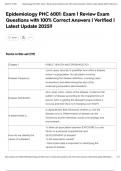
Chapter 1 PUBLIC HEALTH AND EPIDEMIOLOGY
count cases, records. It quantifies how often a disease
arises in a population. Its calculation involves
Disease Frequency establishing the disease definition, counting cases
(numerator), and determining the size of the
underlying population (denominator)
who, what, when, where of the disease. It refers to the
pattern of disease according to the characteristics of
Disease Distribution
person (who is getting the disease?), place (where it
occurs), and time (how is it changing over time?)
a characteristic that influences whether or not the
disease occurs. Determinants of disease can be
A determinant is...
influenced by the individual, social surroundings, and
environment.
-Is there an association between EXPOSURE to a risk
factor or a personal characteristic and
How do we identify the DEVELOPMENT of disease?
cause of a disease? -Is the association causal?
- Descriptive data is important to identifying the
causes of disease.
https://quizlet.com/1063537296/epidemiology-phc-6001-exam-1-review-exam-questions-with-100-correct-answers-verified-latest-update-2025-flash-c… 1/18
,8/2/25, 5:19 PM Epidemiology PHC 6001: Exam 1 Review Exam Questions with 100% Correct Answers | Verified | Latest Update 2025!! Flashcards |…
(1850-1900) Specific organisms cause specific
diseases. Resulted from advances in science that
Germ Theory of disease allowed viruses and bacteria to be visualized,
isolated, and used to cause disease in healthy animals.
These steps were known as Koch Postulates.
One of the 10 great Inclusion of seat belts in all cars
achievements of public
health in the 20th century
was:
-The frequency and distribution of diseases
Epidemiologists are
-The causes of disease and ways to control or cure
interested in learning
them and
about:
-The causal relationships between diseases
Match the epidemiologist
with the work/discovery he
is historically known for:
Semmelweis Hand hygiene and prevention of Puerperal Fever
Experimental study of diet and scurvy. One of the
earliest experimental studies on treatment of scurvy
Lind
among sailors.. Consumption of oranges and lemons
was most effective for scurvy tx.
Published an analysis of the Bills of Mortality- patterns
Graunt of mortality and discovered regularity of deaths and
births.
Combined data on births, marriages, and deaths with
Farr
census data on the population size.
Developed postulates to explain the causes of
Koch
cholera and TB
Believed that Cholera was caused by a "germ" spread
Snow through contaminated water.
Shoe leather EPIDEMIOLOGY.
https://quizlet.com/1063537296/epidemiology-phc-6001-exam-1-review-exam-questions-with-100-correct-answers-verified-latest-update-2025-flash-c… 2/18
, 8/2/25, 5:19 PM Epidemiology PHC 6001: Exam 1 Review Exam Questions with 100% Correct Answers | Verified | Latest Update 2025!! Flashcards |…
This historic disease Zyme Theory
theory said that disease
was a result of contact
with decaying animal or
vegetable matter:
PH is a multidisciplinary field whose goal is to
Public Health promote the health of populations through organized
community efforts.
The study of the distribution and determinants of
disease frequency in human pop's and the application
of this study to control health problems. Disease
Epidemiology
refers to a broad array of health-related states and
events including diseases, injuries, disabilities, and
death.
MEASURES OF DISEASE FREQUENCY AND
Chapter 2
POPULATIONS IN EPIDEMIOLOGY
A population is a group of people with a common
Population
characterisitic
Is to study the natural course of disease, to determine
the extent of disease in a population, to identify
What are the main
patterns and trends in disease occurrence, to identify
objective of
the causes of disease, and to evaluate the
Epidemiology?
effectiveness of measures that prevent and treat
disease.
membership is permanent and defined by an event.
Fixed population
Ex. Atomic Bomb survivors
aka open pop/transient member and is defined by
Dynamic popultion being in or out of a "state". Ex. residents of Miami, FL.
They can move and come back.
https://quizlet.com/1063537296/epidemiology-phc-6001-exam-1-review-exam-questions-with-100-correct-answers-verified-latest-update-2025-flash-c… 3/18
Epidemiology PHC 6001: Exam 1 Review Exam
Questions with 100% Correct Answers | Verified |
Latest Update 2025!!
Save
Terms in this set (117)
Chapter 1 PUBLIC HEALTH AND EPIDEMIOLOGY
count cases, records. It quantifies how often a disease
arises in a population. Its calculation involves
Disease Frequency establishing the disease definition, counting cases
(numerator), and determining the size of the
underlying population (denominator)
who, what, when, where of the disease. It refers to the
pattern of disease according to the characteristics of
Disease Distribution
person (who is getting the disease?), place (where it
occurs), and time (how is it changing over time?)
a characteristic that influences whether or not the
disease occurs. Determinants of disease can be
A determinant is...
influenced by the individual, social surroundings, and
environment.
-Is there an association between EXPOSURE to a risk
factor or a personal characteristic and
How do we identify the DEVELOPMENT of disease?
cause of a disease? -Is the association causal?
- Descriptive data is important to identifying the
causes of disease.
https://quizlet.com/1063537296/epidemiology-phc-6001-exam-1-review-exam-questions-with-100-correct-answers-verified-latest-update-2025-flash-c… 1/18
,8/2/25, 5:19 PM Epidemiology PHC 6001: Exam 1 Review Exam Questions with 100% Correct Answers | Verified | Latest Update 2025!! Flashcards |…
(1850-1900) Specific organisms cause specific
diseases. Resulted from advances in science that
Germ Theory of disease allowed viruses and bacteria to be visualized,
isolated, and used to cause disease in healthy animals.
These steps were known as Koch Postulates.
One of the 10 great Inclusion of seat belts in all cars
achievements of public
health in the 20th century
was:
-The frequency and distribution of diseases
Epidemiologists are
-The causes of disease and ways to control or cure
interested in learning
them and
about:
-The causal relationships between diseases
Match the epidemiologist
with the work/discovery he
is historically known for:
Semmelweis Hand hygiene and prevention of Puerperal Fever
Experimental study of diet and scurvy. One of the
earliest experimental studies on treatment of scurvy
Lind
among sailors.. Consumption of oranges and lemons
was most effective for scurvy tx.
Published an analysis of the Bills of Mortality- patterns
Graunt of mortality and discovered regularity of deaths and
births.
Combined data on births, marriages, and deaths with
Farr
census data on the population size.
Developed postulates to explain the causes of
Koch
cholera and TB
Believed that Cholera was caused by a "germ" spread
Snow through contaminated water.
Shoe leather EPIDEMIOLOGY.
https://quizlet.com/1063537296/epidemiology-phc-6001-exam-1-review-exam-questions-with-100-correct-answers-verified-latest-update-2025-flash-c… 2/18
, 8/2/25, 5:19 PM Epidemiology PHC 6001: Exam 1 Review Exam Questions with 100% Correct Answers | Verified | Latest Update 2025!! Flashcards |…
This historic disease Zyme Theory
theory said that disease
was a result of contact
with decaying animal or
vegetable matter:
PH is a multidisciplinary field whose goal is to
Public Health promote the health of populations through organized
community efforts.
The study of the distribution and determinants of
disease frequency in human pop's and the application
of this study to control health problems. Disease
Epidemiology
refers to a broad array of health-related states and
events including diseases, injuries, disabilities, and
death.
MEASURES OF DISEASE FREQUENCY AND
Chapter 2
POPULATIONS IN EPIDEMIOLOGY
A population is a group of people with a common
Population
characterisitic
Is to study the natural course of disease, to determine
the extent of disease in a population, to identify
What are the main
patterns and trends in disease occurrence, to identify
objective of
the causes of disease, and to evaluate the
Epidemiology?
effectiveness of measures that prevent and treat
disease.
membership is permanent and defined by an event.
Fixed population
Ex. Atomic Bomb survivors
aka open pop/transient member and is defined by
Dynamic popultion being in or out of a "state". Ex. residents of Miami, FL.
They can move and come back.
https://quizlet.com/1063537296/epidemiology-phc-6001-exam-1-review-exam-questions-with-100-correct-answers-verified-latest-update-2025-flash-c… 3/18

