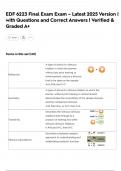
EDF 6223 Final Exam Exam – Latest 2025 Version |
with Questions and Correct Answers | Verified &
Graded A+
Save
Terms in this set (149)
A type of stimuli-to-stimulus
relation in which the learner,
without any prior training or
Reflexivity
reinforcement, selects a stimulus
that is the same as the sample.
A=A, B=B, and C=C
A type of stimuli-to-stimulus relation in which the
learner, without prior training or reinforcement,
Symmetry demonstrates the reversibility of the sample stimulus
and the comparison stimulus.
A=B, then B=A, or A=C, then C=A
Describes the stimulus-stimulus
relations that emerge as a
Transitivity product of training two other
stimulus-stimulus relations.
If A=B and A=C, then B=C
Describes a behavior analytic
approach to understanding and
Stimulus equivalence
establishing symbolic function.
, The ability to create and understand an infinite
Generativity
number of meaningful sentences and utterances.
A theory of derived stimulus relations proposing that
Relational Frame Theory such relations are inherently verbal and that the
(RTF) accumulated experience with relational exemplars
creates generalized repertoires of relating.
The relation between two or more stimuli that is not
derived stimulus relation directly trained or taught and is not based solely on
the physical properties of the stimuli.
Performance in a match-to-
sample procedure in which
discrimination between the
Conditional Discrimination comparison stimuli is
conditional on, or depends on,
the sample stimulus present on
each trial.
- sample stimulus (antecedent stimulus)
Conditional Discrimination - correct comparison (antecedent stimulus)
4-term contingency - selection response
- reinforcer
A probe for the emergence of
untrained stimulus-stimulus
equivalence test relations that evaluates both
symmetry and transitivity
simultaneously.
, A relation in one direction
between two stimuli (e.g., A to B)
entails a relation in the other
direction (e.g., B to A)
(symmetry)
Mutual Entailment
if you are told that A = B, you
can derive that B = A. That is, the
specified A = B relation mutually
entails the (symmetrical) B = A
relation.
A derived stimulus relation in which two or more
stimulus relations (trained or derived) mutually
combine.
Combinatory Entailment
(transitivity)
if A is related to B and A is related to C, then B and C
are mutually related in that context.
Independent equivalence classes are combined as
Class merger the result of teaching a new but interrelated
conditional discrimination.
A new member is added to a demonstrated stimulus
Class expansion equivalence class as the result of teaching a new
conditional discrimination.
Equivalence Class The collection of stimuli that evoke the same behavior.
Stimuli that evoke the same
response, but they do NOT
share a common stimulus
feature. They do not physically
look alike or share a relative
Arbitrary stimulus class
relationship.
LIMITED number of stimuli
Developed through stimulus
equivalence.
Equivalence Relations Relations that are reflexive, symmetric, and transitive.
with Questions and Correct Answers | Verified &
Graded A+
Save
Terms in this set (149)
A type of stimuli-to-stimulus
relation in which the learner,
without any prior training or
Reflexivity
reinforcement, selects a stimulus
that is the same as the sample.
A=A, B=B, and C=C
A type of stimuli-to-stimulus relation in which the
learner, without prior training or reinforcement,
Symmetry demonstrates the reversibility of the sample stimulus
and the comparison stimulus.
A=B, then B=A, or A=C, then C=A
Describes the stimulus-stimulus
relations that emerge as a
Transitivity product of training two other
stimulus-stimulus relations.
If A=B and A=C, then B=C
Describes a behavior analytic
approach to understanding and
Stimulus equivalence
establishing symbolic function.
, The ability to create and understand an infinite
Generativity
number of meaningful sentences and utterances.
A theory of derived stimulus relations proposing that
Relational Frame Theory such relations are inherently verbal and that the
(RTF) accumulated experience with relational exemplars
creates generalized repertoires of relating.
The relation between two or more stimuli that is not
derived stimulus relation directly trained or taught and is not based solely on
the physical properties of the stimuli.
Performance in a match-to-
sample procedure in which
discrimination between the
Conditional Discrimination comparison stimuli is
conditional on, or depends on,
the sample stimulus present on
each trial.
- sample stimulus (antecedent stimulus)
Conditional Discrimination - correct comparison (antecedent stimulus)
4-term contingency - selection response
- reinforcer
A probe for the emergence of
untrained stimulus-stimulus
equivalence test relations that evaluates both
symmetry and transitivity
simultaneously.
, A relation in one direction
between two stimuli (e.g., A to B)
entails a relation in the other
direction (e.g., B to A)
(symmetry)
Mutual Entailment
if you are told that A = B, you
can derive that B = A. That is, the
specified A = B relation mutually
entails the (symmetrical) B = A
relation.
A derived stimulus relation in which two or more
stimulus relations (trained or derived) mutually
combine.
Combinatory Entailment
(transitivity)
if A is related to B and A is related to C, then B and C
are mutually related in that context.
Independent equivalence classes are combined as
Class merger the result of teaching a new but interrelated
conditional discrimination.
A new member is added to a demonstrated stimulus
Class expansion equivalence class as the result of teaching a new
conditional discrimination.
Equivalence Class The collection of stimuli that evoke the same behavior.
Stimuli that evoke the same
response, but they do NOT
share a common stimulus
feature. They do not physically
look alike or share a relative
Arbitrary stimulus class
relationship.
LIMITED number of stimuli
Developed through stimulus
equivalence.
Equivalence Relations Relations that are reflexive, symmetric, and transitive.