100% de satisfacción garantizada Inmediatamente disponible después del pago Tanto en línea como en PDF No estas atado a nada 4,6 TrustPilot
logo-home
Examen

ASE A1 (Engine Repair) Practice Test – Cumulative Questions With Verified Answers

Puntuación
-
Vendido
-
Páginas
69
Grado
A+
Subido en
31-07-2025
Escrito en
2024/2025

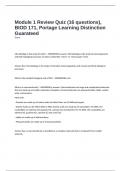
an engine miss is being diagnosed using a cylinder leakage test. Technician A says that any cylinder with over 20% leakage has excessive leakage. Tech B says that air leaking from the tailpipe indicates a cracked cylinder. A only, B only, A & B, Neither . - ANSWERSA only: If cylinder leakage exceeds 20%, check for air escaping the tailpipe, the PCV valve opening in the rocker arm cover, and the top of the throttle body or carburetor. Air leaking from the tailpipe usually indicates an exhaust valve leak during a compression test, a cylinder has 40% of the specified compression reading. When the tech performs a wet test, the compression reading on this cylinder has 75% of the specified reading. The cause of the low compression reading could be worn piston rings, a burned exhaust valve, a bent intake valve, a worn camshaft lobe, - ANSWERSworn piston rings if compression increases during a wet test, this indicates worn piston rings. Compression would not increase if an exhaust valve is burned, intake valve is bent, or camshaft lobe is worn. the customer complains that the engine cranks but does not start; the first thing to check should be valve train operation, battery voltage, compression, engine vacuum, - ANSWERSvalve train operation: if the engine cranks properly, the battery is not the problem. Compression would not be the FIRST test, and because engine vacuum is low during a crank, a vacuum test would not be conclusive. during a cylinder balance test on an engine with fuel injection, one cylinder provides very little rpm drop. Tech A says the ignition system may be misfiring on that cylinder. Tech B says the engine may have an intake manifold vacuum leak. A only, B only, A & B, Neither , - ANSWERSBoth A&B Both a misfiring ignition system and an intake manifold leak could cause a cylinder to contribute too little power while discussing basic diagnostic procedures, Tech A says the most complicated diagnostic tests should be performed first. Tech B says that you should first question the customer to obtain as much info as possible about the problem A, B , A & B, Neither, - ANSWERSB Always attempt the more simple diagnosis first with the engine idling, a vacuum gauge connected to the intake manifold fluctuates (from 15 to 20). These fluctuations may be caused by late ignition timing, intake manifold vacuum leaks, a restricted exhaust system, sticky valve stems and guides, - ANSWERSsticky valve stems and guides -late ignition timing would result in a low, steady reading -intake manifold leaks would cause a very low, steady reading -a restricted exhaust system would cause vacuum to slowly decrease after the engine was accelerated and held steady oil is leaking from the crankshaft rear main bearing seal on an engine. Tech A says the oil seal could be faulty. Tech B says the PCV system may not be functioning. A, B, A & B, Neither, - ANSWERSA&B A high-pitched squealing noise is heard during hard acceleration. This may be the cause of: intake manifold leak, the choke stuck closed fuel system leak small leak in exhaust manifold - ANSWERSsmall leak in exhaust manifold -intake manifold leak causes a high-pitched whistle at idle and low speeds -carb choke stuck closed will not cause a high-pitched whistle -fuel system leak normally would not cause a noise a heavy thumping noise occurs with the engine idling, but the oil pressure is normal. this may be caused by: worn pistons and cylinders, loose flywheel bolts, worm main bearings, loose camshaft bearings, - ANSWERSloose flywheel bolts -worn pistons and cylinders would cause a thumping noise during acceleration -worn main bearings cause a thump when the engine is started -loose camshaft bearings would cause a growling noise at all times after a vehicle is parked overnight and then started in the morning, the engine has a lifter noise that disappears after running for a short time. this may be caused by: low oil pressure, low oil level, worn lifter bottom, excessive lifter leak-down, - ANSWERSexcessive lifter leak-down low oil pressure would result in a continuous noise low oil level would result in a continuous noise worn lifter bottom would result in a continuous noise when using a compression tester, the readings on the cylinders are all even, but lower than spec. this could indicate: blown head gasket, carbon buildup, cracked head, worn rings and cylinders, - ANSWERSworn rings and cylinders -a low reading on two adjacent cylinders may indicate a blown head gasket -carbon buildup would cause a high reading -a low reading on two adjacent cylinders may indicate a cracked head a cylinder balance test is being performed on an engine to determine which cylinder is causing a miss. Tech A says that when the faulty cylinder is disabled, engine rpm will drop more than for the other cylinders. Tech B says disabling the faulty cylinder will cause the engine to stall A , B, Both, Neither, - ANSWERSNeither the faulty cylinder will not cause the engine to stall, neither will it cause the engine to drop in RPM since it is faulty. an engine is idling at 750 rpm. the pointer on the vacuum gauge is floating between 11 and 16 in Hg. The most likely cause is retarded timing, advanced timing, stuch EGR valve, too lean idle mixture, - ANSWERStoo lean idle mixture all others would not result in gauge fluctuation the first step a Tech should take for diagnosis is: think of possible causes of the problem, question the customer, road test the vehicle, listen to the customer, - ANSWERSlisten to the customer the customer says that the engine requires excessive cranking to start. the LEAST likely cause of this problem would be: cracked cylinder block, jumped timing belt, faulty fuel pump, stuck-open EGR valve, - ANSWERScracked cylinder block which of the following is LEAST likely to cause engine noise? loose pistons, worn cylinders, worn main bearings, loose camshaft bearings, - ANSWERSloose cam bearings -loose pistons may cause a rapping noise while accel -worn cylinders may cause a rapping noise while accel -worn main bearings may cause a thumping noise when starting the least likely first step in a diagnosis would be to: question the customer for more info, be sure that the customer complaint is eliminated start with the most difficult test road test the vehicle - ANSWERSstart with the most difficult test a cylinder balance test on a carbureted engine has revealed one cylinder is contributing less power than the others. The LEAST likely cause of this is: faulty ignition system burned exhaust valve faulty carburetor leaking intake manifold - ANSWERSfaulty carburetor -faulty ignition system, burned exhaust valve, and leaking intake manifold are likely to cause one cylinder to provide less power than others. The carburetor would not cause one single cylinder to contribute less power. an excessive sulfur smell in the exhaust with a cat can be an indication of: lean fuel mixture coolant leaking into combustion chamber rich fuel mixture vacuum leak - ANSWERSrich fuel mixture an engine miss is being diagnosed using a cylinder leakage test. Technician A says that any cylinder with over 20% leakage has excessive leakage. Tech B says that air leaking from the tailpipe indicates a cracked cylinder. A only, B only, A & B, Neither . - ANSWERSA only: If cylinder leakage exceeds 20%, check for air escaping the tailpipe, the PCV valve opening in the rocker arm cover, and the top of the throttle body or carburetor. Air leaking from the tailpipe usually indicates an exhaust valve leak during a compression test, a cylinder has 40% of the specified compression reading. When the tech performs a wet test, the compression reading on this cylinder has 75% of the specified reading. The cause of the low compression reading could be worn piston rings, a burned exhaust valve, a bent intake valve, a worn camshaft lobe, - ANSWERSworn piston rings if compression increases during a wet test, this indicates worn piston rings. Compression would not increase if an exhaust valve is burned, intake valve is bent, or camshaft lobe is worn. the customer complains that the engine cranks but does not start; the first thing to check should be valve train operation, battery voltage, compression, engine vacuum, - ANSWERSvalve train operation: if the engine cranks properly, the battery is not the problem. Compression would not be the FIRST test, and because engine vacuum is low during a crank, a vacuum test would not be conclusive. during a cylinder balance test on an engine with fuel injection, one cylinder provides very little rpm drop. Tech A says the ignition system may be misfiring on that cylinder. Tech B says the engine may have an intake manifold vacuum leak. A only, B only, A & B, Neither , - ANSWERSBoth A&B Both a misfiring ignition system and an intake manifold leak could cause a cylinder to contribute too little power while discussing basic diagnostic procedures, Tech A says the most complicated diagnostic tests should be performed first. Tech B says that you should first question the customer to obtain as much info as possible about the problem A, B , A & B, Neither, - ANSWERSB Always attempt the more simple diagnosis first with the engine idling, a vacuum gauge connected to the intake manifold fluctuates (from 15 to 20). These fluctuations may be caused by late ignition timing, intake manifold vacuum leaks, a restricted exhaust system, sticky valve stems and guides, - ANSWERSsticky valve stems and guides -late ignition timing would result in a low, steady reading -intake manifold leaks would cause a very low, steady reading -a restricted exhaust system would cause vacuum to slowly decrease after the engine was accelerated and held steady oil is leaking from the crankshaft rear main bearing seal on an engine. Tech A says the oil seal could be faulty. Tech B says the PCV system may not be functioning. A, B, A & B, Neither, - ANSWERSA&B A high-pitched squealing noise is heard during hard acceleration. This may be the cause of: intake manifold leak, the choke stuck closed fuel system leak small leak in exhaust manifold - ANSWERSsmall leak in exhaust manifold -intake manifold leak causes a high-pitched whistle at idle and low speeds -carb choke stuck closed will not cause a high-pitched whistle -fuel system leak normally would not cause a noise a heavy thumping noise occurs with the engine idling, but the oil pressure is normal. this may be caused by: worn pistons and cylinders, loose flywheel bolts, worm main bearings, loose camshaft bearings, - ANSWERSloose flywheel bolts -worn pistons and cylinders would cause a thumping noise during acceleration -worn main bearings cause a thump when the engine is started -loose camshaft bearings would cause a growling noise at all times after a vehicle is parked overnight and then started in the morning, the engine has a lifter noise that disappears after running for a short time. this may be caused by: low oil pressure, low oil level, worn lifter bottom, excessive lifter leak-down, - ANSWERSexcessive lifter leak-down low oil pressure would result in a continuous noise low oil level would result in a continuous noise worn lifter bottom would result in a continuous noise when using a compression tester, the readings on the cylinders are all even, but lower than spec. this could indicate: blown head gasket, carbon buildup, cracked head, worn rings and cylinders, - ANSWERSworn rings and cylinders -a low reading on two adjacent cylinders may indicate a blown head gasket -carbon buildup would cause a high reading -a low reading on two adjacent cylinders may indicate a cracked head a cylinder balance test is being performed on an engine to determine which cylinder is causing a miss. Tech A says that when the faulty cylinder is disabled, engine rpm will drop more than for the other cylinders. Tech B says disabling the faulty cylinder will cause the engine to stall A , B, Both, Neither, - ANSWERSNeither the faulty cylinder will not cause the engine to stall, neither will it cause the engine to drop in RPM since it is faulty. an engine is idling at 750 rpm. the pointer on the vacuum gauge is floating between 11 and 16 in Hg. The most likely cause is retarded timing, advanced timing, stuch EGR valve, too lean idle mixture, - ANSWERStoo lean idle mixture all others would not result in gauge fluctuation the first step a Tech should take for diagnosis is: think of possible causes of the problem, question the customer, road test the vehicle, listen to the customer, - ANSWERSlisten to the customer the customer says that the engine requires excessive cranking to start. the LEAST likely cause of this problem would be: cracked cylinder block, jumped timing belt, faulty fuel pump, stuck-open EGR valve, - ANSWERScracked cylinder block which of the following is LEAST likely to cause engine noise? loose pistons, worn cylinders, worn main bearings, loose camshaft bearings, - ANSWERSloose cam bearings -loose pistons may cause a rapping noise while accel -worn cylinders may cause a rapping noise while accel -worn main bearings may cause a thumping noise when starting the least likely first step in a diagnosis would be to: question the customer for more info, be sure that the customer complaint is eliminated start with the most difficult test road test the vehicle - ANSWERSstart with the most difficult test a cylinder balance test on a carbureted engine has revealed one cylinder is contributing less power than the others. The LEAST likely cause of this is: faulty ignition system burned exhaust valve faulty carburetor leaking intake manifold - ANSWERSfaulty carburetor -faulty ignition system, burned exhaust valve, and leaking intake manifold are likely to cause one cylinder to provide less power than others. The carburetor would not cause one single cylinder to contribute less power. an excessive sulfur smell in the exhaust with a cat can be an indication of: lean fuel mixture coolant leaking into combustion chamber rich fuel mixture vacuum leak - ANSWERSrich fuel mixture -lean fuel mixture would not cause a sulfur smell -coolant leaking into the chamber would cause a gray exhaust color -a vacuum leak would cause a rough idle that would decrease as engine speed in -lean fuel mixture would not cause a sulfur smell -coolant leaking into the chamber would cause a gray exhaust color -a vacuum leak would cause a rough idle that would decrease as engine speed in

Mostrar más Leer menos
Institución
NU 136
Grado
NU 136


Ups! No podemos cargar tu documento ahora. Inténtalo de nuevo o contacta con soporte.

Escuela, estudio y materia

Institución
NU 136
Grado
NU 136

Información del documento

Subido en
31 de julio de 2025
Número de páginas
69
Escrito en
2024/2025
Tipo
Examen
Contiene
Preguntas y respuestas

Temas

Vista previa del contenido

ASE A1 (Engine Repair) Practice Test –
Cumulative Questions With Verified
Answers


an engine miss is being diagnosed using a cylinder leakage test.

Technician A says that any cylinder with over 20% leakage has excessive leakage. Tech B says that air
leaking from the tailpipe indicates a cracked cylinder.


A only,

B only,

A & B,

Neither . - ANSWERSA only:


If cylinder leakage exceeds 20%, check for air escaping the tailpipe, the PCV valve opening in the rocker
arm cover, and the top of the throttle body or carburetor.


Air leaking from the tailpipe usually indicates an exhaust valve leak


during a compression test, a cylinder has 40% of the specified compression reading. When the tech
performs a wet test, the compression reading on this cylinder has 75% of the specified reading. The
cause of the low compression reading could be


worn piston rings,

a burned exhaust valve,

a bent intake valve,

a worn camshaft lobe, - ANSWERSworn piston rings

,if compression increases during a wet test, this indicates worn piston rings. Compression would not
increase if an exhaust valve is burned, intake valve is bent, or camshaft lobe is worn.


the customer complains that the engine cranks but does not start; the first thing to check should be


valve train operation,

battery voltage,

compression,

engine vacuum, - ANSWERSvalve train operation:


if the engine cranks properly, the battery is not the problem. Compression would not be the FIRST test,
and because engine vacuum is low during a crank, a vacuum test would not be conclusive.


during a cylinder balance test on an engine with fuel injection, one cylinder provides very little rpm drop.

Tech A says the ignition system may be misfiring on that cylinder.

Tech B says the engine may have an intake manifold vacuum leak.


A only,

B only,

A & B,

Neither , - ANSWERSBoth A&B


Both a misfiring ignition system and an intake manifold leak could cause a cylinder to contribute too
little power


while discussing basic diagnostic procedures,

Tech A says the most complicated diagnostic tests should be performed first. Tech B says that you
should first question the customer to obtain as much info as possible about the problem

,A,

B,

A & B,

Neither, - ANSWERSB


Always attempt the more simple diagnosis first


with the engine idling, a vacuum gauge connected to the intake manifold fluctuates (from 15 to 20).
These fluctuations may be caused by


late ignition timing,

intake manifold vacuum leaks,

a restricted exhaust system,

sticky valve stems and guides, - ANSWERSsticky valve stems and guides


-late ignition timing would result in a low, steady reading

-intake manifold leaks would cause a very low, steady reading

-a restricted exhaust system would cause vacuum to slowly decrease after the engine was accelerated
and held steady


oil is leaking from the crankshaft rear main bearing seal on an engine. Tech A says the oil seal could be
faulty. Tech B says the PCV system may not be functioning.


A,

B,

A & B,

Neither, - ANSWERSA&B


A high-pitched squealing noise is heard during hard acceleration. This may be the cause of:

, intake manifold leak,

the choke stuck closed

fuel system leak

small leak in exhaust manifold - ANSWERSsmall leak in exhaust manifold


-intake manifold leak causes a high-pitched whistle at idle and low speeds

-carb choke stuck closed will not cause a high-pitched whistle

-fuel system leak normally would not cause a noise


a heavy thumping noise occurs with the engine idling, but the oil pressure is normal. this may be caused
by:


worn pistons and cylinders,

loose flywheel bolts,

worm main bearings,

loose camshaft bearings, - ANSWERSloose flywheel bolts


-worn pistons and cylinders would cause a thumping noise during acceleration

-worn main bearings cause a thump when the engine is started

-loose camshaft bearings would cause a growling noise at all times


after a vehicle is parked overnight and then started in the morning, the engine has a lifter noise that
disappears after running for a short time. this may be caused by:


low oil pressure,

low oil level,

worn lifter bottom,

excessive lifter leak-down, - ANSWERSexcessive lifter leak-down
$16.99
Accede al documento completo:

100% de satisfacción garantizada
Inmediatamente disponible después del pago
Tanto en línea como en PDF
No estas atado a nada

Conoce al vendedor
Seller avatar
paugrades1479
2.0
(1)

Conoce al vendedor

Seller avatar
paugrades1479 Nursing
Seguir Necesitas iniciar sesión para seguir a otros usuarios o asignaturas
Vendido
1
Miembro desde
2 año
Número de seguidores
1
Documentos
470
Última venta
2 año hace

2.0

1 reseñas

5
0
4
0
3
0
2
1
1
0

Recientemente visto por ti

Por qué los estudiantes eligen Stuvia

Creado por compañeros estudiantes, verificado por reseñas

Calidad en la que puedes confiar: escrito por estudiantes que aprobaron y evaluado por otros que han usado estos resúmenes.

¿No estás satisfecho? Elige otro documento

¡No te preocupes! Puedes elegir directamente otro documento que se ajuste mejor a lo que buscas.

Paga como quieras, empieza a estudiar al instante

Sin suscripción, sin compromisos. Paga como estés acostumbrado con tarjeta de crédito y descarga tu documento PDF inmediatamente.

Student with book image

“Comprado, descargado y aprobado. Así de fácil puede ser.”

Alisha Student

Preguntas frecuentes