Summary
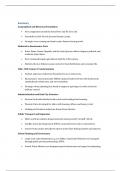
Geographical and Historical Foundation
Paris originated around the Seine River and Île de la Cité.
Founded by Celtic Parisii; became Roman Lutetia.
Strategic river crossing and trade routes fostered early growth.
Medieval to Renaissance Paris
Notre-Dame, Sainte-Chapelle, and the Latin Quarter reflect religious, political, and
academic importance.
Paris remained largely agricultural until the 13th century.
Markets, like Les Halles, became central to food distribution and economic life.
18th–19th Century Transformations
Fashion and luxury industries flourished to serve aristocrats.
Haussmann's renovation (mid-1800s) replaced medieval Paris with boulevards,
standardized architecture, and new sanitation.
Strategic urban planning also aimed to suppress uprisings via wide streets for
military control.
Industrialization and Dual City Structure
Eastern Paris industrialized with canals and working-class housing.
Western Paris developed for elites with housing, offices, and luxury retail.
Clothing and furniture industries formed local clusters.
Public Transport and Expansion
Metro and train stations shaped outward urban growth (“oil spill” effect).
Satellite towns developed post-WWII; connected by fast rail to central Paris.
Greater Paris project introduced express metro lines linking suburbs and airports.
Urban Planning and Governance
Large-scale redevelopments (e.g., Les Halles, Canal Saint-Martin) were managed
through public-private partnerships (PPP).
French Prime Minister can designate special urban zones to bypass local planning.
Geographical and Historical Foundation
Paris originated around the Seine River and Île de la Cité.
Founded by Celtic Parisii; became Roman Lutetia.
Strategic river crossing and trade routes fostered early growth.
Medieval to Renaissance Paris
Notre-Dame, Sainte-Chapelle, and the Latin Quarter reflect religious, political, and
academic importance.
Paris remained largely agricultural until the 13th century.
Markets, like Les Halles, became central to food distribution and economic life.
18th–19th Century Transformations
Fashion and luxury industries flourished to serve aristocrats.
Haussmann's renovation (mid-1800s) replaced medieval Paris with boulevards,
standardized architecture, and new sanitation.
Strategic urban planning also aimed to suppress uprisings via wide streets for
military control.
Industrialization and Dual City Structure
Eastern Paris industrialized with canals and working-class housing.
Western Paris developed for elites with housing, offices, and luxury retail.
Clothing and furniture industries formed local clusters.
Public Transport and Expansion
Metro and train stations shaped outward urban growth (“oil spill” effect).
Satellite towns developed post-WWII; connected by fast rail to central Paris.
Greater Paris project introduced express metro lines linking suburbs and airports.
Urban Planning and Governance
Large-scale redevelopments (e.g., Les Halles, Canal Saint-Martin) were managed
through public-private partnerships (PPP).
French Prime Minister can designate special urban zones to bypass local planning.