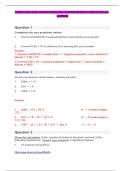
CHEM 103 FINAL EXAM - REQUIRES RESPONDUS LOCKDOWN BROWSER + WEBCAM PORTAGE
LEARNING
Question 1
Complete the two problems below:
1. Convert 0.0000726 to exponential form and explain your answer.
2. Convert 5.82 x 10³ to ordinary form and explain your answer.
Answer:
1. Convert 0.0000726 = smaller than 1 = negative exponent, move decimal 5
places = 7.26 x 10⁻⁵
2. Convert 5.82 x 103 = positive exponent = larger than 1, move decimal 3
places = 5820
Question 2
Do the conversions shown below, showing all work:
1. 358oK = ? oC
2. 53oC = ? oF
3. 158oF = ? oK
Answer:
1. 358oK - 273 = 85 oC o
K → oC (make smaller)
-273
2. 53oC x 1.8 + 32 = 127.4 oF o
C → oF (make larger) x
1.8 + 32
3. 158oF - 32 ÷ 1.8 = 70 + 273 = 343 oK F → oC → oK
o
Question 3
Show the calculation of the number of moles in the given amount of the
following substances. Report your answerto 3 significant figures.
1. 12.0 grams of Ca3(PO4)2
https://www.stuvia.com/user/Mboffin
, 2. 15.0 grams of C9H8NO4Cl
Answer:
1. Moles = grams / molecular weight = 12..18 = 0.0387 mole
2. Moles = grams / molecular weight = 15..61 = 0.0653 mole
Question 4
Show the calculation of the percent of each element present in the following
compounds. Report your answer to 2 places after the decimal.
1. Al2(SO4)3
2. C7H5NOBr
Answer:
1. %Al = 2 x 26.98/342.17 x 100 = 15.77% %S = 3 x 32.07/342.17
x 100 = 28.12%
%O = 12 x 16/342.17 = 56.11%
2.
%C = 7 x 12.01/ 199.02 x 100 = 42.24% %H = 5 x 1.008/ 199.02 x 100
= 2.53%
%N = 1 x 14.01/199.02 = 7.04% %O = 1 x 16.00/199.02 x 100
= 8.04%
%Br = 79.90/199.02 x 100 = 40.15%
Question 5
Show the calculation of the heat of reaction (ΔHrxn) for the reaction:
CH4 (g) + 2 O2 (g) → CO2 (g) + 2 H2O (l)
by using the following thermochemical data:
ΔHf0 CH4 (g) = -74.6 kJ/mole, ΔHf0 CO2 (g) = -393.5 kJ/mole, ΔHf0 H2O (l) = -285.8
kJ/mole
Answer:
https://www.stuvia.com/user/Mboffin
LEARNING
Question 1
Complete the two problems below:
1. Convert 0.0000726 to exponential form and explain your answer.
2. Convert 5.82 x 10³ to ordinary form and explain your answer.
Answer:
1. Convert 0.0000726 = smaller than 1 = negative exponent, move decimal 5
places = 7.26 x 10⁻⁵
2. Convert 5.82 x 103 = positive exponent = larger than 1, move decimal 3
places = 5820
Question 2
Do the conversions shown below, showing all work:
1. 358oK = ? oC
2. 53oC = ? oF
3. 158oF = ? oK
Answer:
1. 358oK - 273 = 85 oC o
K → oC (make smaller)
-273
2. 53oC x 1.8 + 32 = 127.4 oF o
C → oF (make larger) x
1.8 + 32
3. 158oF - 32 ÷ 1.8 = 70 + 273 = 343 oK F → oC → oK
o
Question 3
Show the calculation of the number of moles in the given amount of the
following substances. Report your answerto 3 significant figures.
1. 12.0 grams of Ca3(PO4)2
https://www.stuvia.com/user/Mboffin
, 2. 15.0 grams of C9H8NO4Cl
Answer:
1. Moles = grams / molecular weight = 12..18 = 0.0387 mole
2. Moles = grams / molecular weight = 15..61 = 0.0653 mole
Question 4
Show the calculation of the percent of each element present in the following
compounds. Report your answer to 2 places after the decimal.
1. Al2(SO4)3
2. C7H5NOBr
Answer:
1. %Al = 2 x 26.98/342.17 x 100 = 15.77% %S = 3 x 32.07/342.17
x 100 = 28.12%
%O = 12 x 16/342.17 = 56.11%
2.
%C = 7 x 12.01/ 199.02 x 100 = 42.24% %H = 5 x 1.008/ 199.02 x 100
= 2.53%
%N = 1 x 14.01/199.02 = 7.04% %O = 1 x 16.00/199.02 x 100
= 8.04%
%Br = 79.90/199.02 x 100 = 40.15%
Question 5
Show the calculation of the heat of reaction (ΔHrxn) for the reaction:
CH4 (g) + 2 O2 (g) → CO2 (g) + 2 H2O (l)
by using the following thermochemical data:
ΔHf0 CH4 (g) = -74.6 kJ/mole, ΔHf0 CO2 (g) = -393.5 kJ/mole, ΔHf0 H2O (l) = -285.8
kJ/mole
Answer:
https://www.stuvia.com/user/Mboffin