Memory
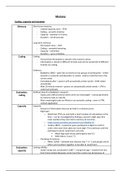
Coding, capacity and duration
Memory Short-term memory:
- Limited-capacity store – STM.
- Coding – acoustic (mainly).
- Capacity – between 5-9 items.
- Duration – 18-30 seconds.
Long-term memory:
- Permanent store – LTM.
- Coding – semantic/meaning.
- Capacity – unlimited.
- Duration – up to a lifetime.
Coding Coding:
- Format that information is stored in the memory stores.
- Information is stored in different formats and can be converted to different
formats via coding.
Evidence:
- Baddeley (1966) – gave lists of words to four groups of participants – either
acoustic or semantic and dissimilar or similar. Had to recall the lists in the
correct order.
- Immediately after = poorer with acoustically similar words = STM coded
acoustically.
- After 20 minute interval = poorer on semantically similar words = LTM is
coded semantically.
Evaluation: Artificial stimuli in Baddeley’s research:
coding - Study used artificial stimuli which were not meaningful – cannot generalise
to memory tasks in real-life.
- More meaningful tasks are likely to use semantic coding – even in STM.
- Limited application
Capacity Capacity:
- Amount of information that can be held in a memory store.
- Digit span
o Belief that STM can only hold a small number of information at the
time – can be investigated by findings a person’s digit span (the
most numbers they can hold in memory at one time.
o https://www.youtube.com/watch?v=p-j4WWko-4Y
o Jacobs (1887) – researcher gives participant 4 digits to recall in
order, then each time adds one more digit. This continues until the
participant cannot recall them correctly.
Mean digit span across participants was 9.3.
With letters, it was 7.3
- Chunking of memory
o Miller (1956) – believed that memory was 7 +/- 2 and people chunk
letters and numbers together to be able to recall them.
Evaluation: Lacking validity:
capacity - Jacob’s study was conducted in 1887 – a long time ago – studies from this
time frame lacked adequate control and the results may be because of
, confounding variables which were not controlled for.
Overestimated capacity of STM:
- Cowan (2001) – capacity for STM is only about 4 chunks of information –
suggesting that Miller’s estimate is not appropriate unless you look at the
lowest end (five).
Duration Duration:
- Length of time a memory is held in memory.
- Duration of STM:
o Peterson and Peterson (1959) – 24 undergraduate students took
part in eight trials. Given a consonant syllable (a trigram of three
letters) to remember and a 3-digit number to count back from to
stop mental rehearsal of the letters. On each trial they had to stop
after a different amount of time, when told by the researcher, of
intervals of 3 seconds (up to 18s).
Found that STM has a very short duration.
If they recalled after 3 seconds = 80% accuracy.
After 18 seconds = 10% accuracy.
GOOD STUDY TO REPLICATE IN CLASS
- Duration of LTM:
o Bahrick et al., (1975) – 392 participants from Ohio between the ages
of 17-74 asked to complete a photo-recognition test (from 50
photos) and free recall (of names of their class) regarding their high
school yearbooks.
If recalling within 15 years of graduation = 90% accuracy on
photo-recognition and 60% accuracy on free recall.
Recalling after 48 years = 70% accuracy for photo
recognition and 30% for free recall.
Shows that LTM is long – even though there is a slight
reduction, they can still remember.
o Bahrick et al., (2008) – investigated the LTM of exam grade achieved
at college (can be checked against objective records) – 267 people
who had graduated from Ohio Wesleyan university within 1 and 54
years of the study completed a free recall task (list courses and
grades achieved) and cued recall (copy of courses needed grades
filled in).
People who achieved better grades were generally more
accurate
Mistakes made – more likely to increase a grade than
decrease it.
50% accuracy if graduated within 15 years of study, 30% if
within 50 years.
Again, showing the length of memory.
Evaluation: Meaningless stimuli in Peterson and Peterson’s study:
duration - stimulus material was artificial – will not reflect memory in real-life activities
= lacking ecological validity and real-life application.
Criticising Peterson and Peterson:
- One explanation for forgetting is that a lack of rehearsal causes the memory
trace to disappear (spontaneous decay) – their findings may show that from
blocking rehearsal the memory was displaced because new information of
, counting pushes it out of STM.
High external validity in Bahrick’s study:
- Used real-life meaningful memories – information that the participants are
likely to want to/try to remember more.
o COUNTER – does limit the control over confounding variables
(cannot be sure how often people look back over their yearbooks).
- Meaningless stimuli can sometimes show lower recall rates.
EXAM 2 marks:
QUESTIONS Explain what is meant by coding in terms of memory.
Explain what is meant by capacity of STM.
Explain what is meant by duration of STM.
Explain what is meant by capacity of LTM.
Explain what is meant by duration of LTM.
4 marks:
Outline one research study into the coding of memory. Include what the researchers
did and what they found out.
Outline one research study into the capacity of STM. Include what the researchers
did and what they found out.
Outline one research study into the duration of STM. Include what the researchers
did and what they found out.
Outline one research study into the duration of LTM. Include what the researchers
did and what they found out.
Explain how the findings of one or more research studies show that STM and LTM
are different.
6 marks:
Describe research into the coding of STM.
Describe research into the coding of LTM.
Describe research into the capacity of STM.
Describe research into the duration of STM.
Describe research into the duration of LTM.
Finn and Amber were discussing their days at primary school. 'I can still remember the
names of most of the kids in my class, you know.' Finn said. 'I'm not sure I can', replied
Amber, 'But I think I would recognise them if I saw them.' Describe research into the
duration of LTM. Refer to Finn and Amber's conversation in your answer.
16 marks:
Outline and evaluate research related to features of STM (coding, capacity and
duration).
Multi-store model of memory
Multi-store Created by Atkinson and Shiffrin (1968, 1971) to describe how information flows
model of through the memory system.
memory (MSM)
Three stores make up the model including the sensory register, STM and LTM.
Provides support for how information is transferred from one store to another:
Coding, capacity and duration
Memory Short-term memory:
- Limited-capacity store – STM.
- Coding – acoustic (mainly).
- Capacity – between 5-9 items.
- Duration – 18-30 seconds.
Long-term memory:
- Permanent store – LTM.
- Coding – semantic/meaning.
- Capacity – unlimited.
- Duration – up to a lifetime.
Coding Coding:
- Format that information is stored in the memory stores.
- Information is stored in different formats and can be converted to different
formats via coding.
Evidence:
- Baddeley (1966) – gave lists of words to four groups of participants – either
acoustic or semantic and dissimilar or similar. Had to recall the lists in the
correct order.
- Immediately after = poorer with acoustically similar words = STM coded
acoustically.
- After 20 minute interval = poorer on semantically similar words = LTM is
coded semantically.
Evaluation: Artificial stimuli in Baddeley’s research:
coding - Study used artificial stimuli which were not meaningful – cannot generalise
to memory tasks in real-life.
- More meaningful tasks are likely to use semantic coding – even in STM.
- Limited application
Capacity Capacity:
- Amount of information that can be held in a memory store.
- Digit span
o Belief that STM can only hold a small number of information at the
time – can be investigated by findings a person’s digit span (the
most numbers they can hold in memory at one time.
o https://www.youtube.com/watch?v=p-j4WWko-4Y
o Jacobs (1887) – researcher gives participant 4 digits to recall in
order, then each time adds one more digit. This continues until the
participant cannot recall them correctly.
Mean digit span across participants was 9.3.
With letters, it was 7.3
- Chunking of memory
o Miller (1956) – believed that memory was 7 +/- 2 and people chunk
letters and numbers together to be able to recall them.
Evaluation: Lacking validity:
capacity - Jacob’s study was conducted in 1887 – a long time ago – studies from this
time frame lacked adequate control and the results may be because of
, confounding variables which were not controlled for.
Overestimated capacity of STM:
- Cowan (2001) – capacity for STM is only about 4 chunks of information –
suggesting that Miller’s estimate is not appropriate unless you look at the
lowest end (five).
Duration Duration:
- Length of time a memory is held in memory.
- Duration of STM:
o Peterson and Peterson (1959) – 24 undergraduate students took
part in eight trials. Given a consonant syllable (a trigram of three
letters) to remember and a 3-digit number to count back from to
stop mental rehearsal of the letters. On each trial they had to stop
after a different amount of time, when told by the researcher, of
intervals of 3 seconds (up to 18s).
Found that STM has a very short duration.
If they recalled after 3 seconds = 80% accuracy.
After 18 seconds = 10% accuracy.
GOOD STUDY TO REPLICATE IN CLASS
- Duration of LTM:
o Bahrick et al., (1975) – 392 participants from Ohio between the ages
of 17-74 asked to complete a photo-recognition test (from 50
photos) and free recall (of names of their class) regarding their high
school yearbooks.
If recalling within 15 years of graduation = 90% accuracy on
photo-recognition and 60% accuracy on free recall.
Recalling after 48 years = 70% accuracy for photo
recognition and 30% for free recall.
Shows that LTM is long – even though there is a slight
reduction, they can still remember.
o Bahrick et al., (2008) – investigated the LTM of exam grade achieved
at college (can be checked against objective records) – 267 people
who had graduated from Ohio Wesleyan university within 1 and 54
years of the study completed a free recall task (list courses and
grades achieved) and cued recall (copy of courses needed grades
filled in).
People who achieved better grades were generally more
accurate
Mistakes made – more likely to increase a grade than
decrease it.
50% accuracy if graduated within 15 years of study, 30% if
within 50 years.
Again, showing the length of memory.
Evaluation: Meaningless stimuli in Peterson and Peterson’s study:
duration - stimulus material was artificial – will not reflect memory in real-life activities
= lacking ecological validity and real-life application.
Criticising Peterson and Peterson:
- One explanation for forgetting is that a lack of rehearsal causes the memory
trace to disappear (spontaneous decay) – their findings may show that from
blocking rehearsal the memory was displaced because new information of
, counting pushes it out of STM.
High external validity in Bahrick’s study:
- Used real-life meaningful memories – information that the participants are
likely to want to/try to remember more.
o COUNTER – does limit the control over confounding variables
(cannot be sure how often people look back over their yearbooks).
- Meaningless stimuli can sometimes show lower recall rates.
EXAM 2 marks:
QUESTIONS Explain what is meant by coding in terms of memory.
Explain what is meant by capacity of STM.
Explain what is meant by duration of STM.
Explain what is meant by capacity of LTM.
Explain what is meant by duration of LTM.
4 marks:
Outline one research study into the coding of memory. Include what the researchers
did and what they found out.
Outline one research study into the capacity of STM. Include what the researchers
did and what they found out.
Outline one research study into the duration of STM. Include what the researchers
did and what they found out.
Outline one research study into the duration of LTM. Include what the researchers
did and what they found out.
Explain how the findings of one or more research studies show that STM and LTM
are different.
6 marks:
Describe research into the coding of STM.
Describe research into the coding of LTM.
Describe research into the capacity of STM.
Describe research into the duration of STM.
Describe research into the duration of LTM.
Finn and Amber were discussing their days at primary school. 'I can still remember the
names of most of the kids in my class, you know.' Finn said. 'I'm not sure I can', replied
Amber, 'But I think I would recognise them if I saw them.' Describe research into the
duration of LTM. Refer to Finn and Amber's conversation in your answer.
16 marks:
Outline and evaluate research related to features of STM (coding, capacity and
duration).
Multi-store model of memory
Multi-store Created by Atkinson and Shiffrin (1968, 1971) to describe how information flows
model of through the memory system.
memory (MSM)
Three stores make up the model including the sensory register, STM and LTM.
Provides support for how information is transferred from one store to another: