

EMD V14 Rulex and Axioms
Study online at https://quizlet.com/_fkz9xd
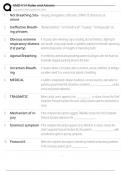
1. Not Breathing Situ- Hanging, Strangulation, Suffocation, COMPLETE Obstruction, etc.
ations
2. Ineffective Breath- "Barely breathing", "Can't breath at all", "Gasping", "Turning purple", etc.
ing phrases
3. Obvious extreme A 1st party caller exhibiting signs including, but not limited to, fighting for
respiratory distress each breath, using single words or syllable to express her/himself, expressing
(1st party) extreme desperation, or thoughts of impending death.
4. Agonal Breathing An ineffective, deteriorating breathing pattern that lingers after the heart has
essentially stopped pumping blood to the brain.
5. Uncertain Breath- A situation where a 2nd party caller is uncertain, unsure, indefinite, or ambigu-
ing ous when asked if an unconscious patient is breathing.
6. MEDICAL A sudden, unexplained collapse resulting in unconsciousness, even when re-
ported as ground-level fall, should be considered _________________ cardiac
arrest until proven otherwise.
7. TRAUMATIC When cardiac arrest appears to be ____________ in nature, choose the Chief
Complaint Protocol that best fits scene safety concerns and the mechanism or
injury.
8. Mechanism of in- If the complaint description suggests TRAUMA, choose the Chief Complaint
jury Protocol that best addresses the _________________.
9. foremost symptom If the complaint description appears to be MEDICAL in nature, choose the
Chief Complaint Protocol that best fits the patient's ________________ , with
consideration given to priority symptoms.
10. Protocol 6 When the complaint description is breathing-related tracheostomy problems
in the conscious patient, go to ____________.
1/6
, EMD V14 Rulex and Axioms
Study online at https://quizlet.com/_fkz9xd
11. Do not utilize If the complaint description involves both chest pain/HEART ATTACK symptoms
and STROKE symptoms, go to Protocol 10 but _________________ the Aspirin
Diagnostic and Instructions tool.
12. consciousness and When the complaint description strongly suggests GENERALIZED seizure, go to
breathing Protocol 12 regardless of __________________________.
13. coffee grounds ap- If the complaint description involves vomit with a
pearance or unusu- __________________________ and tar like fecal matter go to Protocol 21.
ally dark or black
14. Protocol 26 Sickle cell crisis/thalassemia, autonumic dysreflexia or acute adrenal insuffi-
ciency are handled on
15. due to trauma For chest pain _______________________ go to Protocol 30.
16. ground-level For ______________________ falls caused by fainting, near fainting, or dizzi-
ness, go to Protocol 31.
17. Protocol 32 If the Chief Complaint and status of consciousness and/or breathing are un-
known initially (3rd party), go to ___________________.
18. Scene Safety Any significant ____________________ concerns take precedence and must
be addressed before the provision of patient care instructions.
19. Sinking Vehicle For a 1st party caller in a _________________, obtaining an exact location,
when not immediately available, should not delay PAI's.
20. Case Entry Ques- __________________________ must always be completed after PDIs when
tioning directed by the protocol.
21. Aortic Aneurysm A condition in which a patient simultaneously describes with "tearing" or
ripping" pain in the back or flank and in the abdomen.
2/6
Study online at https://quizlet.com/_fkz9xd
1. Not Breathing Situ- Hanging, Strangulation, Suffocation, COMPLETE Obstruction, etc.
ations
2. Ineffective Breath- "Barely breathing", "Can't breath at all", "Gasping", "Turning purple", etc.
ing phrases
3. Obvious extreme A 1st party caller exhibiting signs including, but not limited to, fighting for
respiratory distress each breath, using single words or syllable to express her/himself, expressing
(1st party) extreme desperation, or thoughts of impending death.
4. Agonal Breathing An ineffective, deteriorating breathing pattern that lingers after the heart has
essentially stopped pumping blood to the brain.
5. Uncertain Breath- A situation where a 2nd party caller is uncertain, unsure, indefinite, or ambigu-
ing ous when asked if an unconscious patient is breathing.
6. MEDICAL A sudden, unexplained collapse resulting in unconsciousness, even when re-
ported as ground-level fall, should be considered _________________ cardiac
arrest until proven otherwise.
7. TRAUMATIC When cardiac arrest appears to be ____________ in nature, choose the Chief
Complaint Protocol that best fits scene safety concerns and the mechanism or
injury.
8. Mechanism of in- If the complaint description suggests TRAUMA, choose the Chief Complaint
jury Protocol that best addresses the _________________.
9. foremost symptom If the complaint description appears to be MEDICAL in nature, choose the
Chief Complaint Protocol that best fits the patient's ________________ , with
consideration given to priority symptoms.
10. Protocol 6 When the complaint description is breathing-related tracheostomy problems
in the conscious patient, go to ____________.
1/6
, EMD V14 Rulex and Axioms
Study online at https://quizlet.com/_fkz9xd
11. Do not utilize If the complaint description involves both chest pain/HEART ATTACK symptoms
and STROKE symptoms, go to Protocol 10 but _________________ the Aspirin
Diagnostic and Instructions tool.
12. consciousness and When the complaint description strongly suggests GENERALIZED seizure, go to
breathing Protocol 12 regardless of __________________________.
13. coffee grounds ap- If the complaint description involves vomit with a
pearance or unusu- __________________________ and tar like fecal matter go to Protocol 21.
ally dark or black
14. Protocol 26 Sickle cell crisis/thalassemia, autonumic dysreflexia or acute adrenal insuffi-
ciency are handled on
15. due to trauma For chest pain _______________________ go to Protocol 30.
16. ground-level For ______________________ falls caused by fainting, near fainting, or dizzi-
ness, go to Protocol 31.
17. Protocol 32 If the Chief Complaint and status of consciousness and/or breathing are un-
known initially (3rd party), go to ___________________.
18. Scene Safety Any significant ____________________ concerns take precedence and must
be addressed before the provision of patient care instructions.
19. Sinking Vehicle For a 1st party caller in a _________________, obtaining an exact location,
when not immediately available, should not delay PAI's.
20. Case Entry Ques- __________________________ must always be completed after PDIs when
tioning directed by the protocol.
21. Aortic Aneurysm A condition in which a patient simultaneously describes with "tearing" or
ripping" pain in the back or flank and in the abdomen.
2/6

