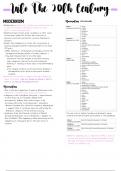
Into The 20th Century
Modernism Maximalism (Continued)
O
Modernism is defined not only by new techniques but by
a radical rejection of the past in favour of a new,
better + more exciting future
O
Modernists had to have great confidence in their vision
of how music should be, as their bold rejection of
musical conventions presented a serious challenge to
listeners
O
Despite the complaints of critics, the conventions of
musical language had been relatively stable for at least
200 years
↳
While harmony + tonality had continually evolved, the
fundamental building blocks of triads, cadences +
keys had remained more or less the same
Starting in the last decades of the 19th century,
-
some composers started to stretch traditional
harmony + tonality so much that it reached breaking
point
The collapse of these conventions had a dramatic +
*
fundamental effect both on how music worked +
sounded
O
Modernists often have a complex attitude towards the
music of the past + are not always as willing or able to
reject it as fully as they might pretend
Maximalism
O
One of the most important trends in Modernism is the
expansion + intensification of musical resources
O
Composers tried to heighten the power + expressiveness
of their music by, for example, adding more
instruments, making their works longer; or by
increasing the levels of chromaticism + dissonance
↳
Richard Taruskin has called this tendency 'Maximalism'
+ suggests that it continues a process started by the
Romantic composers of the previous century
g
Expansion from the Classical orchestra of Mozart O
You can trace a similar tendency in Romantic music
through the Romantic ones of Beethoven + Wagner to towards increasing length, particularly in the symphony
that of Mahler's 8th Symphony, which was known as the
'symphony of a thousand' due to the vast forces it
required
↳
Mahler's Symphony No.3, completed in 1896, is close to
an hour and a half, but like many maximalist trends,
this type of expansion begs the question of how much
further it is possible to go
, Into The 20th Century
'The Rite Of Spring' - Stravinsky (1913) Impressionism
O
One of the most extreme examples of Maximalism O
'Impressionism' is a term borrowed from art history
O
The brutal intensity of this piece has made it one of the ↳
French painters at the end of the 19th century aimed
most famous + influential early 20th century works not at exact representation but in capturing an
O
The orchestra is a similar size to Mahler's 8th symphony impression of a scene
(without the choirs and soloists), but it is the violence ↳
The most famous artist associated with Impressionism
with which Stravinsky deploys these forces that really is Claude Monet (1840-1926), who was interested in
makes it stand out how the same view could be shown in different lights
O
Creates maximum dissonance, rhythmic unpredictability In such paintings, the colour of morning or evening
-
+ fragmentation (Part 1: 'The Augurs of Spring') light, for example, is more important than the
↳
The chord played by the strings is highly dissonance, details of the scene itself, which are often blurred +
consisting of an E major chord against an Eb dominant vague
7th O
Another relevant movement from the late 19th
Not only is this a very harsh dissonance, but
-
century is that of the Symbolist poets, who aimed not
Stravinsky seems to have no interest in resolving it to describe precisely but to evoke and suggest meanings
↳
The rhythm is very simple, but savage + irregular O
The term 'Impressionist' was first used in music to
accents destroy any sense of metre describe the work of Claude Debussy
↳
After 8 bars, Stravinsky suddenly breaks off + ↳
Like many names for musical styles, it was meant as
begins a new dissonant idea adding C major and E a criticism
minor arpeggios into the mix O
The other composer associated with this style is Maurice
In more traditional music, ideas are developed +
-
Ravel + both certainly show an intense interest in
linked with transitions, but here Stravinsky just colourful orchestral + harmonic effects
repeats + juxtaposes G
Dynamics
↳
While this section ends with maximum brutality on a ↳
More use of subtle dynamics
fff tutti that cuts the frenetic rhythms suddenly O
Rhythm
short ↳
Is important, but not heavily rhythmic
O
Structure
'Erwartung' - Schoenberg (1909) ↳
No balanced phrases
O
Melody
O
One of the most famous pieces of musical Expressionism ↳
Ostinato + drones (Debussy)
+ was written in a white heat of creativity in just More of a feature, not for keeping the rhythm
-
under 3 weeks (not including the orchestration which More fluid
*
took another 3) ↳
Whole tone scales
O
Lasts around half an hour ↳
Pentatonic scales
O
Features a single female singer (with orchestra) who ↳
Motifs
becomes increasingly crazed as she searches for her lover ↳
Uneven phrase lengths
in a forest O
Instrumentation
↳
The increasing hysteria of the solo singer is matched by ↳
Instruments used for the timbre (their colour)
anguished dissonance + dense textures in the orchestra ↳
Influences from other styles from around the world
O
Last half-bar (Gamalan)
↳
This is chromaticism taken to its absolute limit, as Expressive qualities
-
multiple chromatic lines ascend + descend at ↳
Putting together instruments to create effects (e.g.
different rates Shimmering)
↳
The individual chords are all based on the whole tone G
Texture
scale, which means that the only possible type of triad ↳
Not very dense
is that which is most uncommon in tonal music, the ↳
No big chords
unstable + ambiguous augmented triad O
Tonality
The incredibly high level of chromaticism along with
-
↳
Tonally ambiguous
these augmented chords makes any sense of tonal ↳
No clear keys (Debussy)
centre absolutely impossible Sometimes becomes atonal
-
↳
These maximalist scores are used by Stravinsky + O
Tempo
Schoenberg to portray emotional + physical violence, ↳
Not rigid, more rubato
but both of these composers + many of their C
Harmony
contemporaries struggled to use this expressively ↳
No conventional functional harmony
distorted musical language to write music for less ↳
Extended chords (Debussy)
extreme circumstances ↳
Parallelism (Debussy)
Modernism Maximalism (Continued)
O
Modernism is defined not only by new techniques but by
a radical rejection of the past in favour of a new,
better + more exciting future
O
Modernists had to have great confidence in their vision
of how music should be, as their bold rejection of
musical conventions presented a serious challenge to
listeners
O
Despite the complaints of critics, the conventions of
musical language had been relatively stable for at least
200 years
↳
While harmony + tonality had continually evolved, the
fundamental building blocks of triads, cadences +
keys had remained more or less the same
Starting in the last decades of the 19th century,
-
some composers started to stretch traditional
harmony + tonality so much that it reached breaking
point
The collapse of these conventions had a dramatic +
*
fundamental effect both on how music worked +
sounded
O
Modernists often have a complex attitude towards the
music of the past + are not always as willing or able to
reject it as fully as they might pretend
Maximalism
O
One of the most important trends in Modernism is the
expansion + intensification of musical resources
O
Composers tried to heighten the power + expressiveness
of their music by, for example, adding more
instruments, making their works longer; or by
increasing the levels of chromaticism + dissonance
↳
Richard Taruskin has called this tendency 'Maximalism'
+ suggests that it continues a process started by the
Romantic composers of the previous century
g
Expansion from the Classical orchestra of Mozart O
You can trace a similar tendency in Romantic music
through the Romantic ones of Beethoven + Wagner to towards increasing length, particularly in the symphony
that of Mahler's 8th Symphony, which was known as the
'symphony of a thousand' due to the vast forces it
required
↳
Mahler's Symphony No.3, completed in 1896, is close to
an hour and a half, but like many maximalist trends,
this type of expansion begs the question of how much
further it is possible to go
, Into The 20th Century
'The Rite Of Spring' - Stravinsky (1913) Impressionism
O
One of the most extreme examples of Maximalism O
'Impressionism' is a term borrowed from art history
O
The brutal intensity of this piece has made it one of the ↳
French painters at the end of the 19th century aimed
most famous + influential early 20th century works not at exact representation but in capturing an
O
The orchestra is a similar size to Mahler's 8th symphony impression of a scene
(without the choirs and soloists), but it is the violence ↳
The most famous artist associated with Impressionism
with which Stravinsky deploys these forces that really is Claude Monet (1840-1926), who was interested in
makes it stand out how the same view could be shown in different lights
O
Creates maximum dissonance, rhythmic unpredictability In such paintings, the colour of morning or evening
-
+ fragmentation (Part 1: 'The Augurs of Spring') light, for example, is more important than the
↳
The chord played by the strings is highly dissonance, details of the scene itself, which are often blurred +
consisting of an E major chord against an Eb dominant vague
7th O
Another relevant movement from the late 19th
Not only is this a very harsh dissonance, but
-
century is that of the Symbolist poets, who aimed not
Stravinsky seems to have no interest in resolving it to describe precisely but to evoke and suggest meanings
↳
The rhythm is very simple, but savage + irregular O
The term 'Impressionist' was first used in music to
accents destroy any sense of metre describe the work of Claude Debussy
↳
After 8 bars, Stravinsky suddenly breaks off + ↳
Like many names for musical styles, it was meant as
begins a new dissonant idea adding C major and E a criticism
minor arpeggios into the mix O
The other composer associated with this style is Maurice
In more traditional music, ideas are developed +
-
Ravel + both certainly show an intense interest in
linked with transitions, but here Stravinsky just colourful orchestral + harmonic effects
repeats + juxtaposes G
Dynamics
↳
While this section ends with maximum brutality on a ↳
More use of subtle dynamics
fff tutti that cuts the frenetic rhythms suddenly O
Rhythm
short ↳
Is important, but not heavily rhythmic
O
Structure
'Erwartung' - Schoenberg (1909) ↳
No balanced phrases
O
Melody
O
One of the most famous pieces of musical Expressionism ↳
Ostinato + drones (Debussy)
+ was written in a white heat of creativity in just More of a feature, not for keeping the rhythm
-
under 3 weeks (not including the orchestration which More fluid
*
took another 3) ↳
Whole tone scales
O
Lasts around half an hour ↳
Pentatonic scales
O
Features a single female singer (with orchestra) who ↳
Motifs
becomes increasingly crazed as she searches for her lover ↳
Uneven phrase lengths
in a forest O
Instrumentation
↳
The increasing hysteria of the solo singer is matched by ↳
Instruments used for the timbre (their colour)
anguished dissonance + dense textures in the orchestra ↳
Influences from other styles from around the world
O
Last half-bar (Gamalan)
↳
This is chromaticism taken to its absolute limit, as Expressive qualities
-
multiple chromatic lines ascend + descend at ↳
Putting together instruments to create effects (e.g.
different rates Shimmering)
↳
The individual chords are all based on the whole tone G
Texture
scale, which means that the only possible type of triad ↳
Not very dense
is that which is most uncommon in tonal music, the ↳
No big chords
unstable + ambiguous augmented triad O
Tonality
The incredibly high level of chromaticism along with
-
↳
Tonally ambiguous
these augmented chords makes any sense of tonal ↳
No clear keys (Debussy)
centre absolutely impossible Sometimes becomes atonal
-
↳
These maximalist scores are used by Stravinsky + O
Tempo
Schoenberg to portray emotional + physical violence, ↳
Not rigid, more rubato
but both of these composers + many of their C
Harmony
contemporaries struggled to use this expressively ↳
No conventional functional harmony
distorted musical language to write music for less ↳
Extended chords (Debussy)
extreme circumstances ↳
Parallelism (Debussy)