Symphony No. 104
HAYDN
Movement 1
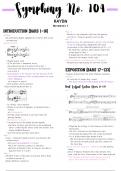
INTRODUCTION (BARS 1-16) O
Bar 14
O
Adagio
↳
Return to the dramatic call from the opening
↳
As with many Haydn symphonies, it starts with a slow
↳
Cut short + drops to pp after just one bar
introduction
O
Bar 15
O
Fanfare motif
↳
Resolves onto the subdominant chord on the 3rd beat
of bar 15, followed by a Neapolitan 6th chord,
progressing to the cadential figuration of I 64 --> V
An imperfect cadence, above which is heard the
-
↳
string motif in oboe 1
A Neapolitan 6th chord is a chord built on the
-
flattened 2nd degree of the scale
Played unison tutti
-
O
The introduction concludes with a 1 bar pause
ff on the tonic + dominant notes
-
↳
Preparing us expectantly for the next section
Ascending interval of a perfect 5th in bar 1
-
reflected in the downward move to the dominant
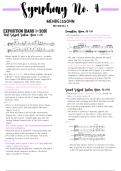
note in bar 2 Exposition (bars 17-123)
Key signature is for D major, but the omission of the
-
O
Exposes and presents the main thematic material
3rd in these opening 2 bars actually makes the mode O
Allegro
rather ambiguous ↳
A contrast of tempo, key + mood
Is it major or minor?
*
The music moves into the brighter mode of D major
-
Root position chords used here
-
O
Quiet answering phrase (bar 3) First Subject Section (Bars 17-49)
O
S1
↳
↳
In strings + first bassoon
-
Brings a contrast of dynamic, instrumentation +
-
texture ↳
Now homophonic
&
Overall range of pitches is narrower than the
-
opening fanfare
Movement is conjunt
-
Continued use of the double dotted rhythm
-
The F↳ in the bass, and the C#s in the antiphonal
&
Played by the strings (+ first bassoon at the start),
-
effect created by the offset violin line answer, now heard piano
firmly establish D minor The 3rd + 4th bars of this theme are used
-
Inverted chords used here until bar 6
-
extensively throughout the rest of the movement
O
Bar 7 -
It is a 16 bar theme that divides in 8+8
↳
Tonic + dominant fanfare motive now heard in the The first phrase ending with an imperfect cadence,
*
relative major the second concluding with a perfect cadence in
The music has modulated to F major
-
the tonic key
Via a C↳ + a perfect cadence in that key
*
↳
Clear sense of structure + symmetry in this opening
No brass included for this, as they are not able to
K
theme
play the notes of F and C ↳
Sense of balance between the 2 bars phrases very
O
Bar 9 clear, with the first 2 bars based on the same material
↳
Another 5 bars of the piano string idea, with a flute The thematic material is mid range in terms of
-
incldued from bar 12 pitch, which allows for expansion to follow
↳
Rising harmonic sequences
, Symphony No. 104
HAYDN
Movement 1
First Subject Section (Bars 17-49) (Continued) Second Subject Section (Bars 65-98)
O
S2a (S1 in the key of A major)
↳
↳
↳
Instead of contrasting lyrical theme as expected, we
The tutti section which follows at bar 32 could be the
↳
hear S1 in the dominant key of A major
start of the transition passage, but it certainly feels ↳
Not unusual practice for Haydn
like a celebratory continuation of the previous section ↳
He often presents the same theme but achieves the
rather than the start of something new contrast through the key change
Heard f, firmly in D with the semiquaver patterns
-
Known as monothematicism
-
supported by 8 bars of tonic pedal of D + with the O
Bars 65-76
brass instruments able to reinforce the sonority ↳
Same as bars 17-28 of S1
Rhythm at bar 32 is the same as the first bar of S1
↳
Though additional woodwind has been added + there
-
O
Bar 40 is some re-arrangement of the material in terms of
Move to the submediant chord with chromatic touches
↳
the instrumentation
adding further harmonic interest Provides a contrast in sonority
&
O
Bar 43-44 O
Bars 73-79
Scalic crotchet patterns feel like an augmented
↳ ↳
Harmony becomes more chromatic + the texture
reminder of the scalic quavers from bar 2 of S1 includes imitative counterpoint
Music content is full of energy
↳ ↳
Concludes on the dominant 7th chord of A major
Increasing use of semiquaver patterning
- &
S2b
Faster rate of harmonic change in some bars
-
Ascending quaver seuqnece played staccato in the
-
violins
↳
More active bass line which rises excitedly to
-
conclude with a perfect cadence (still in D major) at
bar 50 ↳
Unexpected harmonic twist
-
Previous dominant 7th chord resolves upward with
an interrupted cadence
Transition (bars 50-64) ↳
More dependent on quaver passage work than
O
Transition theme thematic material, with lower strings playing a
syncopated descending stepwise line, based on bars
↳
21-22
↳
Tutti passage at bar 86 is similar to the tutti section
of bar 32
↳
Built on the repeated notes of the 3rd bar of S1
↳
Strings + upper woodwind spiral downwards in broken
↳
Start of the transition, noted by the inclusion of chord fashion (bar 89) to arrive on a unison semibreve
↳
G#s, signifying the intention of preparing the way C# in bar 90
for the move to the related dominant key of S2
-
Moves upwards via a D# to arrive on the dominant,
↳
More accidentals from bars 54 onwards create complete with dominant pedal in preparation for a
further harmonic interest, but the bass part rises to perfect cadence in A major in bar 98-99
an E in bar 57
-
Remains as a pedal note which is clearly dominant
preparation for the modulation to the related key in
which the second subject will be presented
, Symphony No. 104
HAYDN
Movement 1
Codetta (bars 99-123) Development (bars 124-192)
O
Codetta theme (Continued)
O
Bars 145-155
↳
Textural contrast
↳
Scored for just upper strings
-
↳
Violins develop bars 105-105 from the codetta
2nd violins continue with the oscillating quaver
-
figuration
Violas accompany by continuing the repeated note
-
figure
↳
Passage starts in the key of C# minor
↳
Rounds off the exposition section ↳
From bar 150, the 2 bar phrases proceed through a circle
↳
More melodious section than we expect of 5ths in a descending sequence, seen clearly in the
↳
Bars 100-112 introduce new material, heard piano, bassoon
though the triadic motif has been well used prior to Bar 150
-
this D# major
&
↳
Move to F# minor in bar 109 + E major in bar 111 Bar 151
-
↳
From bar 112, the material presents extended G# minor
*
cadential material + is more codetta-like Bar 152
-
↳
Bars 116-117 is based on material from bars 112-115, C# major
*
with a re-ordered texture + scoring with a different Bar 153
-
layout of registers F# minor
&
Development (bars 124-192) Bar 154
-
B major
*
O
Bars 124-145 Bar 155
-
↳
Section begins with a clear development of bars 3 + 4 E major
*
of S1, which receives sequential + imitational &
Bar 155-179
treatment in a variety of registers + instruments ↳
Change to the major mode, tutti, f, as the codetta
↳
Begins quietly in the strings in B minor triadic motif from bar 105 is heart in diminution in
Flutes + oboes enter in bar 132
-
bar 155
Clarinets, bassoons + brass enter in bar 137
-
E major, though back to E minor at bar 157
-
↳
Inclusion of some chromatic inflections Further treatment of the 3rd bar of S1 in bar 159
&
The way that the rate of harmony is varied + the way
-
for an extended passage in this key
that Haydn avoids cadential definition ↳
Pace + tension of the music is increased through the
↳
Bar 137 use of syncopation in bar 164
Tutti ff passage with clarinets, bassoons + bass
-
↳
Figure Y from S1 still persists in the bass in E minor
delivering figure Y, while the 4-crotchet rhythm is at bar 166, and in the upper woodwind + violins in B
further emphasised in the brass minor at bar 174
Quaver figuration in violins contribute to the energy,
-
Motif is heard in a variety of ways
-
along with the syncopation in violin 1 Overlapping, and distributed among a variety of
*
Their move upwards to B# in bar 141, along with
*
instruments, in sequence, in shortened for etc
figure Y gradually descending in the bass prepares Music gathers increasing momentum
>
-
us for the move to C# minor in bar 145 ↳
From bar 170, the E minor 63 leads to an augmented
A remote relationship with the home key
>
-
6th chord, as the E moves up a semitone to E#s above
the bass G
↳
For the first time in the development section, the
timpani joins in on the D-pitched timp
Fits with the augmented 6th chord in 172
-
↳
Phrase eventually resolves onto an F# major chord at
bar 174
Along with the pedal note on the F#, gives us
-
dominant preparation for B minor
Eventually arrives in bar 179
&
Relative minor of the home key of D major
*
HAYDN
Movement 1
INTRODUCTION (BARS 1-16) O
Bar 14
O
Adagio
↳
Return to the dramatic call from the opening
↳
As with many Haydn symphonies, it starts with a slow
↳
Cut short + drops to pp after just one bar
introduction
O
Bar 15
O
Fanfare motif
↳
Resolves onto the subdominant chord on the 3rd beat
of bar 15, followed by a Neapolitan 6th chord,
progressing to the cadential figuration of I 64 --> V
An imperfect cadence, above which is heard the
-
↳
string motif in oboe 1
A Neapolitan 6th chord is a chord built on the
-
flattened 2nd degree of the scale
Played unison tutti
-
O
The introduction concludes with a 1 bar pause
ff on the tonic + dominant notes
-
↳
Preparing us expectantly for the next section
Ascending interval of a perfect 5th in bar 1
-
reflected in the downward move to the dominant
note in bar 2 Exposition (bars 17-123)
Key signature is for D major, but the omission of the
-
O
Exposes and presents the main thematic material
3rd in these opening 2 bars actually makes the mode O
Allegro
rather ambiguous ↳
A contrast of tempo, key + mood
Is it major or minor?
*
The music moves into the brighter mode of D major
-
Root position chords used here
-
O
Quiet answering phrase (bar 3) First Subject Section (Bars 17-49)
O
S1
↳
↳
In strings + first bassoon
-
Brings a contrast of dynamic, instrumentation +
-
texture ↳
Now homophonic
&
Overall range of pitches is narrower than the
-
opening fanfare
Movement is conjunt
-
Continued use of the double dotted rhythm
-
The F↳ in the bass, and the C#s in the antiphonal
&
Played by the strings (+ first bassoon at the start),
-
effect created by the offset violin line answer, now heard piano
firmly establish D minor The 3rd + 4th bars of this theme are used
-
Inverted chords used here until bar 6
-
extensively throughout the rest of the movement
O
Bar 7 -
It is a 16 bar theme that divides in 8+8
↳
Tonic + dominant fanfare motive now heard in the The first phrase ending with an imperfect cadence,
*
relative major the second concluding with a perfect cadence in
The music has modulated to F major
-
the tonic key
Via a C↳ + a perfect cadence in that key
*
↳
Clear sense of structure + symmetry in this opening
No brass included for this, as they are not able to
K
theme
play the notes of F and C ↳
Sense of balance between the 2 bars phrases very
O
Bar 9 clear, with the first 2 bars based on the same material
↳
Another 5 bars of the piano string idea, with a flute The thematic material is mid range in terms of
-
incldued from bar 12 pitch, which allows for expansion to follow
↳
Rising harmonic sequences
, Symphony No. 104
HAYDN
Movement 1
First Subject Section (Bars 17-49) (Continued) Second Subject Section (Bars 65-98)
O
S2a (S1 in the key of A major)
↳
↳
↳
Instead of contrasting lyrical theme as expected, we
The tutti section which follows at bar 32 could be the
↳
hear S1 in the dominant key of A major
start of the transition passage, but it certainly feels ↳
Not unusual practice for Haydn
like a celebratory continuation of the previous section ↳
He often presents the same theme but achieves the
rather than the start of something new contrast through the key change
Heard f, firmly in D with the semiquaver patterns
-
Known as monothematicism
-
supported by 8 bars of tonic pedal of D + with the O
Bars 65-76
brass instruments able to reinforce the sonority ↳
Same as bars 17-28 of S1
Rhythm at bar 32 is the same as the first bar of S1
↳
Though additional woodwind has been added + there
-
O
Bar 40 is some re-arrangement of the material in terms of
Move to the submediant chord with chromatic touches
↳
the instrumentation
adding further harmonic interest Provides a contrast in sonority
&
O
Bar 43-44 O
Bars 73-79
Scalic crotchet patterns feel like an augmented
↳ ↳
Harmony becomes more chromatic + the texture
reminder of the scalic quavers from bar 2 of S1 includes imitative counterpoint
Music content is full of energy
↳ ↳
Concludes on the dominant 7th chord of A major
Increasing use of semiquaver patterning
- &
S2b
Faster rate of harmonic change in some bars
-
Ascending quaver seuqnece played staccato in the
-
violins
↳
More active bass line which rises excitedly to
-
conclude with a perfect cadence (still in D major) at
bar 50 ↳
Unexpected harmonic twist
-
Previous dominant 7th chord resolves upward with
an interrupted cadence
Transition (bars 50-64) ↳
More dependent on quaver passage work than
O
Transition theme thematic material, with lower strings playing a
syncopated descending stepwise line, based on bars
↳
21-22
↳
Tutti passage at bar 86 is similar to the tutti section
of bar 32
↳
Built on the repeated notes of the 3rd bar of S1
↳
Strings + upper woodwind spiral downwards in broken
↳
Start of the transition, noted by the inclusion of chord fashion (bar 89) to arrive on a unison semibreve
↳
G#s, signifying the intention of preparing the way C# in bar 90
for the move to the related dominant key of S2
-
Moves upwards via a D# to arrive on the dominant,
↳
More accidentals from bars 54 onwards create complete with dominant pedal in preparation for a
further harmonic interest, but the bass part rises to perfect cadence in A major in bar 98-99
an E in bar 57
-
Remains as a pedal note which is clearly dominant
preparation for the modulation to the related key in
which the second subject will be presented
, Symphony No. 104
HAYDN
Movement 1
Codetta (bars 99-123) Development (bars 124-192)
O
Codetta theme (Continued)
O
Bars 145-155
↳
Textural contrast
↳
Scored for just upper strings
-
↳
Violins develop bars 105-105 from the codetta
2nd violins continue with the oscillating quaver
-
figuration
Violas accompany by continuing the repeated note
-
figure
↳
Passage starts in the key of C# minor
↳
Rounds off the exposition section ↳
From bar 150, the 2 bar phrases proceed through a circle
↳
More melodious section than we expect of 5ths in a descending sequence, seen clearly in the
↳
Bars 100-112 introduce new material, heard piano, bassoon
though the triadic motif has been well used prior to Bar 150
-
this D# major
&
↳
Move to F# minor in bar 109 + E major in bar 111 Bar 151
-
↳
From bar 112, the material presents extended G# minor
*
cadential material + is more codetta-like Bar 152
-
↳
Bars 116-117 is based on material from bars 112-115, C# major
*
with a re-ordered texture + scoring with a different Bar 153
-
layout of registers F# minor
&
Development (bars 124-192) Bar 154
-
B major
*
O
Bars 124-145 Bar 155
-
↳
Section begins with a clear development of bars 3 + 4 E major
*
of S1, which receives sequential + imitational &
Bar 155-179
treatment in a variety of registers + instruments ↳
Change to the major mode, tutti, f, as the codetta
↳
Begins quietly in the strings in B minor triadic motif from bar 105 is heart in diminution in
Flutes + oboes enter in bar 132
-
bar 155
Clarinets, bassoons + brass enter in bar 137
-
E major, though back to E minor at bar 157
-
↳
Inclusion of some chromatic inflections Further treatment of the 3rd bar of S1 in bar 159
&
The way that the rate of harmony is varied + the way
-
for an extended passage in this key
that Haydn avoids cadential definition ↳
Pace + tension of the music is increased through the
↳
Bar 137 use of syncopation in bar 164
Tutti ff passage with clarinets, bassoons + bass
-
↳
Figure Y from S1 still persists in the bass in E minor
delivering figure Y, while the 4-crotchet rhythm is at bar 166, and in the upper woodwind + violins in B
further emphasised in the brass minor at bar 174
Quaver figuration in violins contribute to the energy,
-
Motif is heard in a variety of ways
-
along with the syncopation in violin 1 Overlapping, and distributed among a variety of
*
Their move upwards to B# in bar 141, along with
*
instruments, in sequence, in shortened for etc
figure Y gradually descending in the bass prepares Music gathers increasing momentum
>
-
us for the move to C# minor in bar 145 ↳
From bar 170, the E minor 63 leads to an augmented
A remote relationship with the home key
>
-
6th chord, as the E moves up a semitone to E#s above
the bass G
↳
For the first time in the development section, the
timpani joins in on the D-pitched timp
Fits with the augmented 6th chord in 172
-
↳
Phrase eventually resolves onto an F# major chord at
bar 174
Along with the pedal note on the F#, gives us
-
dominant preparation for B minor
Eventually arrives in bar 179
&
Relative minor of the home key of D major
*