The Western Classical Tradition
& A
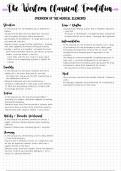
Overview of The musical elements
Structure Tempo / Rhythm
In the Classical era, the emphasis was on proportion + Classical music employs a great deal of rhythmic figuration
balance + repetition
Sonata form became the most important structure, The music of the Romantic era implied greater interpretive
used to organise the music within movements freedom with the use of rubato + changing time signatures
(particularly 1st movements) + in single pieces such as
instrumental overtures Instrumentation
Romantic music enjoyed further exploration + freedom, In the Classical era, the orchestra increased in size + range
with some symphony movements being particularly of instruments as new developments were taking place
lengthy + written in a modified + extended structure Eventually the harpsichord continuo fell out of use + the
Such works sometimes relied on such devices as motto woodwind section assumed greater importance in the
themes, recurring themes, + idee fixe orchestra
Closer links with the arts results in music which The Romantic orchestra expanded to mighty proportions in
relied on an accompanying program to explain the some cases + continued developments in instrument-
content making enabled more flexibility, particularly with the brass
instruments, which often dominated the texture
Tonality This was the era of the virtuoso performer
In the Classical era, the major tonalities were more
widely used + the minor keys used for contrast Mood
One important change was the shift towards keys in
the subdominant direction There was more contrast found within Classical + Romantic
Romantic harmonies were more adventurous + works
chromatic, looking back in some ways to the works of Increasingly, composers were also known for incorporating
J.S. Bach, but also pushing tonality to its limits with nationalistic influences in their music
increasingly dissonant content
Texture
In the Classical era, the textures became lighter +
generally less complex, with much emphasis on melody-
dominated homophony
Romantic music was often presented in textures which
were more dense in terms of the orchestral resources,
exploring the wider range of timbres + tone-colours
Melody / Thematic Development
In the Classical era, melodies tended to be shorter +
simpler, with more balanced phrases (punctuated by
cadences)
Romantic themes were extremely lyrical + song-like
Harmony
In the Classical era, the harmony is more clearly defined
i.e. functional harmony
Keys are used to delineate sections in a composition, but
are also an important element used to add colour +
suggest emotion in the music
Romantic music used more complex chords, the harmonic
function of which was sometimes ambiguous + not to
reliant on cadential definition
, The Western Classical Tradition
& A
an introduction to some classical structures
Binary Form Sonata Form
This structure is in 2 sections Even some of the compositions of the Baroque era showed
Section A + section B, both of which are repeated signs of what was eventually to become recognised +
accepted as sonata form
There can be little doubt than sonata form had gradually
emerged from the binary form of the Baroque
The general plan of sonata form (often to be found in 1st
movements of sonatas, concertos, chamber music, some 1
movement overtures + symphonies) is:
Ternary Form
This structure is in 3 sections
Section A, section B, then section A again (ABA)
Section B may present contrasted (or slightly
developed) material, section A may be altered on its
return (if so, labelled A1)
If the 2nd A section is exactly the same as the 1st,
the composer sometimes didn’t write the music out
again + instead, the instruction ‘da capo’ would be
found at the end of section B
The performers would then repeat sectionA + at
the end of the section the word ‘fine’ would be
found, which indicated the ‘end’ of the piece There are many cased where this form is adapted slightly,
This was known as da capo form in which case it becomes referred to as ‘modified sonata
form’
Rondo Form Sonata form is sometimes referred to as ‘first-movement’
This is a structure with a recurring section A, separated form as it is widely used to organise the material in the
by contrasting sections called ‘episodes’ (ABACA) opening movements of symphonies, concertos, sonatas +
string quartets
& A
Overview of The musical elements
Structure Tempo / Rhythm
In the Classical era, the emphasis was on proportion + Classical music employs a great deal of rhythmic figuration
balance + repetition
Sonata form became the most important structure, The music of the Romantic era implied greater interpretive
used to organise the music within movements freedom with the use of rubato + changing time signatures
(particularly 1st movements) + in single pieces such as
instrumental overtures Instrumentation
Romantic music enjoyed further exploration + freedom, In the Classical era, the orchestra increased in size + range
with some symphony movements being particularly of instruments as new developments were taking place
lengthy + written in a modified + extended structure Eventually the harpsichord continuo fell out of use + the
Such works sometimes relied on such devices as motto woodwind section assumed greater importance in the
themes, recurring themes, + idee fixe orchestra
Closer links with the arts results in music which The Romantic orchestra expanded to mighty proportions in
relied on an accompanying program to explain the some cases + continued developments in instrument-
content making enabled more flexibility, particularly with the brass
instruments, which often dominated the texture
Tonality This was the era of the virtuoso performer
In the Classical era, the major tonalities were more
widely used + the minor keys used for contrast Mood
One important change was the shift towards keys in
the subdominant direction There was more contrast found within Classical + Romantic
Romantic harmonies were more adventurous + works
chromatic, looking back in some ways to the works of Increasingly, composers were also known for incorporating
J.S. Bach, but also pushing tonality to its limits with nationalistic influences in their music
increasingly dissonant content
Texture
In the Classical era, the textures became lighter +
generally less complex, with much emphasis on melody-
dominated homophony
Romantic music was often presented in textures which
were more dense in terms of the orchestral resources,
exploring the wider range of timbres + tone-colours
Melody / Thematic Development
In the Classical era, melodies tended to be shorter +
simpler, with more balanced phrases (punctuated by
cadences)
Romantic themes were extremely lyrical + song-like
Harmony
In the Classical era, the harmony is more clearly defined
i.e. functional harmony
Keys are used to delineate sections in a composition, but
are also an important element used to add colour +
suggest emotion in the music
Romantic music used more complex chords, the harmonic
function of which was sometimes ambiguous + not to
reliant on cadential definition
, The Western Classical Tradition
& A
an introduction to some classical structures
Binary Form Sonata Form
This structure is in 2 sections Even some of the compositions of the Baroque era showed
Section A + section B, both of which are repeated signs of what was eventually to become recognised +
accepted as sonata form
There can be little doubt than sonata form had gradually
emerged from the binary form of the Baroque
The general plan of sonata form (often to be found in 1st
movements of sonatas, concertos, chamber music, some 1
movement overtures + symphonies) is:
Ternary Form
This structure is in 3 sections
Section A, section B, then section A again (ABA)
Section B may present contrasted (or slightly
developed) material, section A may be altered on its
return (if so, labelled A1)
If the 2nd A section is exactly the same as the 1st,
the composer sometimes didn’t write the music out
again + instead, the instruction ‘da capo’ would be
found at the end of section B
The performers would then repeat sectionA + at
the end of the section the word ‘fine’ would be
found, which indicated the ‘end’ of the piece There are many cased where this form is adapted slightly,
This was known as da capo form in which case it becomes referred to as ‘modified sonata
form’
Rondo Form Sonata form is sometimes referred to as ‘first-movement’
This is a structure with a recurring section A, separated form as it is widely used to organise the material in the
by contrasting sections called ‘episodes’ (ABACA) opening movements of symphonies, concertos, sonatas +
string quartets