BULLETED AND NUMBERED LISTS
You can use lists to make your document more skim-able – easier for your audience to
understand, remember, and review key pieces of information within your text. Lists can
also help readers follow a sequence of actions or events and break up long stretches of
text.
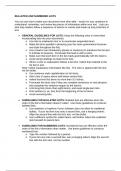
GENERAL GUIDELINES FOR LISTS: Keep the following rules in mind when
incorporating lists into your documents:
o Use lists to emphasize text or to enumerate sequential items.
o Make list items parallel in phrasing (use the same grammatical structure
and style throughout the list).
o Use a lead-in (an introductory phrase or sentence) to introduce the list and
to indicate its purpose. Punctuate that lead-in with a colon.
o Make sure that each item in the list reads grammatically with the lead-in.
o Avoid using headings as lead-ins for lists.
o When a note or explanation follows a list item, indent that material to the
list item’s text.
Note: Indent explanatory information like this. The note is aligned with the text,
not the bullet.
o Use sentence-style capitalization on list items.
o Add a line of space above and below vertical lists.
o Indent first-level list items no more than 0.5 inches.
o Punctuate list items only if they are complete sentences or verb phrases
that complete the sentence begun by the lead-in.
o Limit long lists (more than eight items), and avoid single-item lists.
o Omit articles (a, an, the) from the beginning of the list items.
o Avoid overusing lists.
GUIDELINES FOR BULLETED LISTS: Bulleted lists are effective when the
order of the list’s information doesn’t matter. Use these guidelines to construct
bulleted lists:
o Use asterisks or hyphens if your software does not allow for traditional
bullets. If your list item runs onto a second line, use a hanging indent:
Align the second line with the list’s text, not the bullet.
o Use a different symbol for sublist items, and further indent the sublisted
item beneath its parent item.
GUIDELINES FOR NUMBERED LISTS: Numbered lists are effective when the
order of the list’s information does matter. Use these guidelines to construct
numbered lists:
o Type the number followed by a period.
o If your list runs onto a second line, use a hanging indent: Align the second
line with the list’s text, not the number.
You can use lists to make your document more skim-able – easier for your audience to
understand, remember, and review key pieces of information within your text. Lists can
also help readers follow a sequence of actions or events and break up long stretches of
text.
GENERAL GUIDELINES FOR LISTS: Keep the following rules in mind when
incorporating lists into your documents:
o Use lists to emphasize text or to enumerate sequential items.
o Make list items parallel in phrasing (use the same grammatical structure
and style throughout the list).
o Use a lead-in (an introductory phrase or sentence) to introduce the list and
to indicate its purpose. Punctuate that lead-in with a colon.
o Make sure that each item in the list reads grammatically with the lead-in.
o Avoid using headings as lead-ins for lists.
o When a note or explanation follows a list item, indent that material to the
list item’s text.
Note: Indent explanatory information like this. The note is aligned with the text,
not the bullet.
o Use sentence-style capitalization on list items.
o Add a line of space above and below vertical lists.
o Indent first-level list items no more than 0.5 inches.
o Punctuate list items only if they are complete sentences or verb phrases
that complete the sentence begun by the lead-in.
o Limit long lists (more than eight items), and avoid single-item lists.
o Omit articles (a, an, the) from the beginning of the list items.
o Avoid overusing lists.
GUIDELINES FOR BULLETED LISTS: Bulleted lists are effective when the
order of the list’s information doesn’t matter. Use these guidelines to construct
bulleted lists:
o Use asterisks or hyphens if your software does not allow for traditional
bullets. If your list item runs onto a second line, use a hanging indent:
Align the second line with the list’s text, not the bullet.
o Use a different symbol for sublist items, and further indent the sublisted
item beneath its parent item.
GUIDELINES FOR NUMBERED LISTS: Numbered lists are effective when the
order of the list’s information does matter. Use these guidelines to construct
numbered lists:
o Type the number followed by a period.
o If your list runs onto a second line, use a hanging indent: Align the second
line with the list’s text, not the number.