Week 1
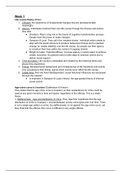
Life course theory (Elder)
1. Lifespan: the experience of fundamental changes that are developmentally
meaningful
2. Agency: Individuals construct their own life course through the choices and actions
they take.
● Giordano: Play’s a big role in the theory of cognitive transformation process.
People have the power to make changes.
● Sampson & Laub: They call it the ‘situated choice’; individual action needs to
align with the social structure to produce behavioral change and to maintain
change (or maybe stability) over the life course. So people use their agency
to construct their lives within the context of ongoing straints.
● Wright & Cullen: ‘Parental efficacy’ involves agency or action taken to achieve
certain outcomes. So parents need to take steps to exercise control and to
deliver social support.
3. Time and place: Life course is embedded and shaped by the historical times and
places they experience.
4. Timing: Developmental background and consequences of life transitions and events
vary according to their timing; age at which events occur affect the life course.
5. Linked lives: lives are lived interdependent, social historical influences are expressed
through this network.
● Is important in Sampson & Laub’s theory: the age-graded theory of informal
social control
Age-crime curve is invariant (Gottfredson & Hirschi)
They stated that the age crime curve is invariant, so their explanations for crime could be
used at any given moment in time and space, regardless of the offense. This is a static
theory.
↳ Steffensmeier - Age and distribution of crime: They reject the hypothesis that the age
distribution of crime is invariant (= onveranderbaar) across crime types and over time. There
is not a single age pattern in crime. So steffensmeier is not against the age-crime curve, yet
they think that the offense rime curve is different in any single offense.
, Week 2
Dual taxonomy (Moffit)
There is a distinction between two types of offenders, you have the:
● Life course persistent offenders where the onset starts because of
neuropsychological dysfunctions and the social environment. The LCP offenders do
not desist.
● Adolescent limited offenders where the onset is caused by maturity gap and mimicry.
Al offenders desist upon gaining adult status, this can happen throughout marriage,
employment and parenthood.
↳ Sampson & Laub: You can’t divide offenders into two groups. Also all individuals desist
due to turning points and social bonds. In this theory it is more about the environment and
social bonds than the individual differences and traits (so cumulative continuity over self-
selection). They say that their data supports the assertion that there are high-rate offenders,
which equals life course persistent offenders.
↳ Chen tested Moffit’s theory about abstainers. Moffit states that delinquency abstainers are
socially isolated due to certain unappealing physical/personality characteristics. So she
makes an association between social exclusion and delinquency. Chen’s analysis showed
that delinquent abstainers are not as popular as delinquent adolescents, however they are
not socially excluded from peer groups nor are they marginalized in their peer networks.
Instead, they have prosocial friends.
Three types of major theoretical frameworks
1. Static theories: The causes are in the differences and similarities between people.
Traits / disposition explain the behavior.
● An example of such a theory is General theory of crime from Gottfredson and
Hirschi, people commit crime because of low-self control (character trait). The
low self control is developed because of the parent’s socialization.
2. Dynamic theories: It is about development in people, events / actions have causal
effects going on in the future for example criminal behavior. Important terms are
cumulative continuity and self-selection.
● Cumulative continuity: snowball effect, prior criminal behavior increases
likelihood of future criminal behavior.
● Self-selection: people select experiences / groups based on internal traits, i.e.
similar people ‘end up together’.
● An example of such a theory is the Age-graded effect; biological and
environmental factors have a strong correlation with chronical age.
3. Typological theories: These theories combine different crime perspectives. Crime
over the life course is not one age-crime curve, there are different types of offenders
with different causes and mechanisms and different predictions for behavior.
● An example of such a theory is Moffit’s dual taxonomy.
Restricted behavioral repertoire
Theory of LCP antisocial behavior asserts that the causal sequence begins very early and
the formative years are dominated by chains of cumulative and contemporary continuity.
This leads to little opportunity that is afforded for the antisocial individual to learn a
behavioral repertoire of prosocial alternatives.
Week 3
Life course theory (Elder)
1. Lifespan: the experience of fundamental changes that are developmentally
meaningful
2. Agency: Individuals construct their own life course through the choices and actions
they take.
● Giordano: Play’s a big role in the theory of cognitive transformation process.
People have the power to make changes.
● Sampson & Laub: They call it the ‘situated choice’; individual action needs to
align with the social structure to produce behavioral change and to maintain
change (or maybe stability) over the life course. So people use their agency
to construct their lives within the context of ongoing straints.
● Wright & Cullen: ‘Parental efficacy’ involves agency or action taken to achieve
certain outcomes. So parents need to take steps to exercise control and to
deliver social support.
3. Time and place: Life course is embedded and shaped by the historical times and
places they experience.
4. Timing: Developmental background and consequences of life transitions and events
vary according to their timing; age at which events occur affect the life course.
5. Linked lives: lives are lived interdependent, social historical influences are expressed
through this network.
● Is important in Sampson & Laub’s theory: the age-graded theory of informal
social control
Age-crime curve is invariant (Gottfredson & Hirschi)
They stated that the age crime curve is invariant, so their explanations for crime could be
used at any given moment in time and space, regardless of the offense. This is a static
theory.
↳ Steffensmeier - Age and distribution of crime: They reject the hypothesis that the age
distribution of crime is invariant (= onveranderbaar) across crime types and over time. There
is not a single age pattern in crime. So steffensmeier is not against the age-crime curve, yet
they think that the offense rime curve is different in any single offense.
, Week 2
Dual taxonomy (Moffit)
There is a distinction between two types of offenders, you have the:
● Life course persistent offenders where the onset starts because of
neuropsychological dysfunctions and the social environment. The LCP offenders do
not desist.
● Adolescent limited offenders where the onset is caused by maturity gap and mimicry.
Al offenders desist upon gaining adult status, this can happen throughout marriage,
employment and parenthood.
↳ Sampson & Laub: You can’t divide offenders into two groups. Also all individuals desist
due to turning points and social bonds. In this theory it is more about the environment and
social bonds than the individual differences and traits (so cumulative continuity over self-
selection). They say that their data supports the assertion that there are high-rate offenders,
which equals life course persistent offenders.
↳ Chen tested Moffit’s theory about abstainers. Moffit states that delinquency abstainers are
socially isolated due to certain unappealing physical/personality characteristics. So she
makes an association between social exclusion and delinquency. Chen’s analysis showed
that delinquent abstainers are not as popular as delinquent adolescents, however they are
not socially excluded from peer groups nor are they marginalized in their peer networks.
Instead, they have prosocial friends.
Three types of major theoretical frameworks
1. Static theories: The causes are in the differences and similarities between people.
Traits / disposition explain the behavior.
● An example of such a theory is General theory of crime from Gottfredson and
Hirschi, people commit crime because of low-self control (character trait). The
low self control is developed because of the parent’s socialization.
2. Dynamic theories: It is about development in people, events / actions have causal
effects going on in the future for example criminal behavior. Important terms are
cumulative continuity and self-selection.
● Cumulative continuity: snowball effect, prior criminal behavior increases
likelihood of future criminal behavior.
● Self-selection: people select experiences / groups based on internal traits, i.e.
similar people ‘end up together’.
● An example of such a theory is the Age-graded effect; biological and
environmental factors have a strong correlation with chronical age.
3. Typological theories: These theories combine different crime perspectives. Crime
over the life course is not one age-crime curve, there are different types of offenders
with different causes and mechanisms and different predictions for behavior.
● An example of such a theory is Moffit’s dual taxonomy.
Restricted behavioral repertoire
Theory of LCP antisocial behavior asserts that the causal sequence begins very early and
the formative years are dominated by chains of cumulative and contemporary continuity.
This leads to little opportunity that is afforded for the antisocial individual to learn a
behavioral repertoire of prosocial alternatives.
Week 3