Problem 3
Hergenhahn + Valentine E. Chapter 5 Introspection + Danziger K. Chapter 4 the Social Structure of
Psychological Experimentation
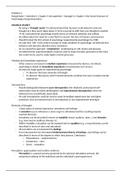
WILHELM WUNDT
- By using a “thought meter” he demonstrated that humans could attend to only one
thought at a time and it takes about 1/10 of a second to shift from one thought to another
He concluded that psychology should stress on selective attention and volition
- He talked about the need for a new field to uncover the facts of human consciousness
- Wundt formed the first school of psychology (experimental psychology) by 1980
- He said that “will” is the central concept of major problems in psychology, he believed that
behavior and selective attention were motivated
- So, he named his approach “voluntarism” emphasizing on will, choice and purpose
- He believed that experimentations could be used to study the basic processes of the mind
but could not be used to study higher mental processes
Mediate and immediate experience:
- Other sciences are based on mediate experience (measured by devices, not direct),
psychology is based on immediate experience (consciousness as it occurs)
- He had two major goals for experimental psychology:
o To discover the basic elements of thought
o To discover the laws by which mental elements combine into more complex mental
experiences
Introspection:
- Wundt distinguished between pure introspection: the relatively unstructured self-
observation used by earlier philosophers and experimental introspection: which he
believed to be scientifically respectable
- He said introspection could be used to study immediate experiences but not higher
processes, they are beyond reach of introspection or any experimental technique
Elements of thought:
- 2 basic types of mental experience: sensations and feelings
- A sensation occurs whenever a sense organ is stimulated and the resulting impulse
reached the brain
- Sensations can be described in terms of modality (visual, auditory, taste…) and intensity
(e.g. how loud an auditory stimulus is)
- Within modality a sensation can be analyzed into its qualities (e.g. a visual stimulus can be
described in terms of color and saturation)
- All sensations are accompanied by feelings
- From introspection he formulated tridimensional theory of feelings: any feelings can be
described in terms of the degree to which they possess 3 attributes:
o Pleasantness – unpleasantness
o Excitement – calm
o Strain – relaxation
Perception, apperception and creative synthesis
- Perception is a passive process governed by the physical stimulation present, the
anatomical makeup of the individual and the individual’s past experiences
, - These 3 influences interact and determine the person’s perceptual field
- The part of the perceptual field the person attends to is apperceived, what is attended to is
apperceived
- Perception is passive and automatic but apperception is active and voluntary so it is under
the person’s control
- When elements are attended to, they can be arranged and rearranged according to the
individual’s will, this phenomenon is called creative synthesis
- Wundt viewed the mind as creative, dynamic, active and volitional
- He believed that the apperceptive process is vital for mental functioning, he even
speculated that schizophrenia could be a result of a breakdown in the attentional
processes
- In explaining how sensations combined into perceptions he used associationism
- With apperception, he emphasized attention, thinking and creative synthesis (closely
aligned with rationalist tradition)
Mental chronometry:
- Wundt believed that reaction time could supplement introspection as a technique to study
how long it takes to perform various mental operations
- Donders:
o Discrimination: responding to only one stimulus
o Choice reaction time: several different stimuli and responding to each differently
- Wundt used Donders’s methods to provide a mental chronometry
- However: reactions times varied between subjects and studies, it was too complicated
Psychological vs physical causation:
- Psychological and physical causality are polar opposites
- Physical causality is predicted from antecedent conditions and psychological events are not
- Intentions are willfully created so they can’t be predicted in terms of physical causation
- Principle of the heterogony of ends: a goal directed activity seldom attains its goals and
nothing else, something unexpected happens and in turn one’s motivational pattern
changes
o Makes prediction of psychological events impossible
- Principle of contrasts: opposite experiences intensify one another, explains the complexity
of psychological experiences e.g. after a painful experience pleasure is more pleasurable
- Principle toward the development of opposites: after a prolonged experience of one type
there is an increased tendency to seek opposite type of experience
Völkerpsychologie (cultural psychology):
- Wundt was a determinist (also reflects a rationalist tradition) and didn’t believe in free will
- Behind all volitional acts are mental laws acting on the contents of consciousness
- These laws are unconscious and complex and can’t be deduced by introspection
- According to Wundt higher mental processes can be deduced from studying cultural
products like religion, social customs, myths, history, language, morals, arts and law
- Verbal communication in 3 steps:
o The speaker must apperceive his/her general impression
o The speaker chooses words and sentences structures to express the general
impression
o The listener must apperceive the speaker’s general impression
Hergenhahn + Valentine E. Chapter 5 Introspection + Danziger K. Chapter 4 the Social Structure of
Psychological Experimentation
WILHELM WUNDT
- By using a “thought meter” he demonstrated that humans could attend to only one
thought at a time and it takes about 1/10 of a second to shift from one thought to another
He concluded that psychology should stress on selective attention and volition
- He talked about the need for a new field to uncover the facts of human consciousness
- Wundt formed the first school of psychology (experimental psychology) by 1980
- He said that “will” is the central concept of major problems in psychology, he believed that
behavior and selective attention were motivated
- So, he named his approach “voluntarism” emphasizing on will, choice and purpose
- He believed that experimentations could be used to study the basic processes of the mind
but could not be used to study higher mental processes
Mediate and immediate experience:
- Other sciences are based on mediate experience (measured by devices, not direct),
psychology is based on immediate experience (consciousness as it occurs)
- He had two major goals for experimental psychology:
o To discover the basic elements of thought
o To discover the laws by which mental elements combine into more complex mental
experiences
Introspection:
- Wundt distinguished between pure introspection: the relatively unstructured self-
observation used by earlier philosophers and experimental introspection: which he
believed to be scientifically respectable
- He said introspection could be used to study immediate experiences but not higher
processes, they are beyond reach of introspection or any experimental technique
Elements of thought:
- 2 basic types of mental experience: sensations and feelings
- A sensation occurs whenever a sense organ is stimulated and the resulting impulse
reached the brain
- Sensations can be described in terms of modality (visual, auditory, taste…) and intensity
(e.g. how loud an auditory stimulus is)
- Within modality a sensation can be analyzed into its qualities (e.g. a visual stimulus can be
described in terms of color and saturation)
- All sensations are accompanied by feelings
- From introspection he formulated tridimensional theory of feelings: any feelings can be
described in terms of the degree to which they possess 3 attributes:
o Pleasantness – unpleasantness
o Excitement – calm
o Strain – relaxation
Perception, apperception and creative synthesis
- Perception is a passive process governed by the physical stimulation present, the
anatomical makeup of the individual and the individual’s past experiences
, - These 3 influences interact and determine the person’s perceptual field
- The part of the perceptual field the person attends to is apperceived, what is attended to is
apperceived
- Perception is passive and automatic but apperception is active and voluntary so it is under
the person’s control
- When elements are attended to, they can be arranged and rearranged according to the
individual’s will, this phenomenon is called creative synthesis
- Wundt viewed the mind as creative, dynamic, active and volitional
- He believed that the apperceptive process is vital for mental functioning, he even
speculated that schizophrenia could be a result of a breakdown in the attentional
processes
- In explaining how sensations combined into perceptions he used associationism
- With apperception, he emphasized attention, thinking and creative synthesis (closely
aligned with rationalist tradition)
Mental chronometry:
- Wundt believed that reaction time could supplement introspection as a technique to study
how long it takes to perform various mental operations
- Donders:
o Discrimination: responding to only one stimulus
o Choice reaction time: several different stimuli and responding to each differently
- Wundt used Donders’s methods to provide a mental chronometry
- However: reactions times varied between subjects and studies, it was too complicated
Psychological vs physical causation:
- Psychological and physical causality are polar opposites
- Physical causality is predicted from antecedent conditions and psychological events are not
- Intentions are willfully created so they can’t be predicted in terms of physical causation
- Principle of the heterogony of ends: a goal directed activity seldom attains its goals and
nothing else, something unexpected happens and in turn one’s motivational pattern
changes
o Makes prediction of psychological events impossible
- Principle of contrasts: opposite experiences intensify one another, explains the complexity
of psychological experiences e.g. after a painful experience pleasure is more pleasurable
- Principle toward the development of opposites: after a prolonged experience of one type
there is an increased tendency to seek opposite type of experience
Völkerpsychologie (cultural psychology):
- Wundt was a determinist (also reflects a rationalist tradition) and didn’t believe in free will
- Behind all volitional acts are mental laws acting on the contents of consciousness
- These laws are unconscious and complex and can’t be deduced by introspection
- According to Wundt higher mental processes can be deduced from studying cultural
products like religion, social customs, myths, history, language, morals, arts and law
- Verbal communication in 3 steps:
o The speaker must apperceive his/her general impression
o The speaker chooses words and sentences structures to express the general
impression
o The listener must apperceive the speaker’s general impression