Management, Leadership and
Entrepreneurship
Entrepreneurs vs Intrepreneurs
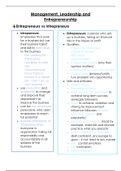
• Intrepreneurs: • Entrepreneurs: a person who sets
employees that work up a business, taking on financial
for a business but use risks in the hopes of profit
their business talent • Qualities:
and skill to add value - Passionate Visionaries
to the business - Creative Thinkers
- Not working for - Risk takers
themselves - Good leaders
- Less likely to take - Independent spirits (only their
risks opinion matters)
- Circumstances - Perseverance and commitment
force them to - Opportunists (propourtunists:
remain in a stable turn problem into opportunity)
job – don’t set up • Skills and attitudes
own business - Results driven
• use innovation and - Formulate a vision
leadership to change - Build success on teamwork to
and improve their achieve long term success
department to (energise followers)
improve the business - Drive to achieve, ambition and
• can be any employee striving for improvement
• persuasive, who assist - Influence followers – inspire,
employees to reach gain trust, respect (not
full potential popularity)
• Business philosophy of - Honesty and integrity. (lead by
intrepreneurship: example, share risk and reward,
everyone in practice what you preach)
organisation taking full - Instil confidence in followers
responsibility and (Self-confident, encourage to
accountability in all grow – if not: lead to low morale
spheres of the - EQ – control emotions
business - Self-motivation
- Follow-through
, Management and Leadership
- Management: controlling the situation, event, or person
- Involves:
- Planning
- Organising
- Controlling
- Leading
• Differences:
- Manager: given authority by being appointed to a position
- Leadership: have authority/power regardless of position (due
to his real/perceived expertise)
• Different Styles:
- Different styles can be applied to different situations – should
analyse this to determine effectiveness
- Styles:
o Autocratic:
- Manager is only person making decisions
- Associated with second wave management approach
- Positive: can be used to restore discipline or gain back
lost respect
- Negative: employees have low morale, feel
undervalued, self-destructive for organisation
o Democratic/Participative:
- Cannot have a one-step transformation to fully
democratic – chaos
- Ranges: leaders allowing feedback to allowing
suggestion while leader maintains control
- Fully democratic: leaders and followers have equal
decision-making powers
- Fully Participative: followers have full control and are
able to make final decision
- Positive: ensures buy-in & commitment from people
involved in process
- Negative: lead to slower decision making when
manager allows participation from all parties
Entrepreneurship
Entrepreneurs vs Intrepreneurs
• Intrepreneurs: • Entrepreneurs: a person who sets
employees that work up a business, taking on financial
for a business but use risks in the hopes of profit
their business talent • Qualities:
and skill to add value - Passionate Visionaries
to the business - Creative Thinkers
- Not working for - Risk takers
themselves - Good leaders
- Less likely to take - Independent spirits (only their
risks opinion matters)
- Circumstances - Perseverance and commitment
force them to - Opportunists (propourtunists:
remain in a stable turn problem into opportunity)
job – don’t set up • Skills and attitudes
own business - Results driven
• use innovation and - Formulate a vision
leadership to change - Build success on teamwork to
and improve their achieve long term success
department to (energise followers)
improve the business - Drive to achieve, ambition and
• can be any employee striving for improvement
• persuasive, who assist - Influence followers – inspire,
employees to reach gain trust, respect (not
full potential popularity)
• Business philosophy of - Honesty and integrity. (lead by
intrepreneurship: example, share risk and reward,
everyone in practice what you preach)
organisation taking full - Instil confidence in followers
responsibility and (Self-confident, encourage to
accountability in all grow – if not: lead to low morale
spheres of the - EQ – control emotions
business - Self-motivation
- Follow-through
, Management and Leadership
- Management: controlling the situation, event, or person
- Involves:
- Planning
- Organising
- Controlling
- Leading
• Differences:
- Manager: given authority by being appointed to a position
- Leadership: have authority/power regardless of position (due
to his real/perceived expertise)
• Different Styles:
- Different styles can be applied to different situations – should
analyse this to determine effectiveness
- Styles:
o Autocratic:
- Manager is only person making decisions
- Associated with second wave management approach
- Positive: can be used to restore discipline or gain back
lost respect
- Negative: employees have low morale, feel
undervalued, self-destructive for organisation
o Democratic/Participative:
- Cannot have a one-step transformation to fully
democratic – chaos
- Ranges: leaders allowing feedback to allowing
suggestion while leader maintains control
- Fully democratic: leaders and followers have equal
decision-making powers
- Fully Participative: followers have full control and are
able to make final decision
- Positive: ensures buy-in & commitment from people
involved in process
- Negative: lead to slower decision making when
manager allows participation from all parties