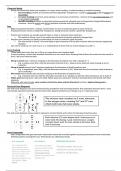
Chemical Bonds
o Atoms can chemically bond (join together) in 3 ways: ionic bonding, covalent bonding or metallic bonding.
• Ionic bonding involves an attraction between oppositely charged ions - found in compounds made of metals and
non-metals.
• Covalent bonding involves 2 atoms sharing 1 or more pairs of electrons - found in most non-metal elements and
in non-metal compounds.
• Metallic bonding involves an attraction between positively charged ions and negatively charged delocalised
electrons - found in metals and alloys (mixtures of metals and other substances).
Ions
o Ions are particles that have a charge, created when an atom or molecule gains or loses electrons.
o Gaining electrons creates a negatively charged ion; losing electrons creates a positively charged ion.
o Positive ions (cations) are usually created when an atom or molecule loses electrons.
• The metals in Group 1 and 2 can easily lose electrons to become positively charged ions.
o Negative ions (anions) are usually created when an atom or molecule gains electrons.
• The non-metals in Group 7 are most likely to gain electrons to fill up their electron shell and become negatively
charged.
o Ions can be made up of 1 atom (e.g. F -), or combinations of atoms with an overall charge (e.g. SO 42-).
Ionic Bonding
o When atoms form ions, they try to fill up or empty their outer electron shell.
o In ionic bonding, a metal atom transfers electrons to a non-metal atom, allowing both of them (the metal and non-metal) to
have a full outer electron shell.
o Group 1 metals lose 1 electron resulting in the formation of positive ions with a charge of +1.
• E.g. a sodium atom (Na), with the electronic structure (2,8,1), loses its outer electron when forming an ion to
make Na+.
o Group 2 metals always lose 2 electrons resulting in the formation of doubly positive ions.
• E.g. a magnesium atom (Mg), with the electronic structure (2,8,2), loses both its outer electrons when forming an
ion to make Mg2+.
o Non-metal atoms always gain electrons resulting in the formation of negative ions.
• E.g. a fluorine atom (F), with the electronic structure (2,7), will gain an electron when forming an ion to make F -.
o Noble gases already have a full outer shell. Noble gases are unreactive and don't normally form ionic bonds with other
elements.
o Materials with ionic bonds: only conduct electricity when molten/dissolved and have high melting points.
Dot-and-Cross Diagrams
Dot-and-cross diagrams can show electrons being transferred and ions being formed. Dots represent electrons from 1 atom
and crosses represent electrons from the other atom. Square brackets and a charge (e.g. 2+) represent ions.
The calcium atom transfers its 2 outer electrons
to the oxygen atom, creating Ca 2+and O2- ions
which both have full outer shells.
Dot-and-cross diagrams can be used to represent covalent bonds and to show the sharing of electron pairs.
Each chlorine (Cl) atom begins with 7 electrons in its
outer shell. By sharing 1 pair of electrons in a single
covalent bond, each Cl atom obtains a full outer shell
with 8 electrons.
Ionic Compounds
o Ionic compounds form giant structures called ionic lattices that are held together by strong electrostatic forces of attraction
between positive and negative ions. These forces are called ionic bonds.
o Atoms can chemically bond (join together) in 3 ways: ionic bonding, covalent bonding or metallic bonding.
• Ionic bonding involves an attraction between oppositely charged ions - found in compounds made of metals and
non-metals.
• Covalent bonding involves 2 atoms sharing 1 or more pairs of electrons - found in most non-metal elements and
in non-metal compounds.
• Metallic bonding involves an attraction between positively charged ions and negatively charged delocalised
electrons - found in metals and alloys (mixtures of metals and other substances).
Ions
o Ions are particles that have a charge, created when an atom or molecule gains or loses electrons.
o Gaining electrons creates a negatively charged ion; losing electrons creates a positively charged ion.
o Positive ions (cations) are usually created when an atom or molecule loses electrons.
• The metals in Group 1 and 2 can easily lose electrons to become positively charged ions.
o Negative ions (anions) are usually created when an atom or molecule gains electrons.
• The non-metals in Group 7 are most likely to gain electrons to fill up their electron shell and become negatively
charged.
o Ions can be made up of 1 atom (e.g. F -), or combinations of atoms with an overall charge (e.g. SO 42-).
Ionic Bonding
o When atoms form ions, they try to fill up or empty their outer electron shell.
o In ionic bonding, a metal atom transfers electrons to a non-metal atom, allowing both of them (the metal and non-metal) to
have a full outer electron shell.
o Group 1 metals lose 1 electron resulting in the formation of positive ions with a charge of +1.
• E.g. a sodium atom (Na), with the electronic structure (2,8,1), loses its outer electron when forming an ion to
make Na+.
o Group 2 metals always lose 2 electrons resulting in the formation of doubly positive ions.
• E.g. a magnesium atom (Mg), with the electronic structure (2,8,2), loses both its outer electrons when forming an
ion to make Mg2+.
o Non-metal atoms always gain electrons resulting in the formation of negative ions.
• E.g. a fluorine atom (F), with the electronic structure (2,7), will gain an electron when forming an ion to make F -.
o Noble gases already have a full outer shell. Noble gases are unreactive and don't normally form ionic bonds with other
elements.
o Materials with ionic bonds: only conduct electricity when molten/dissolved and have high melting points.
Dot-and-Cross Diagrams
Dot-and-cross diagrams can show electrons being transferred and ions being formed. Dots represent electrons from 1 atom
and crosses represent electrons from the other atom. Square brackets and a charge (e.g. 2+) represent ions.
The calcium atom transfers its 2 outer electrons
to the oxygen atom, creating Ca 2+and O2- ions
which both have full outer shells.
Dot-and-cross diagrams can be used to represent covalent bonds and to show the sharing of electron pairs.
Each chlorine (Cl) atom begins with 7 electrons in its
outer shell. By sharing 1 pair of electrons in a single
covalent bond, each Cl atom obtains a full outer shell
with 8 electrons.
Ionic Compounds
o Ionic compounds form giant structures called ionic lattices that are held together by strong electrostatic forces of attraction
between positive and negative ions. These forces are called ionic bonds.