NSG 6005 Advanced Pharmacology FL02 Week 9 Completed A
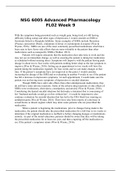
NSG 6005 Advanced Pharmacology FL02 Week 9 With the symptoms being presented such as weight gain, being tired yet still having difficulty falling asleep and other signs of depression, I would consider an SSRI or Serotonin-Selective Reuptake Inhibitor. Some examples of SSRIs include fluoxetine (Prozac), paroxetine (Paxil), citalopram (Celexa) or escitalopram (Lexapro) (Woo & Wynne, 2016). SSRIs are one of the most commonly prescribed medications which have been seen to have fewer side effects that are more tolerable to the patient than other medications such as nonspecific SNRIs (Walker, 2013). Patients will require education that the medication does take time to work and she may not see an immediate change, as well as ensuring the patient is taking her medication as scheduled without missing doses. Symptoms will improve with the patient having peak dosage in about two to four weeks with patients nothing better sleep as the last symptom to improve (Woo & Wynne, 2016). Setting up an appointment in two weeks will have the patient taking the medication regularly for four weeks and we can make changes at that time. If the patient’s symptoms have not improved at this point, I would consider increasing the dosage of the SSRI and re-evaluating in another 4 weeks to see if the patient has felt a decrease in depression symptoms. At each appointment, I would make sure the patient was not having more symptoms of depression or suicidal ideations. Though SSRIs have safer side effects than other antidepressant medications, they do still have some adverse reactions. Some of the adverse drug reactions or side effects of SSRIs were restlessness, drowsiness, constipation, and anxiety (Woo & Wynne, 2016). Considering she denied suicidal ideations but did make a statement that is concerning of her “husband and kids would go on fine without her”, it would be important to also continue evaluation for suicidal ideation that has led to the FDA black box warning on antidepressants (Woo & Wynne, 2016). There have also been reports of a decrease in sexual desire or absent orgasm which may deter some patients who are prescribed the medication. When a patient is beginning the medications, prior to changes being made to the medication, the patient should take the prescribed medication for a full four to six weeks to determine if the original medication is ineffective before changing dosages or medications entirely. As part of the initial education, patients should be aware that they will be taking the prescribed medication for at least one year, and then a tapering off the medication to see if the patient’s symptoms return (Woo & Wynne, 2016). References Walker, F. R. (2013). A critical review of the mechanism of action for the selective serotonin reuptake inhibitors: Do these drugs possess anti-inflammatory properties and how relevant is this in the treatment of depression? Neuropharmacology, 67, 304-317. doi:10.1016/pharm.2012.`0.002 Woo, T. M., & Wynne, A. L. (2016). Pharmacotherapeutics for nurse practitioner prescribers. Philadelphia, PA: F.A. Davis. Retrieved from
Escuela, estudio y materia
- Institución
- South University
- Grado
- NSG 6005
Información del documento
- Subido en
- 25 de octubre de 2020
- Número de páginas
- 2
- Escrito en
- 2020/2021
- Tipo
- Study guide
Temas
-
i would consider
-
nsg 6005 advanced pharmacology fl02 week 9 with the symptoms being presented such as weight gain
-
being tired yet still having difficulty falling asleep and other signs of depression

Documento también disponible en un lote