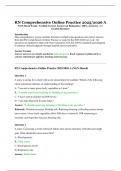
RN Comprehensive Online Practice 2025/2026 A
NGN-Based Exam | Verified Correct Answers & Rationales | 100% Accuracy | A+
Graded Resource
Introduction
This comprehensive review includes the latest verified exam questions and correct answers
from the RN Comprehensive Online Practice A exam for the 2025/2026 test cycle. All
questions are updated to align with Next Generation NCLEX (NGN) standards and designed
to enhance clinical judgment through detailed answer rationales.
Answer Format
Correct answers are clearly marked in bold and green. Each response is followed by a
concise rationale for effective learning and test prep.
RN Comprehensive Online Practice 2025/2026 A (NGN-Based)
Question 1
A nurse is caring for a client with a new prescription for warfarin. Which of the following
client statements indicates an understanding of the teaching?
A. "I can eat as many green leafy vegetables as I want."
B. "I should report any bruising or bleeding to my provider."
C. "I don’t need to monitor my INR levels."
D. "I can take ibuprofen for pain relief."
Answer: "I should report any bruising or bleeding to my provider."
Rationale: Warfarin increases bleeding risk. Reporting bruising or bleeding ensures timely
intervention. Green leafy vegetables affect INR due to vitamin K, INR monitoring is
essential, and ibuprofen increases bleeding risk.
Question 2
A nurse is assessing a client with heart failure who reports shortness of breath and weight
gain. What should the nurse assess first?
A. Blood pressure
B. Fluid status
C. Blood glucose levels
D. Respiratory rate
Answer: Fluid status
,Rationale: Shortness of breath and weight gain suggest fluid overload, a common
complication in heart failure, requiring immediate fluid status assessment.
Question 3
A client with type 1 diabetes mellitus reports shakiness and confusion. What is the nurse’s
priority action?
A. Administer insulin
B. Check blood glucose levels
C. Provide a high-carbohydrate snack
D. Monitor vital signs
Answer: Check blood glucose levels
Rationale: Shakiness and confusion indicate possible hypoglycemia. Checking blood glucose
levels confirms the diagnosis before intervention.
Question 4
A nurse is providing discharge teaching for a client with a new implantable cardioverter
defibrillator (ICD). Which client statement indicates understanding?
A. "I can hold my cellphone on the same side as my ICD."
B. "I will wear loose clothing around my ICD."
C. "I will avoid showering to keep my ICD dry."
D. "I can use my microwave without restrictions."
Answer: "I will wear loose clothing around my ICD."
Rationale: Loose clothing prevents irritation at the ICD site. Cellphones should be held on
the opposite side, showering is allowed, and microwaves are safe.
Question 5
A client with chronic obstructive pulmonary disease (COPD) reports increased dyspnea and
wheezing. What is the priority nursing action?
A. Administer a corticosteroid
B. Administer a rescue inhaler
C. Obtain a peak flow reading
D. Position in high Fowler’s
Answer: Administer a rescue inhaler
Rationale: A rescue inhaler provides rapid bronchodilation for acute COPD symptoms like
dyspnea and wheezing.
,Question 6
A nurse is caring for a client with a new arteriovenous fistula. Which finding should the nurse
report immediately?
A. Thrill upon palpation
B. Absence of a bruit
C. Distended blood vessels
D. Swishing sound upon auscultation
Answer: Absence of a bruit
Rationale: Absence of a bruit indicates possible fistula occlusion, requiring immediate
reporting. A thrill and swishing sound are normal findings.
Question 7
A client at 14 weeks gestation reports ambivalence about the pregnancy. What is the nurse’s
best response?
A. "This is a normal feeling during early pregnancy."
B. "Can you tell me more about how you’re feeling?"
C. "You should discuss this with your healthcare provider."
D. "You’ll feel better once the baby arrives."
Answer: "Can you tell me more about how you’re feeling?"
Rationale: Exploring the client’s feelings promotes therapeutic communication and assesses
emotional needs.
Question 8
A nurse is caring for a client with rheumatoid arthritis prescribed adalimumab. What should
the nurse teach?
A. Take with meals
B. Report signs of infection
C. Avoid physical activity
D. Monitor blood pressure daily
Answer: Report signs of infection
Rationale: Adalimumab, a biologic, increases infection risk, requiring monitoring for
symptoms like fever.
Question 9
A client with chronic kidney disease reports muscle cramps and weakness. What should the
, nurse assess first?
A. Blood glucose levels
B. Electrolyte levels
C. Blood pressure
D. Respiratory rate
Answer: Electrolyte levels
Rationale: Muscle cramps and weakness in CKD suggest electrolyte imbalances like
hyperkalemia or hypocalcemia.
Question 10
A nurse is providing teaching for a client with a new prescription for furosemide. What
should the nurse include?
A. Increase sodium intake
B. Report signs of hypokalemia
C. Take at bedtime
D. Avoid potassium-rich foods
Answer: Report signs of hypokalemia
Rationale: Furosemide, a loop diuretic, can cause hypokalemia, requiring monitoring for
symptoms like muscle cramps.
Question 11
A client with a history of stroke reports difficulty with speech. What is the priority nursing
action?
A. Encourage speech practice
B. Consult a speech therapist
C. Administer analgesics
D. Monitor vital signs
Answer: Consult a speech therapist
Rationale: A speech therapist evaluates and treats speech difficulties post-stroke.
Question 12
A nurse is caring for a client with atrial fibrillation prescribed amiodarone. What should the
nurse monitor?
A. Blood glucose levels
B. Thyroid function
NGN-Based Exam | Verified Correct Answers & Rationales | 100% Accuracy | A+
Graded Resource
Introduction
This comprehensive review includes the latest verified exam questions and correct answers
from the RN Comprehensive Online Practice A exam for the 2025/2026 test cycle. All
questions are updated to align with Next Generation NCLEX (NGN) standards and designed
to enhance clinical judgment through detailed answer rationales.
Answer Format
Correct answers are clearly marked in bold and green. Each response is followed by a
concise rationale for effective learning and test prep.
RN Comprehensive Online Practice 2025/2026 A (NGN-Based)
Question 1
A nurse is caring for a client with a new prescription for warfarin. Which of the following
client statements indicates an understanding of the teaching?
A. "I can eat as many green leafy vegetables as I want."
B. "I should report any bruising or bleeding to my provider."
C. "I don’t need to monitor my INR levels."
D. "I can take ibuprofen for pain relief."
Answer: "I should report any bruising or bleeding to my provider."
Rationale: Warfarin increases bleeding risk. Reporting bruising or bleeding ensures timely
intervention. Green leafy vegetables affect INR due to vitamin K, INR monitoring is
essential, and ibuprofen increases bleeding risk.
Question 2
A nurse is assessing a client with heart failure who reports shortness of breath and weight
gain. What should the nurse assess first?
A. Blood pressure
B. Fluid status
C. Blood glucose levels
D. Respiratory rate
Answer: Fluid status
,Rationale: Shortness of breath and weight gain suggest fluid overload, a common
complication in heart failure, requiring immediate fluid status assessment.
Question 3
A client with type 1 diabetes mellitus reports shakiness and confusion. What is the nurse’s
priority action?
A. Administer insulin
B. Check blood glucose levels
C. Provide a high-carbohydrate snack
D. Monitor vital signs
Answer: Check blood glucose levels
Rationale: Shakiness and confusion indicate possible hypoglycemia. Checking blood glucose
levels confirms the diagnosis before intervention.
Question 4
A nurse is providing discharge teaching for a client with a new implantable cardioverter
defibrillator (ICD). Which client statement indicates understanding?
A. "I can hold my cellphone on the same side as my ICD."
B. "I will wear loose clothing around my ICD."
C. "I will avoid showering to keep my ICD dry."
D. "I can use my microwave without restrictions."
Answer: "I will wear loose clothing around my ICD."
Rationale: Loose clothing prevents irritation at the ICD site. Cellphones should be held on
the opposite side, showering is allowed, and microwaves are safe.
Question 5
A client with chronic obstructive pulmonary disease (COPD) reports increased dyspnea and
wheezing. What is the priority nursing action?
A. Administer a corticosteroid
B. Administer a rescue inhaler
C. Obtain a peak flow reading
D. Position in high Fowler’s
Answer: Administer a rescue inhaler
Rationale: A rescue inhaler provides rapid bronchodilation for acute COPD symptoms like
dyspnea and wheezing.
,Question 6
A nurse is caring for a client with a new arteriovenous fistula. Which finding should the nurse
report immediately?
A. Thrill upon palpation
B. Absence of a bruit
C. Distended blood vessels
D. Swishing sound upon auscultation
Answer: Absence of a bruit
Rationale: Absence of a bruit indicates possible fistula occlusion, requiring immediate
reporting. A thrill and swishing sound are normal findings.
Question 7
A client at 14 weeks gestation reports ambivalence about the pregnancy. What is the nurse’s
best response?
A. "This is a normal feeling during early pregnancy."
B. "Can you tell me more about how you’re feeling?"
C. "You should discuss this with your healthcare provider."
D. "You’ll feel better once the baby arrives."
Answer: "Can you tell me more about how you’re feeling?"
Rationale: Exploring the client’s feelings promotes therapeutic communication and assesses
emotional needs.
Question 8
A nurse is caring for a client with rheumatoid arthritis prescribed adalimumab. What should
the nurse teach?
A. Take with meals
B. Report signs of infection
C. Avoid physical activity
D. Monitor blood pressure daily
Answer: Report signs of infection
Rationale: Adalimumab, a biologic, increases infection risk, requiring monitoring for
symptoms like fever.
Question 9
A client with chronic kidney disease reports muscle cramps and weakness. What should the
, nurse assess first?
A. Blood glucose levels
B. Electrolyte levels
C. Blood pressure
D. Respiratory rate
Answer: Electrolyte levels
Rationale: Muscle cramps and weakness in CKD suggest electrolyte imbalances like
hyperkalemia or hypocalcemia.
Question 10
A nurse is providing teaching for a client with a new prescription for furosemide. What
should the nurse include?
A. Increase sodium intake
B. Report signs of hypokalemia
C. Take at bedtime
D. Avoid potassium-rich foods
Answer: Report signs of hypokalemia
Rationale: Furosemide, a loop diuretic, can cause hypokalemia, requiring monitoring for
symptoms like muscle cramps.
Question 11
A client with a history of stroke reports difficulty with speech. What is the priority nursing
action?
A. Encourage speech practice
B. Consult a speech therapist
C. Administer analgesics
D. Monitor vital signs
Answer: Consult a speech therapist
Rationale: A speech therapist evaluates and treats speech difficulties post-stroke.
Question 12
A nurse is caring for a client with atrial fibrillation prescribed amiodarone. What should the
nurse monitor?
A. Blood glucose levels
B. Thyroid function