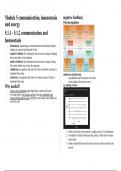
odule 5 communication, homeostasis
M negative feedback
Thermoregulation
and energy
5.1.1 - 5.1.2 communication and
homeostasis
- h omeostasis:maintaining a constant internal environment despite
changes in external and internal factors
- negative feedback:the mechanism that reverses a change, bringing
the system back to the optimum
- positive feedback:the mechanism that increases achange, taking
the system further away from the optimum
- endotherm:an organism that uses heat from metabolic reacitons to
maintain body temp endotherm at high temp
- ectotherm:an organism that relies on external sources of heat to - vasodilation near the surface of the skin
maintain body temp - sweat glands release more sweat
e.g. during exercise
Why needed?
- e nzyme may denaturedunder high temp / extreme pHlevels
- low temp lead tolow enzyme activityandslow metabolic rate
- regulate blood glucose conc.and prevent too muchwater diffuse in/
out of the cell
. b
1 lood is directed to the muscles to supply more O2 for respiration
2. vasodilation to direct blood near the surface of the skin to release
excess heat
3. balance achieved between heat loss and excess heat created in the
muscle
,endotherm at low temp
- vasoconstriction near the surface of skin to reduce heat loss to
positive feedback
surrounding blood clot
- erector muscle contract causing hair to stand up to trap air 1. p latelets are activated and releases a chemical, which triggers more
platelets to be activated
- skeletal muslce contract and relax involuntarily to create heat in the 2. a blood clot can then form at injury site
muslce 3. the body detects the blood clot, negative feedback is applied to stop
- sweat glands release less sweat activating platelets
ectotherm
- they also have thermoregulation mechanism, but not the same as
endotherm
blood glucose regulation
endocrine system
- glands secrete chemicals into blood to affect specific target organs
exocrine system
- glands secrete chemicals into the blood
,5.2.1 excretion 5.2.2 - 5.2.3 liver
- e xcretion:the removal and disposal of the body’smetabolic waste
products
functions
breaking down excess amino acid
organs involved in excretion 1. a mino groups (-NH2) are removedfrom amino acid, formingNH3
- k idney removes urea from excess amino acid via deamination and organic acidsthrough deamination
- skin remove sweat that contains salt and urea 2. organic acids are respired to give ATP, or converted to carbohydrates
- lungs remove CO2 via respiration and stored as glycogen
- liver removes excess amino acid via deamination and bile pigment 3. NH3 combines with CO2 to create urea in the ornithinecycle
4. urea is released into the blood, and kidney filter the blood to excrete
CO2 removal during respiration urea as urine
1 . O2 diffuse down the conc. gradient from the plasmato the RBC
C alcohol detoxification
2. CO2 reacts with H2O to form H2C O3 with carbonic anhydrase
. e thanol is broken down into ethanal using ethanol dehydrogenase
1
3. H2 CO3 dissociates to form HCO3- and H+ 2. ethanal is then converted into acetate using ethanal dehydrogenase
4. HCO3- diffuse out of RBC, Cl- diffuse into RBC (chlorideshift) to 3. Co-enzyme A is added to acetate forming Acetyl-CoA, which is used
balance the charge in the RBC in kerbs cycle
5. H+ react with oxyhaemoglobin by reducing haemoglobinaffinity,
leading to O2 is release and diffuse into cells forrespiration stores glycogen
- liver converts excess glucose into glycogen and stores it in the cell
structure of liver
, 5.2.4 kidney 5.2.8 kidney failure
- it is used to excrete waste products, e.g. urea, and regulate water - it can be detected by glomerular filtration rate (GFR)
potential of blood
- nephron:the functional unit of kidney health problems
Too much urea
- Vomiting and weight loss
Process of producing urine Too much H2O
- Parts of the body swelling
Too much electrolytes (ions)
- Blood become acidic
- Imbalance of calcium and phosphate causing brittle bones
- Salt build up causing more H2O retention
- K+ ion conc. Increase causing frequency of impulsefrom SAN in
heart decrease, causing arrhythmia and heart attack
Treatment of kidney failure
Haemodialysis
1. P atient’s blood flows into one side of the dialysis machine, whereas
the dialysis fluid flows on the other side, they are separated by a
partially permeable membrane
2. Waste product, ions, and H2O
will then diffuse acrossthe membrane,
leaving the blood
**rmb as blood will also come out → “heamo”dialysis
Peritoneal dialysis
. D
1 ialysis fluid flows into the abdominal cavity of the patients
2. Waste products from the blood will then diffuse into the dialysis
fluid
3. The dialysis fluid will then drained out of the abdominal cavity
through a tube
Kidney transplant
1. A
new kidney is implanted into the patient’s body, replacing the
non-functioning kidney
M negative feedback
Thermoregulation
and energy
5.1.1 - 5.1.2 communication and
homeostasis
- h omeostasis:maintaining a constant internal environment despite
changes in external and internal factors
- negative feedback:the mechanism that reverses a change, bringing
the system back to the optimum
- positive feedback:the mechanism that increases achange, taking
the system further away from the optimum
- endotherm:an organism that uses heat from metabolic reacitons to
maintain body temp endotherm at high temp
- ectotherm:an organism that relies on external sources of heat to - vasodilation near the surface of the skin
maintain body temp - sweat glands release more sweat
e.g. during exercise
Why needed?
- e nzyme may denaturedunder high temp / extreme pHlevels
- low temp lead tolow enzyme activityandslow metabolic rate
- regulate blood glucose conc.and prevent too muchwater diffuse in/
out of the cell
. b
1 lood is directed to the muscles to supply more O2 for respiration
2. vasodilation to direct blood near the surface of the skin to release
excess heat
3. balance achieved between heat loss and excess heat created in the
muscle
,endotherm at low temp
- vasoconstriction near the surface of skin to reduce heat loss to
positive feedback
surrounding blood clot
- erector muscle contract causing hair to stand up to trap air 1. p latelets are activated and releases a chemical, which triggers more
platelets to be activated
- skeletal muslce contract and relax involuntarily to create heat in the 2. a blood clot can then form at injury site
muslce 3. the body detects the blood clot, negative feedback is applied to stop
- sweat glands release less sweat activating platelets
ectotherm
- they also have thermoregulation mechanism, but not the same as
endotherm
blood glucose regulation
endocrine system
- glands secrete chemicals into blood to affect specific target organs
exocrine system
- glands secrete chemicals into the blood
,5.2.1 excretion 5.2.2 - 5.2.3 liver
- e xcretion:the removal and disposal of the body’smetabolic waste
products
functions
breaking down excess amino acid
organs involved in excretion 1. a mino groups (-NH2) are removedfrom amino acid, formingNH3
- k idney removes urea from excess amino acid via deamination and organic acidsthrough deamination
- skin remove sweat that contains salt and urea 2. organic acids are respired to give ATP, or converted to carbohydrates
- lungs remove CO2 via respiration and stored as glycogen
- liver removes excess amino acid via deamination and bile pigment 3. NH3 combines with CO2 to create urea in the ornithinecycle
4. urea is released into the blood, and kidney filter the blood to excrete
CO2 removal during respiration urea as urine
1 . O2 diffuse down the conc. gradient from the plasmato the RBC
C alcohol detoxification
2. CO2 reacts with H2O to form H2C O3 with carbonic anhydrase
. e thanol is broken down into ethanal using ethanol dehydrogenase
1
3. H2 CO3 dissociates to form HCO3- and H+ 2. ethanal is then converted into acetate using ethanal dehydrogenase
4. HCO3- diffuse out of RBC, Cl- diffuse into RBC (chlorideshift) to 3. Co-enzyme A is added to acetate forming Acetyl-CoA, which is used
balance the charge in the RBC in kerbs cycle
5. H+ react with oxyhaemoglobin by reducing haemoglobinaffinity,
leading to O2 is release and diffuse into cells forrespiration stores glycogen
- liver converts excess glucose into glycogen and stores it in the cell
structure of liver
, 5.2.4 kidney 5.2.8 kidney failure
- it is used to excrete waste products, e.g. urea, and regulate water - it can be detected by glomerular filtration rate (GFR)
potential of blood
- nephron:the functional unit of kidney health problems
Too much urea
- Vomiting and weight loss
Process of producing urine Too much H2O
- Parts of the body swelling
Too much electrolytes (ions)
- Blood become acidic
- Imbalance of calcium and phosphate causing brittle bones
- Salt build up causing more H2O retention
- K+ ion conc. Increase causing frequency of impulsefrom SAN in
heart decrease, causing arrhythmia and heart attack
Treatment of kidney failure
Haemodialysis
1. P atient’s blood flows into one side of the dialysis machine, whereas
the dialysis fluid flows on the other side, they are separated by a
partially permeable membrane
2. Waste product, ions, and H2O
will then diffuse acrossthe membrane,
leaving the blood
**rmb as blood will also come out → “heamo”dialysis
Peritoneal dialysis
. D
1 ialysis fluid flows into the abdominal cavity of the patients
2. Waste products from the blood will then diffuse into the dialysis
fluid
3. The dialysis fluid will then drained out of the abdominal cavity
through a tube
Kidney transplant
1. A
new kidney is implanted into the patient’s body, replacing the
non-functioning kidney