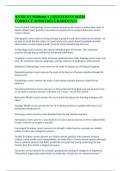
ANTH 311 Midterm 1 || QUESTIONS WITH
CORRECT ANSWERS; GRADED A+!!
Socio-Cultural Anthropology correct answers focused on the current variation that exists in
human culture today; perform cross-cultural comparisons to compare behaviours across
current cultures
Ethnography correct answers living amongst a group to study their culture/social system - an
account of social life and culture in a particular social system based on multiple detailed
observations of what people actually do in the social setting being observed
Archaeology correct answers the cultural anthropologists of the past - they study past
societies through dug up artifacts/art and people (skeletons)
Linguistics correct answers study of human communication; study language across space and
time, the similarities between languages, and the existence of language in other animals
Biological Anthropology correct answers the study of humans as a biological organism
Paleoanthropology correct answers the study of the history of human evolution through the
fossil record
Primatology correct answers the study of non human primates (humans closest living
relatives)
Non Human Primates correct answers we did not descend from them (not our ancestors) but
we do share a common ancestor with them (~5-7 mya) - we are like cousins
Referential Model correct answers the use of particular species for drawing analogies with
others
Strategic Model correct answers the use of evolutionary theory to predict differences and
similarities among species
Homology correct answers a trait inherited from the last common ancestor
Homoplasy correct answers a trait found in 2 or more species that has evolved independently
in each; evolved convergent or parallel
Convergent Evolution correct answers two distantly related species converge on a similar
solution to the same ecological pressures
Parallel Evolution correct answers two similar species (usually with common ancestral
trait(s)) evolve similar traits independently; are more often a closely related species (diverged
from a common ancestor that didn't exhibit the trait) and may end up possessing the trait
because they face similar ecological pressures
Taxonomy correct answers the scientific grouping and naming of categories of organisms;
"hierarchical organizing system based on similarities of traits due to common ancestry" -
, grouped together based on relatedness (morphology, behaviour, vocalizations, genetics, etc.)
- used to distinguish broader categories of organisms (ALWAYS CHANGING)
Taxon correct answers (plural: taxa) single level in the taxonomic classification system
Humans correct answers Homo sapiens (italicized)
Vervet Monkey correct answers Chlorocebus pygerythrus (italicized)
Mammals correct answers the class of primates; endothermic (warm blooded), give birth to
live young, have body hair, young are fed milk from the mammary glands of the mother, and
have three middle ear bones
Lumpers correct answers scientists preferring to lump new fossils into preexisting categories
Splitters correct answers scientists preferring to split new fossils into different species
Primates correct answers the order of humans; although not one ttrait identifies all of them,
they typically have grasping hands and feet, visual system (and associated loss of reliance on
smell), large complex brains (and associated behaviour), and skeletal/dental features
Derived Traits correct answers aka apomorphy; an evolutionary novelty relative to the
ancestral condition - traits that appeared in a group of animals (a taxon or species) AFTER
the last common ancestor
Primitive Traits correct answers aka plesiomorphy; ancestral trait that is shared with the
common ancestor
Primate Hands and Feet correct answers grasping, pentadactyly (5 digits), opposable thumb
(for power grip), nails instead of claws, and sensitive tactile pads (for precision grip, tool use)
Pentadactyly correct answers having 5 digits
Primate Vision correct answers forward facing eyes; stereoscopic vision (allows for depth
perception), greater reliance on vision, elaboration of the visual centres of the brain, colour
vision (only placental mammals with trichromatic colour vision), reduced reliance on smell,
reduction of the olfactory centres of the brain but smell is still important
Primate Brains correct answers large brains relative to body size, learning and socialization
very important for survival, great ability to learn from experience, great reliance on learning,
and reduction on reliance on "instinct"
K-Selection correct answers fewer offspring but greater investment in rearing them, typically
give birth to a single (or few) young (not litters) - cling to mother, not left in nests, longer
juvenile development period (due to reliance on learning)
Sociality correct answers in primates; allows them to learn from one another
CORRECT ANSWERS; GRADED A+!!
Socio-Cultural Anthropology correct answers focused on the current variation that exists in
human culture today; perform cross-cultural comparisons to compare behaviours across
current cultures
Ethnography correct answers living amongst a group to study their culture/social system - an
account of social life and culture in a particular social system based on multiple detailed
observations of what people actually do in the social setting being observed
Archaeology correct answers the cultural anthropologists of the past - they study past
societies through dug up artifacts/art and people (skeletons)
Linguistics correct answers study of human communication; study language across space and
time, the similarities between languages, and the existence of language in other animals
Biological Anthropology correct answers the study of humans as a biological organism
Paleoanthropology correct answers the study of the history of human evolution through the
fossil record
Primatology correct answers the study of non human primates (humans closest living
relatives)
Non Human Primates correct answers we did not descend from them (not our ancestors) but
we do share a common ancestor with them (~5-7 mya) - we are like cousins
Referential Model correct answers the use of particular species for drawing analogies with
others
Strategic Model correct answers the use of evolutionary theory to predict differences and
similarities among species
Homology correct answers a trait inherited from the last common ancestor
Homoplasy correct answers a trait found in 2 or more species that has evolved independently
in each; evolved convergent or parallel
Convergent Evolution correct answers two distantly related species converge on a similar
solution to the same ecological pressures
Parallel Evolution correct answers two similar species (usually with common ancestral
trait(s)) evolve similar traits independently; are more often a closely related species (diverged
from a common ancestor that didn't exhibit the trait) and may end up possessing the trait
because they face similar ecological pressures
Taxonomy correct answers the scientific grouping and naming of categories of organisms;
"hierarchical organizing system based on similarities of traits due to common ancestry" -
, grouped together based on relatedness (morphology, behaviour, vocalizations, genetics, etc.)
- used to distinguish broader categories of organisms (ALWAYS CHANGING)
Taxon correct answers (plural: taxa) single level in the taxonomic classification system
Humans correct answers Homo sapiens (italicized)
Vervet Monkey correct answers Chlorocebus pygerythrus (italicized)
Mammals correct answers the class of primates; endothermic (warm blooded), give birth to
live young, have body hair, young are fed milk from the mammary glands of the mother, and
have three middle ear bones
Lumpers correct answers scientists preferring to lump new fossils into preexisting categories
Splitters correct answers scientists preferring to split new fossils into different species
Primates correct answers the order of humans; although not one ttrait identifies all of them,
they typically have grasping hands and feet, visual system (and associated loss of reliance on
smell), large complex brains (and associated behaviour), and skeletal/dental features
Derived Traits correct answers aka apomorphy; an evolutionary novelty relative to the
ancestral condition - traits that appeared in a group of animals (a taxon or species) AFTER
the last common ancestor
Primitive Traits correct answers aka plesiomorphy; ancestral trait that is shared with the
common ancestor
Primate Hands and Feet correct answers grasping, pentadactyly (5 digits), opposable thumb
(for power grip), nails instead of claws, and sensitive tactile pads (for precision grip, tool use)
Pentadactyly correct answers having 5 digits
Primate Vision correct answers forward facing eyes; stereoscopic vision (allows for depth
perception), greater reliance on vision, elaboration of the visual centres of the brain, colour
vision (only placental mammals with trichromatic colour vision), reduced reliance on smell,
reduction of the olfactory centres of the brain but smell is still important
Primate Brains correct answers large brains relative to body size, learning and socialization
very important for survival, great ability to learn from experience, great reliance on learning,
and reduction on reliance on "instinct"
K-Selection correct answers fewer offspring but greater investment in rearing them, typically
give birth to a single (or few) young (not litters) - cling to mother, not left in nests, longer
juvenile development period (due to reliance on learning)
Sociality correct answers in primates; allows them to learn from one another