PROPERTY OF
VarsityTimes
For more assistance and exclusive, unique assignments, contact us on Telegram:
https://t.me/varsity_times
TAKE YOUR PICK (OPTION A or B)
QUESTION 1
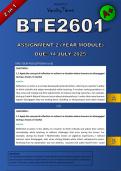
1.1 Apply the concept of reflection-in-action to a situation where learners are disengaged
during a lesson. (5 marks)
ANSWER:
Reflection-in-action is a concept developed by Donald Schön, referring to a teacher’s ability
to think critically and adapt immediately while teaching. It involves noticing problems as
they arise and making real-time adjustments to improve learning outcomes. For example,
during a Grade 4 Natural Sciences lesson about photosynthesis, I notice that many learners
appear disengaged; they are looking down, doodling, or whispering to each other instead
of paying attention. Reflecting in action, I quickly assess that the explanation is too
abstract, lacking practical connection. In response, I pause the theoretical explanation and
shift to an interactive demonstration. I walk outside with learners, pick a leaf from a tree,
QUESTION 1
and show them the stomata under a magnifying glass, linking it back to carbon dioxide
1.1 Apply
intake. the
This conceptresponse
reflective of reflection-in-action to a situation
during the lesson re-engageswhere learners
learners are disengaged
by creating curiosity
during a lesson.
and making (5 marks)
learning tangible. The adaptation not only captures their attention but also
deepens conceptual understanding. Thus, reflection-in-action enabled me to identify
ANSWER:
disengagement, adapt teaching strategies instantly, and improve learner engagement
Reflection-in-action is the ability of a teacher to think critically and adjust their actions
through meaningful, context-based learning.
immediately while teaching to address challenges that arise during the lesson. For
example, during my Grade 7 Mathematics lesson on algebraic expressions, I noticed
learners were disengaged, with some staring blankly while others whispered to peers.
1.2 Using Bronfenbrenner’s theory, describe how one system (e.g., microsystem or
Realising that my explanation was too abstract, I paused and asked myself how I could
macrosystem) might impact learner performance in the classroom. (5 marks)
make the concept relatable. I decided to use learners’ names to create simple algebraic
Bronfenbrenner’s
expressions, such ecological
as “If Thabo has x apples and buys 2 more, how many does he have?”
This reflective response engaged learners instantly as they laughed and paid attention
Disclaimer:
when provided
The materials their names were mentioned.
are intended I then
for educational allowed
and them to
informational createonly.
purposes theirThey
own examples in
should pairs,
not be submitted as original work
bringing relevance and or used in violation
participation intoofthe
any lesson.
academicThus,
institution's
reflection-in-action
policies.helped
The buyer is solely responsible for how the materials are used.
me adapt my teaching on the spot by switching from abstract explanation to
contextual examples, which improved learner engagement by making the content
meaningful and interactive.
VarsityTimes
For more assistance and exclusive, unique assignments, contact us on Telegram:
https://t.me/varsity_times
TAKE YOUR PICK (OPTION A or B)
QUESTION 1
1.1 Apply the concept of reflection-in-action to a situation where learners are disengaged
during a lesson. (5 marks)
ANSWER:
Reflection-in-action is a concept developed by Donald Schön, referring to a teacher’s ability
to think critically and adapt immediately while teaching. It involves noticing problems as
they arise and making real-time adjustments to improve learning outcomes. For example,
during a Grade 4 Natural Sciences lesson about photosynthesis, I notice that many learners
appear disengaged; they are looking down, doodling, or whispering to each other instead
of paying attention. Reflecting in action, I quickly assess that the explanation is too
abstract, lacking practical connection. In response, I pause the theoretical explanation and
shift to an interactive demonstration. I walk outside with learners, pick a leaf from a tree,
QUESTION 1
and show them the stomata under a magnifying glass, linking it back to carbon dioxide
1.1 Apply
intake. the
This conceptresponse
reflective of reflection-in-action to a situation
during the lesson re-engageswhere learners
learners are disengaged
by creating curiosity
during a lesson.
and making (5 marks)
learning tangible. The adaptation not only captures their attention but also
deepens conceptual understanding. Thus, reflection-in-action enabled me to identify
ANSWER:
disengagement, adapt teaching strategies instantly, and improve learner engagement
Reflection-in-action is the ability of a teacher to think critically and adjust their actions
through meaningful, context-based learning.
immediately while teaching to address challenges that arise during the lesson. For
example, during my Grade 7 Mathematics lesson on algebraic expressions, I noticed
learners were disengaged, with some staring blankly while others whispered to peers.
1.2 Using Bronfenbrenner’s theory, describe how one system (e.g., microsystem or
Realising that my explanation was too abstract, I paused and asked myself how I could
macrosystem) might impact learner performance in the classroom. (5 marks)
make the concept relatable. I decided to use learners’ names to create simple algebraic
Bronfenbrenner’s
expressions, such ecological
as “If Thabo has x apples and buys 2 more, how many does he have?”
This reflective response engaged learners instantly as they laughed and paid attention
Disclaimer:
when provided
The materials their names were mentioned.
are intended I then
for educational allowed
and them to
informational createonly.
purposes theirThey
own examples in
should pairs,
not be submitted as original work
bringing relevance and or used in violation
participation intoofthe
any lesson.
academicThus,
institution's
reflection-in-action
policies.helped
The buyer is solely responsible for how the materials are used.
me adapt my teaching on the spot by switching from abstract explanation to
contextual examples, which improved learner engagement by making the content
meaningful and interactive.