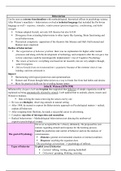
Behaviorism
Can be seen as extreme functionalism with methodological, theoretical effects in psychology science.
After Watson’s manifesto > behaviorism evolved a technical language that included the Pavlovian
language as well > response, stimulus, reinforcement (positive/negative), conditioning, and habit
strength
Tolman adopted Gestalt, not only S-R theories but also S-O-R
Divergence from extending behaviorism to other topics like learning. Brain functioning and
social behaviorism.
Theoretical complexity: opposition of the theorists like Skinner and Hull. Hull internal and
Skinner more empirical.
Decline of behaviorism:
The organization of behavior problem: there was no explanation for higher order mental
processes and along with the development of technology and computers after the war gave rise
to how outcomes could be neurologically implemented > rise of Cognitive Psychology
The return of instincts: everything was based on rat research, rats are very adaptive though,
same for pigeons.
Did not benefit from environmentalism’s popularity because of the extreme views it was
holding- nativists criticized it.
Impact:
Harmonizing with logical positivism and operationalism
Skinner and Watson thought behaviorism as a way to break free from bad habits and desires.
More for practical skills not for revealing human nature
John B. Watson (1878-1958)
Influenced by Jacques Loeb and tropism that supported that behavior of simple organisms could be
explained as being automatically elicited by stimuli. Loeb applied that to animals, plants, insects and
Watson to humans.
Rats solving the maze-removing the senses one by one
→ He was an ethologist, observing animals in natural setting
→ After 1908, he started to express his Behavioristic approach on Psychological matters > radical,
explain all behaviors.
→ After resigning from Hawkins, he made a successful career in advertising.
→ Complete rejection of introspection and mentalism
→ Radical behaviorism > Methodological behaviorism (not denying the unobserved
cognitive/psychological events)
He never accepted Pavlov’s theory ultimately. He proposed his own
notions regarding stimuli and response for the learning process.
Goal: the prediction and control of behavior and not the analysis of
The goal of Psychology consciousness.
Stimulus: general environmental situation or internal condition
Response: anything the organism does
“The psychology of twitchism” > psychology of reflexes
Types of behavior Explicit (overt) behavior
Learned: talking, writing, playing basketball
Unlearned: grasping, blinking, sneezing
, Implicit (covert) behavior
Learned: heart rate at the sight of dentist’s drill
Unlearned : circulatory changes
Four methods of studying behavior:
1. Observation (naturalistic, experimentalist)
2. Conditioned reflex method (like Pavlov)
3. Testing, take behavior samples not measuring capacity or
personality.
4. Verbal reports, like overt behavior
Speaking is nothing more than an overt type of behavior > accompanied by
movement of tongue and larynx.
Thinking is implicit or subvocal speech > the movements of speaking
Language & Thinking accompany thinking.
Faced oppositions even though it had some experimental support
→ Difficult to express what you think in words
→ You can recite a passage without having understood the meaning
Firstly, he talked about instincts > replaced them with learned habits.
He rejected instincts > there are only simple reflexes e.g. sneezing
Radical environmentalism > everything is based on experience; if you
Instincts change experience you can change personality.
He allowed heritable differences in structure that could influence the
personality > more for appearance characteristics
Structure + Experience (training)
Inherited emotions
1. Fear: elicited by loud noises, loss of support (breath, closing eyes)
2. Rage: restricting their movements (stiffen body, striking
movement)
Emotions 3. Love: patting the infants (smiling, cooing, extend arms)
Through learning they become elicited from other than the original stimuli,
all adult emotions derive from these.
Each emotion have overt responses (parenthesis) assoc. with it
Feeling & Sensations not important
Albert 11 year old boy, emotion experiment
Close to rat- hammer sound > after a week, little Albert was distant
from the rat
Fear of rat, generalized to other furry objects e.g. rat, dog, coat etc.
Little Albert Lasted for one month later.
→ Experience rearranged the stimuli > all adult emotional reaction
form like that.
→ Criticized and appreciated their contribution
Peter’s case > behavioral therapy (including counterconditioning)
Sexual education Frank and objective information about sex and gratitude to Freud for
providing explanations for myths and secrecy of sex.
Supported Plato’s view that maybe it is better to for parents and
Can be seen as extreme functionalism with methodological, theoretical effects in psychology science.
After Watson’s manifesto > behaviorism evolved a technical language that included the Pavlovian
language as well > response, stimulus, reinforcement (positive/negative), conditioning, and habit
strength
Tolman adopted Gestalt, not only S-R theories but also S-O-R
Divergence from extending behaviorism to other topics like learning. Brain functioning and
social behaviorism.
Theoretical complexity: opposition of the theorists like Skinner and Hull. Hull internal and
Skinner more empirical.
Decline of behaviorism:
The organization of behavior problem: there was no explanation for higher order mental
processes and along with the development of technology and computers after the war gave rise
to how outcomes could be neurologically implemented > rise of Cognitive Psychology
The return of instincts: everything was based on rat research, rats are very adaptive though,
same for pigeons.
Did not benefit from environmentalism’s popularity because of the extreme views it was
holding- nativists criticized it.
Impact:
Harmonizing with logical positivism and operationalism
Skinner and Watson thought behaviorism as a way to break free from bad habits and desires.
More for practical skills not for revealing human nature
John B. Watson (1878-1958)
Influenced by Jacques Loeb and tropism that supported that behavior of simple organisms could be
explained as being automatically elicited by stimuli. Loeb applied that to animals, plants, insects and
Watson to humans.
Rats solving the maze-removing the senses one by one
→ He was an ethologist, observing animals in natural setting
→ After 1908, he started to express his Behavioristic approach on Psychological matters > radical,
explain all behaviors.
→ After resigning from Hawkins, he made a successful career in advertising.
→ Complete rejection of introspection and mentalism
→ Radical behaviorism > Methodological behaviorism (not denying the unobserved
cognitive/psychological events)
He never accepted Pavlov’s theory ultimately. He proposed his own
notions regarding stimuli and response for the learning process.
Goal: the prediction and control of behavior and not the analysis of
The goal of Psychology consciousness.
Stimulus: general environmental situation or internal condition
Response: anything the organism does
“The psychology of twitchism” > psychology of reflexes
Types of behavior Explicit (overt) behavior
Learned: talking, writing, playing basketball
Unlearned: grasping, blinking, sneezing
, Implicit (covert) behavior
Learned: heart rate at the sight of dentist’s drill
Unlearned : circulatory changes
Four methods of studying behavior:
1. Observation (naturalistic, experimentalist)
2. Conditioned reflex method (like Pavlov)
3. Testing, take behavior samples not measuring capacity or
personality.
4. Verbal reports, like overt behavior
Speaking is nothing more than an overt type of behavior > accompanied by
movement of tongue and larynx.
Thinking is implicit or subvocal speech > the movements of speaking
Language & Thinking accompany thinking.
Faced oppositions even though it had some experimental support
→ Difficult to express what you think in words
→ You can recite a passage without having understood the meaning
Firstly, he talked about instincts > replaced them with learned habits.
He rejected instincts > there are only simple reflexes e.g. sneezing
Radical environmentalism > everything is based on experience; if you
Instincts change experience you can change personality.
He allowed heritable differences in structure that could influence the
personality > more for appearance characteristics
Structure + Experience (training)
Inherited emotions
1. Fear: elicited by loud noises, loss of support (breath, closing eyes)
2. Rage: restricting their movements (stiffen body, striking
movement)
Emotions 3. Love: patting the infants (smiling, cooing, extend arms)
Through learning they become elicited from other than the original stimuli,
all adult emotions derive from these.
Each emotion have overt responses (parenthesis) assoc. with it
Feeling & Sensations not important
Albert 11 year old boy, emotion experiment
Close to rat- hammer sound > after a week, little Albert was distant
from the rat
Fear of rat, generalized to other furry objects e.g. rat, dog, coat etc.
Little Albert Lasted for one month later.
→ Experience rearranged the stimuli > all adult emotional reaction
form like that.
→ Criticized and appreciated their contribution
Peter’s case > behavioral therapy (including counterconditioning)
Sexual education Frank and objective information about sex and gratitude to Freud for
providing explanations for myths and secrecy of sex.
Supported Plato’s view that maybe it is better to for parents and