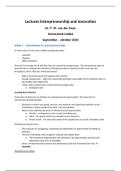
Lectures Entrepreneurship and innovation
Dr. P. W. van der Zwan
Universiteit Leiden
September – oktober 2020
Week 1 – Introduction to entrepreneurship
In some cases it is not easy to define entrepreneurship:
- Capitalist
- Manager
- Utility maximiser
Firms do not emerge out of the blue, they are started by entrepreneurs. The entrepreneurs play an
essential role in strategic firm decisions. Entrepreneurship is important at firm start but also
throughout a firm’s lifecycle. Entrepreneurship:
- Adds to economic growth of regions and countries
- Creates employment – SMEs are numerically dominant and smaller firms contribute more to
job creation than larger firms
- Could create societal and or environmental change/value
o Ecological need
Creating firms (Hisrich)
Generation of ideas but not all ideas are entrepreneurial opportunities. The important of
entrepreneurial opportunities:
- Situations in which new goods, services, raw materials and organizing methods can be
introduced or sold at greater than their cost of production
- What are the defining elements of entrepreneurial opportunities:
o Novelty – entrepreneurs who create something new
o Value – the goods need to be valuable on the long-term
o Unmet needs – it is about the needs of the people that are unmet, desirable needs
Entrepreneurship involves:
- The processes of recognizing, evaluating and exploitation of opportunities (founding of
business)
- The set of individuals who recognize, evaluate and exploit them
o The fit between opportunities and individuals, the opportunities and personal
skills/goals need to fit feasibility
- Hence, entrepreneurship involves two phenomena (and the fit between the two)
feasibility
Entrepreneurial action
,Self-efficacy an individual who is convinced of its own skill and capable of taking on the
entrepreneurial
- Action through the creation of new products/processes and or the entry into new markets,
which may occur through a newly created organization or within an established organization
- Feasibility is related to entrepreneurial self-efficacy; desirability to motivation
Strong opportunities
What is a good opportunity? – that is the opportunity that is between the intersection of desirability
(not just start a business but to solve a problem), feasibility and viability (viable on the long run,
create value)
Three phases of design thinking
A human-centred approach to innovation tha rbings together what people need with what is feasible
and economically viable.
- State the problem
- Show the solution
- Show the benefit
Design thinking exercise
How might we enhance the experience regarding/solve the problem of a particular group?
- Goal to solve those problem
The netherlands reaches high on the early-stage entrepreneurial activity as entrepreneur is defined
as someone who takes steps to start a business: this is mainly because of the high numbers of
“ZZP’ers”.
,What do these firms have in common?
- These firms all started in economic down-turn (economic crisis). That was for instance in
2008.
- Entrepreneurship in crisis time
o Opportunity-motivated and necessity-motivated entrepreneurial activity
o Perhaps people were fired and decided to start a new business
o Necessity-based business went up
Because there are no other alternatives as starting a own business
o Opportunity-motivated businesses went down
Revival of entrepreneurship
- Entrepreneurship rates increased after 1970s, managed economy versus entrepreneurial
economy
- The explanation of the revival of entrepreneurship
o Driving forces as the service economy
Lower entry barriers and smaller firms
o Driving forces as the differentiation of consumer preferences
Niche markets
o Driving forces as occupational preferences
Self-realization and need for autonomy when incomes are higher
Attractiveness of entrepreneurship because of increased availability of
financial resources
o Driving forces of knowledge economy
Generation and commercialization of knowledge
o Driving forces as global trends
ICT revolution
Globalization
Role of government
Post-communist countries
o More generally, demand-side and supply-side trends provide great opportunities for
starting a new venture
(Hisrich), wearable trend, green trend, etc.
Case week 1: Howard Schultz and Starbucks Coffee Company
1. This case is related to changes in society and entrepreneurial opportunities that arise from
these changes. How did Schultz view the U.S. coffee market in the mid-1980s? Which
trends did he observe?
Consumers’ attachment to the Starbucks brand was not based on mass advertising or promotion.
It was based, Schultz believed, on their experience in company stores: on their reactions to the
coffee, the people who made and served it, and the stores’ atmosphere and sense of community.
, This experience, he said, “earned customers’ trust by speaking to their hearts as well as their
heads.”
- People cared more about the origins and flavour of coffee, like is done with wine
- Gdp was rising, people had more money to spend
- Was not yet one big market leader in the coffee market. Benefits of being the first is that you
will be known and as a brand grow bigger (can set the standard) set prices and quality
- Average consumption of coffee rose during the 1980s
- Schultz thought it was more appealing to start a coffee bar (cup idea)
2. Why did Schultz say that the canned and instant coffee he had been drinking tasted “like
swill”?
Starbucks coffee was markedly different. It was also sold differently—with
knowledgeable salespeople scooping coffee beans from bins behind a counter in a store devoted
to coffee and tea. Schultz was impressed with the company’s operation, management, and
product. “I felt as though I had discovered a whole new continent,” he said. “By comparison, I
realized, the coffee I had been drinking was swill. (less processed and more nutritious)
3. How were these prevailing market conditions related to Howard Schultz’s entrepreneurial
vision?
Most Americans in the early 1980s, Schultz realized, had little access to the quality and sociability
of coffee as it was served in Italian espresso bars. Even Starbucks, which was founded to roast and
sell first-rate beans, did not provide coffee by the cup. “We treated coffee as produce,” Schultz
remembered, “something to be bagged and sent home with the groceries.” He and other company
managers had overlooked the important associations that coffee drinking had to conversation and
communal rituals. “We stayed one big step away from the heart and soul of what coffee has meant
throughout the centuries
4. Why did Schultz think he could successfully import the Italian coffee bar concept to the U.S.?
all of the Italian coffee bars provided an inherently social experience—one that offered people
community, comfort, and some sense of extended family
To gain market share and supermarket shelf space, the big processors clashed in frequent price
wars, using coupons, discounts, and other promotions. As price competition and pressure on profit
margins intensified, the major rivals sought ways to cut costs.
And not only good coffee but also hired and trained baristas for the best coffee experience
Dr. P. W. van der Zwan
Universiteit Leiden
September – oktober 2020
Week 1 – Introduction to entrepreneurship
In some cases it is not easy to define entrepreneurship:
- Capitalist
- Manager
- Utility maximiser
Firms do not emerge out of the blue, they are started by entrepreneurs. The entrepreneurs play an
essential role in strategic firm decisions. Entrepreneurship is important at firm start but also
throughout a firm’s lifecycle. Entrepreneurship:
- Adds to economic growth of regions and countries
- Creates employment – SMEs are numerically dominant and smaller firms contribute more to
job creation than larger firms
- Could create societal and or environmental change/value
o Ecological need
Creating firms (Hisrich)
Generation of ideas but not all ideas are entrepreneurial opportunities. The important of
entrepreneurial opportunities:
- Situations in which new goods, services, raw materials and organizing methods can be
introduced or sold at greater than their cost of production
- What are the defining elements of entrepreneurial opportunities:
o Novelty – entrepreneurs who create something new
o Value – the goods need to be valuable on the long-term
o Unmet needs – it is about the needs of the people that are unmet, desirable needs
Entrepreneurship involves:
- The processes of recognizing, evaluating and exploitation of opportunities (founding of
business)
- The set of individuals who recognize, evaluate and exploit them
o The fit between opportunities and individuals, the opportunities and personal
skills/goals need to fit feasibility
- Hence, entrepreneurship involves two phenomena (and the fit between the two)
feasibility
Entrepreneurial action
,Self-efficacy an individual who is convinced of its own skill and capable of taking on the
entrepreneurial
- Action through the creation of new products/processes and or the entry into new markets,
which may occur through a newly created organization or within an established organization
- Feasibility is related to entrepreneurial self-efficacy; desirability to motivation
Strong opportunities
What is a good opportunity? – that is the opportunity that is between the intersection of desirability
(not just start a business but to solve a problem), feasibility and viability (viable on the long run,
create value)
Three phases of design thinking
A human-centred approach to innovation tha rbings together what people need with what is feasible
and economically viable.
- State the problem
- Show the solution
- Show the benefit
Design thinking exercise
How might we enhance the experience regarding/solve the problem of a particular group?
- Goal to solve those problem
The netherlands reaches high on the early-stage entrepreneurial activity as entrepreneur is defined
as someone who takes steps to start a business: this is mainly because of the high numbers of
“ZZP’ers”.
,What do these firms have in common?
- These firms all started in economic down-turn (economic crisis). That was for instance in
2008.
- Entrepreneurship in crisis time
o Opportunity-motivated and necessity-motivated entrepreneurial activity
o Perhaps people were fired and decided to start a new business
o Necessity-based business went up
Because there are no other alternatives as starting a own business
o Opportunity-motivated businesses went down
Revival of entrepreneurship
- Entrepreneurship rates increased after 1970s, managed economy versus entrepreneurial
economy
- The explanation of the revival of entrepreneurship
o Driving forces as the service economy
Lower entry barriers and smaller firms
o Driving forces as the differentiation of consumer preferences
Niche markets
o Driving forces as occupational preferences
Self-realization and need for autonomy when incomes are higher
Attractiveness of entrepreneurship because of increased availability of
financial resources
o Driving forces of knowledge economy
Generation and commercialization of knowledge
o Driving forces as global trends
ICT revolution
Globalization
Role of government
Post-communist countries
o More generally, demand-side and supply-side trends provide great opportunities for
starting a new venture
(Hisrich), wearable trend, green trend, etc.
Case week 1: Howard Schultz and Starbucks Coffee Company
1. This case is related to changes in society and entrepreneurial opportunities that arise from
these changes. How did Schultz view the U.S. coffee market in the mid-1980s? Which
trends did he observe?
Consumers’ attachment to the Starbucks brand was not based on mass advertising or promotion.
It was based, Schultz believed, on their experience in company stores: on their reactions to the
coffee, the people who made and served it, and the stores’ atmosphere and sense of community.
, This experience, he said, “earned customers’ trust by speaking to their hearts as well as their
heads.”
- People cared more about the origins and flavour of coffee, like is done with wine
- Gdp was rising, people had more money to spend
- Was not yet one big market leader in the coffee market. Benefits of being the first is that you
will be known and as a brand grow bigger (can set the standard) set prices and quality
- Average consumption of coffee rose during the 1980s
- Schultz thought it was more appealing to start a coffee bar (cup idea)
2. Why did Schultz say that the canned and instant coffee he had been drinking tasted “like
swill”?
Starbucks coffee was markedly different. It was also sold differently—with
knowledgeable salespeople scooping coffee beans from bins behind a counter in a store devoted
to coffee and tea. Schultz was impressed with the company’s operation, management, and
product. “I felt as though I had discovered a whole new continent,” he said. “By comparison, I
realized, the coffee I had been drinking was swill. (less processed and more nutritious)
3. How were these prevailing market conditions related to Howard Schultz’s entrepreneurial
vision?
Most Americans in the early 1980s, Schultz realized, had little access to the quality and sociability
of coffee as it was served in Italian espresso bars. Even Starbucks, which was founded to roast and
sell first-rate beans, did not provide coffee by the cup. “We treated coffee as produce,” Schultz
remembered, “something to be bagged and sent home with the groceries.” He and other company
managers had overlooked the important associations that coffee drinking had to conversation and
communal rituals. “We stayed one big step away from the heart and soul of what coffee has meant
throughout the centuries
4. Why did Schultz think he could successfully import the Italian coffee bar concept to the U.S.?
all of the Italian coffee bars provided an inherently social experience—one that offered people
community, comfort, and some sense of extended family
To gain market share and supermarket shelf space, the big processors clashed in frequent price
wars, using coupons, discounts, and other promotions. As price competition and pressure on profit
margins intensified, the major rivals sought ways to cut costs.
And not only good coffee but also hired and trained baristas for the best coffee experience