PROBLEM 8. DO WE NEED PSYCHOLOGY? 1
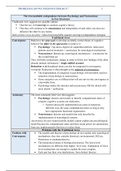
The irreconcilable codependence between Psychology and Neuroscience
by Eric Hochstein
Traditional view suggests two possible options
That the two will converge in common cognitive theory
That they will continue to be autonomous and independent of each other, one does not
influence the other by any means.
Both of these views are false > Idea of irreconcilable (cannot converge) codependence emerged.
Traditional views
Convergence Both have the same goal, to develop an ideally correct theory of cognitive
behavior but differ in the approaches to achieve it.
Psychology: Top-down, high-level capabilities/deficits, behavioral
patterns and environment > conclusions for neurological mechanisms
Neuroscience: Bottom-up, neurological mechanisms > conclusions for
the overall behavior
They will both continuously change in order to fit the new findings of the other
domain (mutual refinement) > single unified account.
Reduction in philosophical terms can also be integrated in convergence
viewpoint. Reduction is often thought as the endpoint of convergence
The fragmentation of categories in psychology will inevitably result in
reduction of psychology to neuroscience.
Some categories are so different that will not survive the convergence in
a knowable form.
Psychology makes the sketches and neuroscience fills the sketch with
more details > unification.
Autonomy The most commonly held view that suggests:
Psychology: theories and models to identify computational states of
complex cognitive systems not realization.
→ Systems physically implemented can cause in numerous
different ways the same computational states as long as they
have appropriate functional organization.
Neuroscience: theories and models that only describe the
implementation of neurological systems
Autonomous because neuroscientific models cannot explain any psychological
model because the computational states and their causal power are autonomous
from any implementation that tries to realize them.
Problems with the Traditional views
Problem with The models and theories of psychology do not explain only neurological
Convergence mechanisms, they also consider historical, environmental, SES etc.
Restriction is counterproductive.
The hierarchical nature of biological processes. The lower level
mechanisms are different from higher- level ones. Explanation of lower
level mechanisms not enough to explain the more complex.
Each part has their own idealizations, form distinct theories
The irreconcilable codependence between Psychology and Neuroscience
by Eric Hochstein
Traditional view suggests two possible options
That the two will converge in common cognitive theory
That they will continue to be autonomous and independent of each other, one does not
influence the other by any means.
Both of these views are false > Idea of irreconcilable (cannot converge) codependence emerged.
Traditional views
Convergence Both have the same goal, to develop an ideally correct theory of cognitive
behavior but differ in the approaches to achieve it.
Psychology: Top-down, high-level capabilities/deficits, behavioral
patterns and environment > conclusions for neurological mechanisms
Neuroscience: Bottom-up, neurological mechanisms > conclusions for
the overall behavior
They will both continuously change in order to fit the new findings of the other
domain (mutual refinement) > single unified account.
Reduction in philosophical terms can also be integrated in convergence
viewpoint. Reduction is often thought as the endpoint of convergence
The fragmentation of categories in psychology will inevitably result in
reduction of psychology to neuroscience.
Some categories are so different that will not survive the convergence in
a knowable form.
Psychology makes the sketches and neuroscience fills the sketch with
more details > unification.
Autonomy The most commonly held view that suggests:
Psychology: theories and models to identify computational states of
complex cognitive systems not realization.
→ Systems physically implemented can cause in numerous
different ways the same computational states as long as they
have appropriate functional organization.
Neuroscience: theories and models that only describe the
implementation of neurological systems
Autonomous because neuroscientific models cannot explain any psychological
model because the computational states and their causal power are autonomous
from any implementation that tries to realize them.
Problems with the Traditional views
Problem with The models and theories of psychology do not explain only neurological
Convergence mechanisms, they also consider historical, environmental, SES etc.
Restriction is counterproductive.
The hierarchical nature of biological processes. The lower level
mechanisms are different from higher- level ones. Explanation of lower
level mechanisms not enough to explain the more complex.
Each part has their own idealizations, form distinct theories