NMS exam 2 TEST BANK\\LATEST VERSION
WITH COMPLETE QUESTIONS AND CORRECT
DETAILED ANSWERS \ASSURED PASS ALREADY
GRADED A+\LATEST EXAM 2025-2026
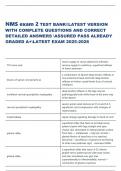
motor supply to rectus abdominis inferialis,
T10 nerve root sensory supply to umbilicus, superficial reflexes
of lower abdomen
a combination of absent deep tendon reflexes at
one anatomical level and brisk deep tendon
lesions of spinal cord present as
reflexes at further caudal levels (loss of cortical
inhibition)
deep tendon reflexes in the legs may be
multilevel cervical spondylotic myelopathy pathologically brisk while those in the arms may
all be absent
severe spinal canal stenosis at C3-4 and C4-5,
cervical spondylotic myelopathy significant cord compression with changes of
myelomalacia
myelomalasia signal change signaling damage to back of cord
superficial reflex that tests L4-S2 tibial nerve;
patient supine with legs straight and eyes
closed, skin stimulated on lateral plantar surface
plantar reflex from heel → metatarsals → big toe; normal =
plantar flexion of toes/foot or no reaction;
abnormal = dorsiflexion of great toe and flaring
of other toes (babinski sign) - indicates UMNL
a superficial reflex that tests L4-S2 inferior
gluteal nerve; patient prone with eyes closed
gluteal reflex and skin stimulated over glut max
superolaterally to inferomedially, normal =
contraction of gluteus maximus
, a superficial reflex testing S3-S5 inferior
hemorrhoidal nerve; patient prone with eyes
anal reflex
closed and skin of perianal area stimulated,
normal = contraction of external anal sphincter
occur when a LMN is released from normal
control or inhibition via motor cortex/pyramidal
pathological reflexes tracts by a discontinuity of cord (UMNL);
considered pathological in adults but may be
normal finding in infants 6 month-2 years old
increased DTRs, absent superficial reflexes, and
typical pattern of UMNL
emergence of pathologic reflexes
, checks for lesion above C5 in corticospinal tract;
patient seated with eyes closed and doc sharply
Hoffman sign and forcible flicks middle/index finger; normal =
no response, abnormal = finger flexion and
adduction of thumb in ‘clawing’ (UMNL)
checks for lesions above C5 in corticospinal
tract; patient seated with eyes closed and doc
taps volar surface of middle finger; normal = no
Tromner sign
response, abnormal = ‘clawing’ with finger
flexion and adduction of thumb - indicates
UMNL
checks for lesions abin cortiospinal tract; patient
supine with eyes closed and doc taps ball of
Rossolimo’s sign
foot with reflex hammer; normal = no response,
abnormal = plantar flexion - indicates UMNL
bilateral leg pain, bowel and bladder
incontinence (urinary retention), sensory exam
cauda equina syndrome
of S3-5 is decreased or absent for light and
sharp touch, medical emergency and ER referral
bilateral leg pain, bowel and bladder function is
normal or maybe some leakage, sensory exam
sacral sparring syndrome of S3-5 is normal bilaterally for light and sharp
touch, should be evaluated and monitored then
treated accordingly
a sign not a test, can be illicited by multiple
tests, dorsiflexion of great toe and flaring of
other toes that indicates an UMNL of
corticospinal tract, most important
pathological reflex by far, knee must be
Babinski sign
extended to be present, often first clinical
evidence of UMNL, one of the most
significant indications of disease of
corticospinal system at any level from motor
cortex through descending pathways
tests corticospinal tract; patient supine with eyes
closed and legs straight, skin stimulated around
Chaddock sign
lateral malleolus from heel to toe; normal = no
reaction, abnormal = babinski sign
Oppenheim’s sign tests corticospinal tract; patient supine with eyes
closed and legs straight, end of reflex hammer
used to stroke along edge of tibial surface from
WITH COMPLETE QUESTIONS AND CORRECT
DETAILED ANSWERS \ASSURED PASS ALREADY
GRADED A+\LATEST EXAM 2025-2026
motor supply to rectus abdominis inferialis,
T10 nerve root sensory supply to umbilicus, superficial reflexes
of lower abdomen
a combination of absent deep tendon reflexes at
one anatomical level and brisk deep tendon
lesions of spinal cord present as
reflexes at further caudal levels (loss of cortical
inhibition)
deep tendon reflexes in the legs may be
multilevel cervical spondylotic myelopathy pathologically brisk while those in the arms may
all be absent
severe spinal canal stenosis at C3-4 and C4-5,
cervical spondylotic myelopathy significant cord compression with changes of
myelomalacia
myelomalasia signal change signaling damage to back of cord
superficial reflex that tests L4-S2 tibial nerve;
patient supine with legs straight and eyes
closed, skin stimulated on lateral plantar surface
plantar reflex from heel → metatarsals → big toe; normal =
plantar flexion of toes/foot or no reaction;
abnormal = dorsiflexion of great toe and flaring
of other toes (babinski sign) - indicates UMNL
a superficial reflex that tests L4-S2 inferior
gluteal nerve; patient prone with eyes closed
gluteal reflex and skin stimulated over glut max
superolaterally to inferomedially, normal =
contraction of gluteus maximus
, a superficial reflex testing S3-S5 inferior
hemorrhoidal nerve; patient prone with eyes
anal reflex
closed and skin of perianal area stimulated,
normal = contraction of external anal sphincter
occur when a LMN is released from normal
control or inhibition via motor cortex/pyramidal
pathological reflexes tracts by a discontinuity of cord (UMNL);
considered pathological in adults but may be
normal finding in infants 6 month-2 years old
increased DTRs, absent superficial reflexes, and
typical pattern of UMNL
emergence of pathologic reflexes
, checks for lesion above C5 in corticospinal tract;
patient seated with eyes closed and doc sharply
Hoffman sign and forcible flicks middle/index finger; normal =
no response, abnormal = finger flexion and
adduction of thumb in ‘clawing’ (UMNL)
checks for lesions above C5 in corticospinal
tract; patient seated with eyes closed and doc
taps volar surface of middle finger; normal = no
Tromner sign
response, abnormal = ‘clawing’ with finger
flexion and adduction of thumb - indicates
UMNL
checks for lesions abin cortiospinal tract; patient
supine with eyes closed and doc taps ball of
Rossolimo’s sign
foot with reflex hammer; normal = no response,
abnormal = plantar flexion - indicates UMNL
bilateral leg pain, bowel and bladder
incontinence (urinary retention), sensory exam
cauda equina syndrome
of S3-5 is decreased or absent for light and
sharp touch, medical emergency and ER referral
bilateral leg pain, bowel and bladder function is
normal or maybe some leakage, sensory exam
sacral sparring syndrome of S3-5 is normal bilaterally for light and sharp
touch, should be evaluated and monitored then
treated accordingly
a sign not a test, can be illicited by multiple
tests, dorsiflexion of great toe and flaring of
other toes that indicates an UMNL of
corticospinal tract, most important
pathological reflex by far, knee must be
Babinski sign
extended to be present, often first clinical
evidence of UMNL, one of the most
significant indications of disease of
corticospinal system at any level from motor
cortex through descending pathways
tests corticospinal tract; patient supine with eyes
closed and legs straight, skin stimulated around
Chaddock sign
lateral malleolus from heel to toe; normal = no
reaction, abnormal = babinski sign
Oppenheim’s sign tests corticospinal tract; patient supine with eyes
closed and legs straight, end of reflex hammer
used to stroke along edge of tibial surface from