'Learning Psychology Specifics Summary'
BUT will signpost a counterpoint / development point
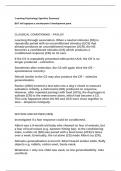
CLASSICAL CONDITIONING – PAVLOV
Learning through association. When a neutral stimulus (NS) is
repeatedly paired with an unconditioned stimulus (UCS) that
already produces an unconditioned response (UCR), the NS
becomes a conditioned stimulus (CS) which produces a
conditioned response (CR) on its own.
If the CS is repeatedly presented without the UCS, the CR is no
longer produced – extinction.
Sometimes after extinction, the CS will again elicit the CR –
spontaneous recovery.
Stimuli similar to the CS may also produce the CR – stimulus
generalisation.
Pavlov (1902) inserted a test tube into a dog’s cheek to measure
salivation. Initially, a metronome (NS) produced no response.
However, after repeated pairings with food (UCS), the dog began to
salivate (CR) to the metronome alone, which had become a CS.
This only happened when the NS and UCS were close together in
time – temporal contiguity.
WATSON AND RAYNER (1920)
Investigated if a fear response could be conditioned.
Albert was a 9-month-old baby who showed no fear of animals, but
a fear of loud noises (e.g. hammer hitting bar). In the conditioning
trials, a white rat (NS) was paired with a loud noise (UCS) 5 times
over a week. Eventually, the rat alone (CS) made Albert cry (CR).
Stimulus generalisation occurred: Albert feared similar white, fluffy
objects e.g. rabbits, cotton wool, Santa mask.
Weakness = only one child was used, so low generalisability. Also
unethical.
, OPERANT CONDITIONING – SKINNER
Behaviour is learned through consequences.
Reinforcement increases behaviour.
Punishment decreases behaviour.
● Positive reinforcement: adding something pleasant.
● Negative reinforcement: removing something unpleasant.
● Positive punishment: adding something unpleasant.
● Negative punishment: removing something pleasant.
Primary reinforcers = biological e.g. food.
Secondary reinforcers = associated with primary e.g. money.
Skinner’s rats: Pressing lever produced food. The reward increased
behaviour – learning had occurred.
Skinner’s pigeons (1948): Pigeons were fed at fixed intervals. They
thought whatever behaviour they were doing caused the food.
Superstitious behaviour was learned.
Strength = lab experiments → high internal validity.
Weakness = animal studies lack generalisability. Also
ignores cognitive processes.
SCHEDULES OF REINFORCEMENT
● Continuous = every time behaviour is shown.
→ Fast learning, fast extinction.
● Partial = not every time.
→ Slower learning, slower extinction.
Types of partial:
BUT will signpost a counterpoint / development point
CLASSICAL CONDITIONING – PAVLOV
Learning through association. When a neutral stimulus (NS) is
repeatedly paired with an unconditioned stimulus (UCS) that
already produces an unconditioned response (UCR), the NS
becomes a conditioned stimulus (CS) which produces a
conditioned response (CR) on its own.
If the CS is repeatedly presented without the UCS, the CR is no
longer produced – extinction.
Sometimes after extinction, the CS will again elicit the CR –
spontaneous recovery.
Stimuli similar to the CS may also produce the CR – stimulus
generalisation.
Pavlov (1902) inserted a test tube into a dog’s cheek to measure
salivation. Initially, a metronome (NS) produced no response.
However, after repeated pairings with food (UCS), the dog began to
salivate (CR) to the metronome alone, which had become a CS.
This only happened when the NS and UCS were close together in
time – temporal contiguity.
WATSON AND RAYNER (1920)
Investigated if a fear response could be conditioned.
Albert was a 9-month-old baby who showed no fear of animals, but
a fear of loud noises (e.g. hammer hitting bar). In the conditioning
trials, a white rat (NS) was paired with a loud noise (UCS) 5 times
over a week. Eventually, the rat alone (CS) made Albert cry (CR).
Stimulus generalisation occurred: Albert feared similar white, fluffy
objects e.g. rabbits, cotton wool, Santa mask.
Weakness = only one child was used, so low generalisability. Also
unethical.
, OPERANT CONDITIONING – SKINNER
Behaviour is learned through consequences.
Reinforcement increases behaviour.
Punishment decreases behaviour.
● Positive reinforcement: adding something pleasant.
● Negative reinforcement: removing something unpleasant.
● Positive punishment: adding something unpleasant.
● Negative punishment: removing something pleasant.
Primary reinforcers = biological e.g. food.
Secondary reinforcers = associated with primary e.g. money.
Skinner’s rats: Pressing lever produced food. The reward increased
behaviour – learning had occurred.
Skinner’s pigeons (1948): Pigeons were fed at fixed intervals. They
thought whatever behaviour they were doing caused the food.
Superstitious behaviour was learned.
Strength = lab experiments → high internal validity.
Weakness = animal studies lack generalisability. Also
ignores cognitive processes.
SCHEDULES OF REINFORCEMENT
● Continuous = every time behaviour is shown.
→ Fast learning, fast extinction.
● Partial = not every time.
→ Slower learning, slower extinction.
Types of partial: