Chapter 04: Living Chemistry: From Atoms to Cells
MULTIPLE CHOICE
1. Which bond type is the strongest in the aqueous cytoplasm of a cell?
a. covalent c. hydrophobic
b. hydrogen d. ionic
ANS: A DIF: Difficult REF: 4.1
OBJ: 4.1b Describe the types of bonds atoms can form to make a molecule.
MSC: Applying
2. Molecules with which kinds of bonds are hydrophobic?
a. hydrogen c. nonpolar covalent
b. ionic d. polar covalent
ANS: C DIF: Moderate REF: 4.1
OBJ: 4.1c Explain the special properties of the water molecule, and distinguish between hydrophilic
and hydrophobic molecules. MSC: Applying
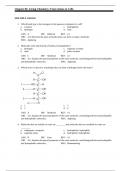
3. Which arrow is drawn to a hydrogen that can form a hydrogen bond with water?
a. 1 c. 3
b. 2 d. 4
ANS: A DIF: Moderate REF: 4.1
OBJ: 4.1c Explain the special properties of the water molecule, and distinguish between hydrophilic
and hydrophobic molecules. MSC: Applying
4. Molecules that are soluble in water are ________ and molecules that are insoluble in water are
________.
a. endergonic; exergonic c. hydrophobic; hydrophilic
b. nonpolar; polar d. hydrophilic; hydrophobic
ANS: D DIF: Easy REF: 4.1
OBJ: 4.1c Explain the special properties of the water molecule, and distinguish between hydrophilic
and hydrophobic molecules. MSC: Remembering
, 5. Which of the following molecular formulas might be of an organic molecule?
a. H2O c. CH4
b. C2H4O d. NH3
ANS: B DIF: Moderate REF: 4.2
OBJ: 4.2a Describe organic molecules, and explain the role of functional groups and the formation of
macromolecules. MSC: Applying
6. What type of cellular molecule is shown here?
a. a lipid c. a ribonucleic acid
b. an amino acid d. a protein
ANS: A DIF: Moderate REF: 4.2
OBJ: 4.2b Describe the structure of lipids and their key functions within a cell.
MSC: Understanding
7. Which of the following is a cellular function of lipids?
a. catalysis c. compartmentalization
b. information storage d. sugar production
ANS: C DIF: Moderate REF: 4.2
OBJ: 4.2b Describe the structure of lipids and their key functions within a cell.
MSC: Understanding
8. Which of the following is true of glycerol?
a. It is hydrophobic. c. It contains three amino groups.
b. It is a component of proteins. d. It contains three hydroxyl groups.
ANS: D DIF: Difficult REF: 4.2
OBJ: 4.2b Describe the structure of lipids and their key functions within a cell.
MSC: Applying
9. Which of the following is true of both lipids and sugars?
MULTIPLE CHOICE
1. Which bond type is the strongest in the aqueous cytoplasm of a cell?
a. covalent c. hydrophobic
b. hydrogen d. ionic
ANS: A DIF: Difficult REF: 4.1
OBJ: 4.1b Describe the types of bonds atoms can form to make a molecule.
MSC: Applying
2. Molecules with which kinds of bonds are hydrophobic?
a. hydrogen c. nonpolar covalent
b. ionic d. polar covalent
ANS: C DIF: Moderate REF: 4.1
OBJ: 4.1c Explain the special properties of the water molecule, and distinguish between hydrophilic
and hydrophobic molecules. MSC: Applying
3. Which arrow is drawn to a hydrogen that can form a hydrogen bond with water?
a. 1 c. 3
b. 2 d. 4
ANS: A DIF: Moderate REF: 4.1
OBJ: 4.1c Explain the special properties of the water molecule, and distinguish between hydrophilic
and hydrophobic molecules. MSC: Applying
4. Molecules that are soluble in water are ________ and molecules that are insoluble in water are
________.
a. endergonic; exergonic c. hydrophobic; hydrophilic
b. nonpolar; polar d. hydrophilic; hydrophobic
ANS: D DIF: Easy REF: 4.1
OBJ: 4.1c Explain the special properties of the water molecule, and distinguish between hydrophilic
and hydrophobic molecules. MSC: Remembering
, 5. Which of the following molecular formulas might be of an organic molecule?
a. H2O c. CH4
b. C2H4O d. NH3
ANS: B DIF: Moderate REF: 4.2
OBJ: 4.2a Describe organic molecules, and explain the role of functional groups and the formation of
macromolecules. MSC: Applying
6. What type of cellular molecule is shown here?
a. a lipid c. a ribonucleic acid
b. an amino acid d. a protein
ANS: A DIF: Moderate REF: 4.2
OBJ: 4.2b Describe the structure of lipids and their key functions within a cell.
MSC: Understanding
7. Which of the following is a cellular function of lipids?
a. catalysis c. compartmentalization
b. information storage d. sugar production
ANS: C DIF: Moderate REF: 4.2
OBJ: 4.2b Describe the structure of lipids and their key functions within a cell.
MSC: Understanding
8. Which of the following is true of glycerol?
a. It is hydrophobic. c. It contains three amino groups.
b. It is a component of proteins. d. It contains three hydroxyl groups.
ANS: D DIF: Difficult REF: 4.2
OBJ: 4.2b Describe the structure of lipids and their key functions within a cell.
MSC: Applying
9. Which of the following is true of both lipids and sugars?