● Keywords are in bold
● Definitions are highlighted in blue
● Equations are highlighted in red
Paper 1 (50%)
Topic 1: Energy
Introduction
● Law of conservation of energy - energy cannot be created or destroyed
● An open system can gain and lose energy from the outside world
● A closed system cannot gain or lose energy from the outside world
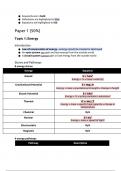
Stores and Pathways
8 energy stores
Energy Equation
Kinetic E = ½mv2
Energy = ½ x mass x velocity2
Gravitational Potential E = mg△h
Energy = mass x gravitational strength x change in height
Elastic Potential E = ½ke2
Energy = ½ x spring constant x extension2
Thermal E = mc△T
Energy = mass x specific heat capacity x change in
temperature
Chemical N/A
Nuclear E = mc2
Energy = mass x speed of light2
Electrostatic N/A
Magnetic N/A
4 energy pathways
Pathway Description
, Mechanical When a force acts on something
Electrical When a current flows
Heating When there’s a temperature difference
Radiation When waves are involved
Required Practical 1 - Specific Heat Capacity
1. Create blocks of equal mass of copper, brass and aluminium, with 2 holes in
the middle
2. Add a few drops of water into the holes and put a heater and thermometer in
each of the holes
3. Set the heater to 10V (roughly) and record the temperature every minute for
10 minutes
4. Calculate the power supplied by the heater by either
a. Counting the number of flashes (a less accurate method)
b. Calculating the PD and current using a voltmeter and ammeter
5. Work out the specific heat capacity using the equation SHC = (power x time) /
(mass x temperature change)
6. The results will most likely be too high, as the block isn’t insulated
Power & Work Done
● Power - the rate at which energy is transferred
● It is measured in watts
● Power = energy transferred / time
● Power = work done / time
● Work done = force x distance
Energy Transfers
● Energy can be transferred, stored or dissipated, but never created or
destroyed
● When energy is stored in less useful ways, it is described as wasted
Ways of reducing unwanted energy transfers
● Lubrication
● Thermal insulation
,Required Practical 2 - Thermal Insulation
1. Wrap bubble wrap around a beaker
2. Create a set of beakers each with different amounts of insulation
3. Pour hot water into them and leave them for 20 minutes
4. Plot a graph of the results
Efficiency
● Useful energy is energy expended for its intended use
● Wasted energy is energy expended in an unintended way
● Efficiency (%) = Useful output/Total input x 100
● No device is 100% efficient
● Sankey diagrams show efficiency
Energy Transfers - what topic?
Conduction
● As one end of the substance heats up, the particles vibrate faster
● This transfers energy to the next particle until it reaches the end
● Happens in all 3 states, but primarily in solids
● Called thermal energy (although it’s the kinetic energy of the particles)
● Conductors support this, insulators inhibit this
Convection
● As one area of the substance is heated, it becomes less dense
● This makes it rise
● This means that the denser, cooler area can be heated
● The cycle repeats itself and evenly heats the whole area of the substance
● Happens in fluids - liquids and gases
● Called a convection current
● Happens in boiling water and the earth’s mantle
, Radiation
● Transfers energy through electromagnetic waves
● Usually refers to infrared radiation
● Does not require a medium
● All objects above absolute zero (-273°F) emit radiation
Energy Resources
● Renewable resource - a resource that can be replenished at the same rate as it
is used
or Resource Description Advantages Disadv
ble?
e Wind ● Generated by wind turbines ● No emissions ● Unrelia
● They have blades that spin due to ● Low operating costs ● Visual a
the wind, turning a generator, impact
● Takes u
producing electricity
● Potent
● Kinetic → Electrical wildlife
Solar ● Solar cells/panels generate ● Have low running costs ● Unrelia
electricity directly from sunlight ● Don’t produce ● Relativ
● Also called a photovoltaic cell pollutants costs
● Take up
Geothermal ● From the thermal energy in the ● Very reliable ● High up
earth’s crust ● Relatively low ● Limited
● We pump cold water into the maintenance costs
ground, which is heated up by the
earth
Biofuel ● Can be used in existing ● Easy to transport ● Require
infrastructure ● Can be used in cars ● Require
● Made from recently living harvest
organisms or animal waste ● Not act
neutral
Hydroelectric ● Water flows downhill ● Reliable ● High up
● A hydroelectric dam will trap the ● Can be used on a large ● Limited
water in a reservoir scale ● Impact
● Low emissions migrati
● Water is released from it,
● Low operating costs
● Definitions are highlighted in blue
● Equations are highlighted in red
Paper 1 (50%)
Topic 1: Energy
Introduction
● Law of conservation of energy - energy cannot be created or destroyed
● An open system can gain and lose energy from the outside world
● A closed system cannot gain or lose energy from the outside world
Stores and Pathways
8 energy stores
Energy Equation
Kinetic E = ½mv2
Energy = ½ x mass x velocity2
Gravitational Potential E = mg△h
Energy = mass x gravitational strength x change in height
Elastic Potential E = ½ke2
Energy = ½ x spring constant x extension2
Thermal E = mc△T
Energy = mass x specific heat capacity x change in
temperature
Chemical N/A
Nuclear E = mc2
Energy = mass x speed of light2
Electrostatic N/A
Magnetic N/A
4 energy pathways
Pathway Description
, Mechanical When a force acts on something
Electrical When a current flows
Heating When there’s a temperature difference
Radiation When waves are involved
Required Practical 1 - Specific Heat Capacity
1. Create blocks of equal mass of copper, brass and aluminium, with 2 holes in
the middle
2. Add a few drops of water into the holes and put a heater and thermometer in
each of the holes
3. Set the heater to 10V (roughly) and record the temperature every minute for
10 minutes
4. Calculate the power supplied by the heater by either
a. Counting the number of flashes (a less accurate method)
b. Calculating the PD and current using a voltmeter and ammeter
5. Work out the specific heat capacity using the equation SHC = (power x time) /
(mass x temperature change)
6. The results will most likely be too high, as the block isn’t insulated
Power & Work Done
● Power - the rate at which energy is transferred
● It is measured in watts
● Power = energy transferred / time
● Power = work done / time
● Work done = force x distance
Energy Transfers
● Energy can be transferred, stored or dissipated, but never created or
destroyed
● When energy is stored in less useful ways, it is described as wasted
Ways of reducing unwanted energy transfers
● Lubrication
● Thermal insulation
,Required Practical 2 - Thermal Insulation
1. Wrap bubble wrap around a beaker
2. Create a set of beakers each with different amounts of insulation
3. Pour hot water into them and leave them for 20 minutes
4. Plot a graph of the results
Efficiency
● Useful energy is energy expended for its intended use
● Wasted energy is energy expended in an unintended way
● Efficiency (%) = Useful output/Total input x 100
● No device is 100% efficient
● Sankey diagrams show efficiency
Energy Transfers - what topic?
Conduction
● As one end of the substance heats up, the particles vibrate faster
● This transfers energy to the next particle until it reaches the end
● Happens in all 3 states, but primarily in solids
● Called thermal energy (although it’s the kinetic energy of the particles)
● Conductors support this, insulators inhibit this
Convection
● As one area of the substance is heated, it becomes less dense
● This makes it rise
● This means that the denser, cooler area can be heated
● The cycle repeats itself and evenly heats the whole area of the substance
● Happens in fluids - liquids and gases
● Called a convection current
● Happens in boiling water and the earth’s mantle
, Radiation
● Transfers energy through electromagnetic waves
● Usually refers to infrared radiation
● Does not require a medium
● All objects above absolute zero (-273°F) emit radiation
Energy Resources
● Renewable resource - a resource that can be replenished at the same rate as it
is used
or Resource Description Advantages Disadv
ble?
e Wind ● Generated by wind turbines ● No emissions ● Unrelia
● They have blades that spin due to ● Low operating costs ● Visual a
the wind, turning a generator, impact
● Takes u
producing electricity
● Potent
● Kinetic → Electrical wildlife
Solar ● Solar cells/panels generate ● Have low running costs ● Unrelia
electricity directly from sunlight ● Don’t produce ● Relativ
● Also called a photovoltaic cell pollutants costs
● Take up
Geothermal ● From the thermal energy in the ● Very reliable ● High up
earth’s crust ● Relatively low ● Limited
● We pump cold water into the maintenance costs
ground, which is heated up by the
earth
Biofuel ● Can be used in existing ● Easy to transport ● Require
infrastructure ● Can be used in cars ● Require
● Made from recently living harvest
organisms or animal waste ● Not act
neutral
Hydroelectric ● Water flows downhill ● Reliable ● High up
● A hydroelectric dam will trap the ● Can be used on a large ● Limited
water in a reservoir scale ● Impact
● Low emissions migrati
● Water is released from it,
● Low operating costs