Topic: Chapter 1: Politics and Power (Van Praag)
Summarize key ideas/ main Notes
points (Tips: Skip a space between ideas/topics and use abbreviations)
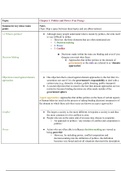
1.2 What is politics? ● Although many people understand what is meant by politics, the term itself
is very difficult to define
○ However, the three elements that are often mentioned are:
○ 1. Decision-making
○ 2. Power
○ 3. Conflict
■ Decisions made within the state are binding and even if you
Decision Making disagree you must obey them
● Approaches that define politics to the domain of
governments or the state are referred to as ‘domain
approaches’
Objections raised against domain ● One objection that is raised against domain approaches is the fact that it is
approaches sometimes not sure if it is the government's responsibility to deal with a
certain issue (e.g. domestic violence, public housing, public transport)
● A second objection that is raised is the fact that domain approaches are too
restrictive because binding decisions are often made outside of the
government sphere
Aspect approaches: approaches that define politics on the basis of certain aspects
of human behavior (such as the process of taking binding decision) irrespective of
the domain in which these activities occur are known as aspect approaches
Conflict ● The larger a society is, the more different viewpoints a society is and thus
the more common it is for conflicts to arise
● People who are on the same side of an issue may choose to cooperate
○ An approach to politics: ‘any mixture of conflict and cooperation is
politics.’
Power ● Actors who are often able to influence decision-making are viewed as
being powerful
○ However, by including power, conflict/cooperation and
decision-making into the definition of politics, the definition
becomes very broad and not all situations that merit the description
, should be considered to be political issues
Topic: IPOL Lecture 2
Summarize key ideas/ main Notes
points (Tips: Skip a space between ideas/topics and use abbreviations)
Political Scientists interest in 1. Frame questions
questions compels them to do four 2. Define concepts
things 3. Specify their theoretical arguments
4. Empirically illustrate and test their arguments
Categories of empirical illustration 1. Anecdotes (a story or illustration of a phenomenon with no clear
and evidence connection to the general question)
2. Case studies (a selected example of an instance or potential instance of a
phenomenon with identified power to speak to a general set of cases)
3. Descriptive quantitative research (the enumeration of the characteristics
of a population)
4. Inferential quantitative research (the use of statistical procedures to reach
conclusions about associations between variables)
Political science reasoning 1. Knowledge begins with asking questions about the world around us
2. The study of politics involves asking questions about conflict, cooperation,
coercion and distribution
3. Political science seeks general answers to these questions
4. Our interest in generalizing leads us to frame questions, define concepts and
specify, illustrate and test arguments
The race to the bottom ● The race to the bottom is a socio-economic phrase which is used to
describe government deregulation of the business environment, or reduction
in tax rates, in order to attract or attain economic activity in their
jurisdictions.
,
Summarize key ideas/ main Notes
points (Tips: Skip a space between ideas/topics and use abbreviations)
1.2 What is politics? ● Although many people understand what is meant by politics, the term itself
is very difficult to define
○ However, the three elements that are often mentioned are:
○ 1. Decision-making
○ 2. Power
○ 3. Conflict
■ Decisions made within the state are binding and even if you
Decision Making disagree you must obey them
● Approaches that define politics to the domain of
governments or the state are referred to as ‘domain
approaches’
Objections raised against domain ● One objection that is raised against domain approaches is the fact that it is
approaches sometimes not sure if it is the government's responsibility to deal with a
certain issue (e.g. domestic violence, public housing, public transport)
● A second objection that is raised is the fact that domain approaches are too
restrictive because binding decisions are often made outside of the
government sphere
Aspect approaches: approaches that define politics on the basis of certain aspects
of human behavior (such as the process of taking binding decision) irrespective of
the domain in which these activities occur are known as aspect approaches
Conflict ● The larger a society is, the more different viewpoints a society is and thus
the more common it is for conflicts to arise
● People who are on the same side of an issue may choose to cooperate
○ An approach to politics: ‘any mixture of conflict and cooperation is
politics.’
Power ● Actors who are often able to influence decision-making are viewed as
being powerful
○ However, by including power, conflict/cooperation and
decision-making into the definition of politics, the definition
becomes very broad and not all situations that merit the description
, should be considered to be political issues
Topic: IPOL Lecture 2
Summarize key ideas/ main Notes
points (Tips: Skip a space between ideas/topics and use abbreviations)
Political Scientists interest in 1. Frame questions
questions compels them to do four 2. Define concepts
things 3. Specify their theoretical arguments
4. Empirically illustrate and test their arguments
Categories of empirical illustration 1. Anecdotes (a story or illustration of a phenomenon with no clear
and evidence connection to the general question)
2. Case studies (a selected example of an instance or potential instance of a
phenomenon with identified power to speak to a general set of cases)
3. Descriptive quantitative research (the enumeration of the characteristics
of a population)
4. Inferential quantitative research (the use of statistical procedures to reach
conclusions about associations between variables)
Political science reasoning 1. Knowledge begins with asking questions about the world around us
2. The study of politics involves asking questions about conflict, cooperation,
coercion and distribution
3. Political science seeks general answers to these questions
4. Our interest in generalizing leads us to frame questions, define concepts and
specify, illustrate and test arguments
The race to the bottom ● The race to the bottom is a socio-economic phrase which is used to
describe government deregulation of the business environment, or reduction
in tax rates, in order to attract or attain economic activity in their
jurisdictions.
,