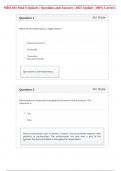
MBA 601 Mod 5 Quizzes | Questions and Answers | 2025 Update | 100% Correct.
Question 1 pts
Which of the following is not a tangible asset?
Building
orrect!
Copyright
Land
Gold
Tangible assets are things that can be perceived by the sensory system. In
other words, tangible assets are things that you can see or touch including
things like buildings, land, or gold. On the other hand, a copyright is a privilege
granted by the government. A privilege is an intangible asset. While it provides
an economic benefit, it cannot be seen or touched.
Question 2 pts
Land is different from other tangible assets in that its utility is not diminished by its
use. This statement is
orrect! True
False
, Using land does not damage its usefulness. To illustrate, consider the land on
which a building rests. The building may become dilapidated to the point it is torn
down while the land on which the building sits does not lose its capacity to
support another building.
Question 3 pts
Which of the following is an intangible asset?
Patent
Copyright
Trademark
orrect! All of the answers are names of intangible assets.
Intangible assets cannot be seen or touched. Do not be confused by the fact
that you can see a trademark. The image you see is not the intangible asset.
The intangible asset is the exclusive right to use the image for branding a
product. Similarly, you can see a book that is protected by a copyright. Again,
the intangible asset is not the book but instead the exclusive privilege to
publish, reproduce, sell, or otherwise distribute the content contained in the
book.
Question 4 pts
Capitalizing the cash cost of a piece of equipment is
orrect! an asset exchange event
an asset source event
, an asset use event
an equity exchange event
Capitalizing the cost of equipment means to record its cost in an asset account. Capitalizing
the cost is an asset exchange event. One asset account (cash) decreases and another asset
(equipment) increases. Total assets are not affected.
Question 5 pts
Corazon Company purchased an asset with a list price of $14,000.
Corazon paid $500 of transportation-in cost, $800 to train an
employee to operate the equipment, and $200 to ensure the asset
against theft after it has been set up in the factory. The asset was
purchased under terms 1/20/n30 and Corazon paid for the asset
within the discount period. Based on this information, Corazon would
capitalize the asset on its books at:
Note: "Terms 1/20/n30" means a 1% discount is offered if the
purchase is paid within 20 days, otherwise the purchase must be
paid within 30 days.
$14,000
$14,660
orrect!
$15,160
$14,800
, Cost of Asset:
List Price $14,000
Plus: Transportation in 500
Plus: Training 800
Less: Cash discount ($14,000 list price × 0.01 (140
discount) )
Total cost capitalized $15,160
The general rule in determining which costs to capitalize in an asset account is to capitalize
any cost that is necessary to obtain the asset or to make it ready for use. Note that the $200
of insurance was not included because it applied to coverage after the asset had been
acquired and set up for use.
Question 6 pts
All training costs associated with the purchase and continuing use of an asset should
be capitalized in the asset account. This statement is
True
orrect! False
Only the initial training cost should be capitalized. Training cost incurred after
the asset is up and running should be expensed.
Question 7 pts
When the total estimated market value of assets acquired in a basket purchase is greater
than the cost of the purchase, the company making the purchase must recognize a gain.
Question 1 pts
Which of the following is not a tangible asset?
Building
orrect!
Copyright
Land
Gold
Tangible assets are things that can be perceived by the sensory system. In
other words, tangible assets are things that you can see or touch including
things like buildings, land, or gold. On the other hand, a copyright is a privilege
granted by the government. A privilege is an intangible asset. While it provides
an economic benefit, it cannot be seen or touched.
Question 2 pts
Land is different from other tangible assets in that its utility is not diminished by its
use. This statement is
orrect! True
False
, Using land does not damage its usefulness. To illustrate, consider the land on
which a building rests. The building may become dilapidated to the point it is torn
down while the land on which the building sits does not lose its capacity to
support another building.
Question 3 pts
Which of the following is an intangible asset?
Patent
Copyright
Trademark
orrect! All of the answers are names of intangible assets.
Intangible assets cannot be seen or touched. Do not be confused by the fact
that you can see a trademark. The image you see is not the intangible asset.
The intangible asset is the exclusive right to use the image for branding a
product. Similarly, you can see a book that is protected by a copyright. Again,
the intangible asset is not the book but instead the exclusive privilege to
publish, reproduce, sell, or otherwise distribute the content contained in the
book.
Question 4 pts
Capitalizing the cash cost of a piece of equipment is
orrect! an asset exchange event
an asset source event
, an asset use event
an equity exchange event
Capitalizing the cost of equipment means to record its cost in an asset account. Capitalizing
the cost is an asset exchange event. One asset account (cash) decreases and another asset
(equipment) increases. Total assets are not affected.
Question 5 pts
Corazon Company purchased an asset with a list price of $14,000.
Corazon paid $500 of transportation-in cost, $800 to train an
employee to operate the equipment, and $200 to ensure the asset
against theft after it has been set up in the factory. The asset was
purchased under terms 1/20/n30 and Corazon paid for the asset
within the discount period. Based on this information, Corazon would
capitalize the asset on its books at:
Note: "Terms 1/20/n30" means a 1% discount is offered if the
purchase is paid within 20 days, otherwise the purchase must be
paid within 30 days.
$14,000
$14,660
orrect!
$15,160
$14,800
, Cost of Asset:
List Price $14,000
Plus: Transportation in 500
Plus: Training 800
Less: Cash discount ($14,000 list price × 0.01 (140
discount) )
Total cost capitalized $15,160
The general rule in determining which costs to capitalize in an asset account is to capitalize
any cost that is necessary to obtain the asset or to make it ready for use. Note that the $200
of insurance was not included because it applied to coverage after the asset had been
acquired and set up for use.
Question 6 pts
All training costs associated with the purchase and continuing use of an asset should
be capitalized in the asset account. This statement is
True
orrect! False
Only the initial training cost should be capitalized. Training cost incurred after
the asset is up and running should be expensed.
Question 7 pts
When the total estimated market value of assets acquired in a basket purchase is greater
than the cost of the purchase, the company making the purchase must recognize a gain.