MAGISTRATES COURT PRACTICES
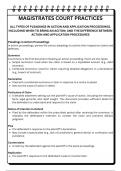
ALL TYPES OF PLEADINGS IN ACTION AND APPLICATION PROCEEDINGS.
INCLUDING WHEN TO BRING AN ACITON; AND THE DIFFERENCE BETWEEN
ACTION AND APPLICATION PROCEDURES
Pleadings in Action Proceedings
In action proceedings, parties file various pleadings to outline their respective claims and
defenses.
Summons
A summons is the first document initiating an action proceeding. There are two types:
Simple Summons: Used when the claim is based on a liquidated amount (e.g., debt
recovery).
Combined Summons: Used for claims requiring detailed allegations in a declaration
(e.g., breach of contract).
Declaration
Filed with a combined summons or later in response to a notice to plead.
Sets out the cause of action in detail.
Particulars of Claim
A detailed statement setting out the plaintiff’s cause of action, including the relevant
facts, legal grounds, and relief sought. This document provides sufficient detail for
the defendant to understand and respond to the claim.
Notice of Intention to Defend
Filed by the defendant within the prescribed period after receiving the summons. It
indicates the defendant’s intention to contest the claim and prevents default
judgment.
Plea
The defendant’s response to the plaintiff’s declaration.
May include a special plea (e.g., lack of jurisdiction), general denial, or confession and
avoidance.
Counterclaim
A claim by the defendant against the plaintiff in the same proceedings.
Replication
The plaintiff’s response to the defendant’s plea or counterclaim.
,Further Pleadings
Rejoinder (by defendant), Surrejoinder (by plaintiff), etc., in cases where further
responses are needed.
Plea
The defendant’s formal response to the particulars of claim. It addresses each
allegation, either admitting, denying, or stating insufficient knowledge to admit or
deny. It may also include legal defenses against the claim.
Special Plea
A preliminary defense raised before addressing the merits of the case. It challenges
aspects such as jurisdiction, prescription, or misjoinder of parties. If upheld, it may
dispose of the case without proceeding to trial.
Exception
Filed when a pleading is vague, embarrassing, or lacks a legal basis. It challenges the
validity of the claim or defense, requiring the opposing party to amend or clarify their
pleading. If upheld, the defective pleading may be struck out.
Objection to Irregular Proceedings
Raised when a party takes a procedural step that does not comply with court rules,
causing prejudice. The opposing party may request that the irregular step be
corrected or set aside.
Pleadings in Application Proceedings
Application proceedings rely on affidavits instead of oral evidence.
Notice of Motion
The applicant files this document to set out the relief sought and the date of the
hearing.
Can be ordinary (normal timelines) or urgent (shortened timelines).
Founding Affidavit
Supports the Notice of Motion with facts and legal grounds for the relief sought.
The deponent must affirm the truth of the statements.
Answering Affidavit
The respondent’s reply to the founding affidavit, disputing the applicant’s claims.
Replying Affidavit
The applicant’s response to the answering affidavit.
, Heads of Argument (if applicable)
A summary of legal arguments prepared for court.
When to Bring an Action vs. Application
Bring an action when factual disputes require witness testimony.
Bring an application when only legal issues or undisputed facts are involved.
The Magistrate’s Court Rules and Superior Courts Act guide the appropriate
procedure.
Difference between action and application
ALL TYPES OF PLEADINGS IN ACTION AND APPLICATION PROCEEDINGS.
INCLUDING WHEN TO BRING AN ACITON; AND THE DIFFERENCE BETWEEN
ACTION AND APPLICATION PROCEDURES
Pleadings in Action Proceedings
In action proceedings, parties file various pleadings to outline their respective claims and
defenses.
Summons
A summons is the first document initiating an action proceeding. There are two types:
Simple Summons: Used when the claim is based on a liquidated amount (e.g., debt
recovery).
Combined Summons: Used for claims requiring detailed allegations in a declaration
(e.g., breach of contract).
Declaration
Filed with a combined summons or later in response to a notice to plead.
Sets out the cause of action in detail.
Particulars of Claim
A detailed statement setting out the plaintiff’s cause of action, including the relevant
facts, legal grounds, and relief sought. This document provides sufficient detail for
the defendant to understand and respond to the claim.
Notice of Intention to Defend
Filed by the defendant within the prescribed period after receiving the summons. It
indicates the defendant’s intention to contest the claim and prevents default
judgment.
Plea
The defendant’s response to the plaintiff’s declaration.
May include a special plea (e.g., lack of jurisdiction), general denial, or confession and
avoidance.
Counterclaim
A claim by the defendant against the plaintiff in the same proceedings.
Replication
The plaintiff’s response to the defendant’s plea or counterclaim.
,Further Pleadings
Rejoinder (by defendant), Surrejoinder (by plaintiff), etc., in cases where further
responses are needed.
Plea
The defendant’s formal response to the particulars of claim. It addresses each
allegation, either admitting, denying, or stating insufficient knowledge to admit or
deny. It may also include legal defenses against the claim.
Special Plea
A preliminary defense raised before addressing the merits of the case. It challenges
aspects such as jurisdiction, prescription, or misjoinder of parties. If upheld, it may
dispose of the case without proceeding to trial.
Exception
Filed when a pleading is vague, embarrassing, or lacks a legal basis. It challenges the
validity of the claim or defense, requiring the opposing party to amend or clarify their
pleading. If upheld, the defective pleading may be struck out.
Objection to Irregular Proceedings
Raised when a party takes a procedural step that does not comply with court rules,
causing prejudice. The opposing party may request that the irregular step be
corrected or set aside.
Pleadings in Application Proceedings
Application proceedings rely on affidavits instead of oral evidence.
Notice of Motion
The applicant files this document to set out the relief sought and the date of the
hearing.
Can be ordinary (normal timelines) or urgent (shortened timelines).
Founding Affidavit
Supports the Notice of Motion with facts and legal grounds for the relief sought.
The deponent must affirm the truth of the statements.
Answering Affidavit
The respondent’s reply to the founding affidavit, disputing the applicant’s claims.
Replying Affidavit
The applicant’s response to the answering affidavit.
, Heads of Argument (if applicable)
A summary of legal arguments prepared for court.
When to Bring an Action vs. Application
Bring an action when factual disputes require witness testimony.
Bring an application when only legal issues or undisputed facts are involved.
The Magistrate’s Court Rules and Superior Courts Act guide the appropriate
procedure.
Difference between action and application