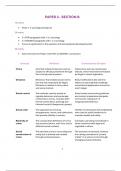
PAPER 3 - SECTION B
10 marks;
• Point; 1-2 sociology develop X3
20 marks;
• 3 x FOR paragraphs with 1-2 x sociology
• 3 x AGAINST paragraphs with 1-2 x sociology
• Focus on application to the question and well explained developed points
40 marks;
• Same structure for Paper 2 (4x FOR, 4x AGAINST, conclusion)
Concept Definition Contemporary Example
Crime Acts that violate formal laws and are Cybercrime such as ransomware
subject to official punishment through attacks, which have been formalized
the criminal justice system. as illegal in recent legislation.
Deviance Behaviour that violates social norms Body modifications like extreme
but may not necessarily be illegal. tattoos or piercings that challenge
Deviance is relative to time, place, conventional appearance norms but
and social context. aren't illegal.
Social control The methods used by society to Social media community guidelines
regulate behaviour and encourage and content moderation alongside
conformity to norms. Includes both community "calling out" of
formal control (laws, policing) and inappropriate behaviour.
informal control (disapproval, gossip).
Social order The organized set of social COVID-19 restrictions that established
arrangements, norms, and institutions new rules for public behaviour to
that provide stability in society. maintain health and safety.
Relativity of The concept that definitions of crime Cannabis use being criminalized in
crime vary across cultures, over time, and in some countries while legal and
different social contexts. regulated in others.
Social The idea that crime is not an objective The evolution of domestic violence
construction of reality but is defined and created from being considered a "private
crime through social processes . matter" to a serious crime through
changing societal attitudes.
1
, Measuring crime
Victim surveys – surveys given to those who have experienced crime, e.g. The Crime Survey for
England & Wales
Advantages Disadvantages
• Provides insights into unreported crime • Coleman – rely on honesty and memory
• Dobash – official statistics can so may not be representative
underestimate the issues of domestic • Dependent on how/what people define
violence as ‘crime’
• Can understand a wide range of • Most surveys exclude under-16s, the
including less visible e.g. Hate crime homeless, and people in institutions
• Lea & Young – emphasise the (e.g., prisons) - groups often more
importance of VS in understanding vulnerable to crime.
effects on people • Large-scale surveys like the CSEW are
expensive and time-consuming to
conduct regularly.
Self-report studies - (often quantitative) individuals anonymously report their own criminal or
deviant behaviour, often revealing higher crime rates than official statistics.
Advantages Disadvantages
• Gives access to the Dark figure of • Respondents may lie or exaggerate;
Crime either to look tough (e.g. among
• Allows for comparisons; how factors peers) or to avoid judgment, reducing
like age, gender, class, or ethnicity validity.
relate to offending rates. • Most respondents are reluctant to
• Bowling - Conducted a SRS on youth admit to serious crimes (e.g., assault,
offending among 14–25-year-olds in sexual violence), so data usually
Britain. Findings showed that offending skews toward less serious offending
rates were more similar across ethnic • Responses rely on accurate memory;
groups than police records suggested, Farrington et al. (1991) – Cambridge
which challenged official statistics. Study in Delinquent Development
Study: Longitudinal self-report and
official data study of 411 working-
class boys in London. Finding: Many
boys underreported their offending,
especially as they got older.
• Often use non-random samples like
students or volunteers — making
findings less representative of the
general population
2
10 marks;
• Point; 1-2 sociology develop X3
20 marks;
• 3 x FOR paragraphs with 1-2 x sociology
• 3 x AGAINST paragraphs with 1-2 x sociology
• Focus on application to the question and well explained developed points
40 marks;
• Same structure for Paper 2 (4x FOR, 4x AGAINST, conclusion)
Concept Definition Contemporary Example
Crime Acts that violate formal laws and are Cybercrime such as ransomware
subject to official punishment through attacks, which have been formalized
the criminal justice system. as illegal in recent legislation.
Deviance Behaviour that violates social norms Body modifications like extreme
but may not necessarily be illegal. tattoos or piercings that challenge
Deviance is relative to time, place, conventional appearance norms but
and social context. aren't illegal.
Social control The methods used by society to Social media community guidelines
regulate behaviour and encourage and content moderation alongside
conformity to norms. Includes both community "calling out" of
formal control (laws, policing) and inappropriate behaviour.
informal control (disapproval, gossip).
Social order The organized set of social COVID-19 restrictions that established
arrangements, norms, and institutions new rules for public behaviour to
that provide stability in society. maintain health and safety.
Relativity of The concept that definitions of crime Cannabis use being criminalized in
crime vary across cultures, over time, and in some countries while legal and
different social contexts. regulated in others.
Social The idea that crime is not an objective The evolution of domestic violence
construction of reality but is defined and created from being considered a "private
crime through social processes . matter" to a serious crime through
changing societal attitudes.
1
, Measuring crime
Victim surveys – surveys given to those who have experienced crime, e.g. The Crime Survey for
England & Wales
Advantages Disadvantages
• Provides insights into unreported crime • Coleman – rely on honesty and memory
• Dobash – official statistics can so may not be representative
underestimate the issues of domestic • Dependent on how/what people define
violence as ‘crime’
• Can understand a wide range of • Most surveys exclude under-16s, the
including less visible e.g. Hate crime homeless, and people in institutions
• Lea & Young – emphasise the (e.g., prisons) - groups often more
importance of VS in understanding vulnerable to crime.
effects on people • Large-scale surveys like the CSEW are
expensive and time-consuming to
conduct regularly.
Self-report studies - (often quantitative) individuals anonymously report their own criminal or
deviant behaviour, often revealing higher crime rates than official statistics.
Advantages Disadvantages
• Gives access to the Dark figure of • Respondents may lie or exaggerate;
Crime either to look tough (e.g. among
• Allows for comparisons; how factors peers) or to avoid judgment, reducing
like age, gender, class, or ethnicity validity.
relate to offending rates. • Most respondents are reluctant to
• Bowling - Conducted a SRS on youth admit to serious crimes (e.g., assault,
offending among 14–25-year-olds in sexual violence), so data usually
Britain. Findings showed that offending skews toward less serious offending
rates were more similar across ethnic • Responses rely on accurate memory;
groups than police records suggested, Farrington et al. (1991) – Cambridge
which challenged official statistics. Study in Delinquent Development
Study: Longitudinal self-report and
official data study of 411 working-
class boys in London. Finding: Many
boys underreported their offending,
especially as they got older.
• Often use non-random samples like
students or volunteers — making
findings less representative of the
general population
2