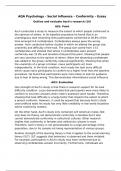
AQA Psychology - Social Influence – Conformity – Essay
Outline and evaluate Asch’s research (16)
A01: Point
Asch conducted a study to measure the extent to which people conformed to
the opinions of others. In his baseline procedure he found that in an
unambiguous task (matching lines) participants conformed to 36.8% of the
time amongst 6-8 confederates. Confederates always gave the wrong
answer. Asch conducted further studies in which he altered the group size,
unanimity and difficulty of the task. The group size varied from 1-15
confederates and showed that where 3 confederates were present
conformity was 31.8% and levelled of beyond this point. Showing that people
are very sensitive to the opinion of others. When the dissenting confederate
was added to the group conformity reduced significantly. Showing that when
the unanimity of a group is broken, naive participants act more
independently. In the third condition, Asch made the task more difficult
which cause naive participants to conform to a higher level than the baseline
procedure. He found that participants were more likely to look for guidance
due to fear of being wrong. This demonstrates informational social influence.
AO3: Evaluation
One strength of Asch’s study is that there is research support for his task
difficulty condition. Lucas demonstrated that participants were more likely to
conform to incorrect answers when math's questions were harder. Therefore,
showing that task difficulty is a large factor that impacts the extent to which
a person conforms. However, it could be argued that because Asch's study
used artificial tasks his study has very little credibility in real world situations
where conformity matters.
On the other hand, Asch’s study only contained 123 American males. Not
only does his theory not demonstrate conformity in females but it also
cannot demonstrate conformity in collectivist cultures. Other research
implies that conformity in females and collectivist cultures is more.
Therefore, Asch’s theory is not generalisable to a large percentage of the
population, due to his sample not being representative of various groups.
Another strength of the learning theory is that it applies to the social learning
theory (SLT). SLT suggests that behaviour is observed and them imitated.
For example, participants in Asch’s study may have conformed due to
observing confederates answer incorrectly. Furthermore, individuals are
Outline and evaluate Asch’s research (16)
A01: Point
Asch conducted a study to measure the extent to which people conformed to
the opinions of others. In his baseline procedure he found that in an
unambiguous task (matching lines) participants conformed to 36.8% of the
time amongst 6-8 confederates. Confederates always gave the wrong
answer. Asch conducted further studies in which he altered the group size,
unanimity and difficulty of the task. The group size varied from 1-15
confederates and showed that where 3 confederates were present
conformity was 31.8% and levelled of beyond this point. Showing that people
are very sensitive to the opinion of others. When the dissenting confederate
was added to the group conformity reduced significantly. Showing that when
the unanimity of a group is broken, naive participants act more
independently. In the third condition, Asch made the task more difficult
which cause naive participants to conform to a higher level than the baseline
procedure. He found that participants were more likely to look for guidance
due to fear of being wrong. This demonstrates informational social influence.
AO3: Evaluation
One strength of Asch’s study is that there is research support for his task
difficulty condition. Lucas demonstrated that participants were more likely to
conform to incorrect answers when math's questions were harder. Therefore,
showing that task difficulty is a large factor that impacts the extent to which
a person conforms. However, it could be argued that because Asch's study
used artificial tasks his study has very little credibility in real world situations
where conformity matters.
On the other hand, Asch’s study only contained 123 American males. Not
only does his theory not demonstrate conformity in females but it also
cannot demonstrate conformity in collectivist cultures. Other research
implies that conformity in females and collectivist cultures is more.
Therefore, Asch’s theory is not generalisable to a large percentage of the
population, due to his sample not being representative of various groups.
Another strength of the learning theory is that it applies to the social learning
theory (SLT). SLT suggests that behaviour is observed and them imitated.
For example, participants in Asch’s study may have conformed due to
observing confederates answer incorrectly. Furthermore, individuals are