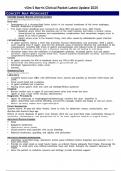
vSim S Morris Clinical Packet Latest Update 2025
DESCRIBE DISEASE PROCESS AFFECTING PATIENT (Include Pathophysiology of Disease Process) Overview ▪ Development of a circumscribed lesion (ulcer) in the mucosal membrane of the lower esophagus, stomach, duodenum, or jejunum ▪ Two major forms: Duodenal ulcer (accounts for about 80%) and gastric ulcer, both chronic o Duodenal ulcers affect the proximal part of the small intestine and follow a chronic course, characterized by remissions and exacerbations; complications that necessitate surgery occur in about 5% to 10% of patients o Gastric ulcers occur in the stomach lining, most often caused by Helicobacter pylori infection Pathophysiology ▪ H. pylori bacteria release a toxin that promotes mucosal inflammation and ulceration. With a peptic ulcer resulting from H. pylori, acid isn't the dominant cause of bacterial infection but contributes to the consequences, including high levels of gastrin and pepsinogen and reduced levels of somatostatin. Duodenal bicarbonate secretion also is impaired, lowering the pH and leading to acid injury. ▪ Ulceration stems from the inhibition of prostaglandin synthesis, increased gastric acid and pepsin secretion, reduced gastric mucosal blood flow, reduced duodenal bicarbonate secretion, and decreased cytoprotective mucus production. Causes ▪ H. pylori (accounts for 90% of duodenal ulcers and 70% to 90% of gastric ulcers) ▪ Nonsteroidal anti-inflammatory drug (NSAID) or glucocorticoid use ▪ Pathologic hypersecretory states (rare) ▪ Genetics DIAGNOSTICS TESTS (Reason for Test and Results) Laboratory ▪ Complete blood count (CBC) with differential shows anemia and possibly an elevated white blood cell count. ▪ Fecal occult blood test is positive. ▪ H. pylori antibody test is positive. ▪ Fasting serum gastrin level test rules out Zollinger-Ellison syndrome. Imaging ▪ Barium swallow test or upper GI and small-bowel series may reveal the ulcer. ▪ Upper GI tract X-rays reveal mucosal abnormalities. Diagnostic Procedures ▪ Upper GI endoscopy or esophagogastroduodenoscopy confirms the ulcer, identifies H. pylori, determines and controls bleeding, and permits cytologic studies and biopsy to rule out cancer. ▪ Gastric secretory studies show hyperchlorhydria PATIENT INFORMATION Suzanne Morris, 43-year-old white female. Came to clinic for abdominal cramps, stomachache, and diarrhea that started 4 days ago History of recent diagnosis of peptic ulcer disease which she was prescribed triple combination therapy of amoxicillin, clarithromycin, and pantoprazole for H. No other significant medical or surgical history. ANTICIPATED PHYSICAL FINDINGS ▪ Pallor ▪ Epigastric tenderness ▪ Hyperactive bowel sounds ▪ Guaiac-positive stool (possible with occult bleeding) ▪ Rebound tenderness, guarding, and rigidity with perforation ANTICIPATED NURSING INTERVENTIONS ▪ Administer prescribed drugs. Administer proton pump inhibitors before breakfast and antacids 1 to 3 hours after meals. ▪ Provide six small meals or small hourly meals, as ordered. Ensure adequate fluid intake. Encourage the patient to avoid spicy and caffeine-containing foods and fluids. Evaluate the patient's tolerance of intake. ▪ Allow the patient to verbalize concerns and feelings; provide emotional support. ▪ Auscultate bowel sounds. ▪ Assess bowel elimination patterns. Check stools for occult blood. ▪ Assess the patient's abdomen for distention and tenderness. ▪ Assist with gastric lavage, as indicated, if the patient is experiencing GI bleeding. ▪ Administer IV fluid therapy, as indicated, if the patient is experiencing GI bleeding. ▪ Assess skin turgor for evidence of hydration. ▪ Obtain specimens for laboratory testing, such as complete blood count. ▪ Screen for and assess the patient's pain using facility-defined criteria that are consistent with the patient's age, condition, and ability to understand. ▪ Treat the patient's pain, as needed and ordered, using nonpharmacologic, pharmacologic, or a combination of approaches. ▪ Reassess and respond to the patient's pain by evaluating the response to treatment and progress toward pain management goals. Prepare the patient and family for possible surgery, as appropriate. ▪ Assist the patient in developing effective relaxation and stress management techniques. VSIM ISBAR ACTIVITY Student Worksheet INTRODUCTION Milagros Ballesteros, LPN, Urgent Care Unit Your name, position (RN), unit you are working on SITUATION Suzanne Morris, is a 43-year-old white female presenting with complaints of increasing abdominal cramps, stomachache, and diarrhea that started 4 days ago. Ms. Morris arrived by private vehicle and has been here for 1 hour. Patient’s name, age, specific reason for visit BACKGROUND Ms. Morris was diagnosed 10 days ago with peptic ulcer disease and prescribed triple combination therapy of amoxicillin, clarithromycin, and pantoprazole for H. pylori. She has been consistently taking the medications. Ms. Morris does not have any other significant previous medical or surgical history. Patient’s primary diagnosis, date of admission, current orders for patient ASSESSMENT Ms. Morris is awake and alert but complains of cramping, stomachache, and diarrhea. Her last set of vital signs was BP: 101/61 mm Hg, HR: 114/min, RR: 17/min, and SpO2 at 95% on room air. Patient has a 20-gauge peripheral IV in her right arm and she was given a 500 mL normal saline bolus at arrival per provider’s orders as her systolic blood pressure was less than 100 mmHg. Normal saline is now running at 100 mL/hour. A blood sample and a stool sample to confirm suspected C. difficile infection. It has been sent Current pertinent assessment data using head-to-toe approach, pertinent diagnostics, vital signs. RECOMMENDATION The provider put orders in the patient’s chart based on the initial assessments. The patient is due for vital signs and other assessments that you will need to implement. You should keep an eye on her blood pressure and call the provider if her systolic pressure drops to less than 100 mmHg. Also, be aware that she is on contact precautions. Any orders or recommendations you may have for this patient NAME OF MEDICATION, CLASSIFICATION AND INCLUDE PROTOTYPE MEDICATION: Pantoprazole sodium CLASSIFICATION: Antiulcer drugs-Proton Pump Inhibitors PROTOTYPE: Omeprazole CONTRAINDICATIONS: ▪ Contraindicated in patients hypersensitive to any component of the formulation. ▪ PPI therapy may be associated with an increased risk of osteoporosis-related fractures. Patients should use lowest dose and shortest duration of therapy appropriate to condition being treated. ▪ Cutaneous lupus erythematosus (CLE) and SLE have been reported, occurring as both new onset and an exacerbation of existing autoimmune disease in patients of all ages within weeks to years after continuous drug therapy. ADVERSE EFFECTS: CNS: anxiety, asthenia, dizziness, headache, insomnia, migraine, pain, depression, vertigo. CV: chest pain, edema, thrombophlebitis. EENT: blurred vision, pharyngitis, rhinitis, sinusitis. GI: abdominal pain, constipation, diarrhea, dyspepsia, eructation, flatulence, gastroenteritis, GI disorder, nausea, rectal disorder, vomiting. GU: urinary frequency, UTI. Hematologic: leukopenia, thrombocytopenia. Hepatic: elevated liver enzyme levels. Metabolic: hyperglycemia, hyperlipidemia. Musculoskeletal: arthralgia, back pain, hypertonia, neck pain. Respiratory: bronchitis, dyspnea, increased cough, URI. Skin: rash, pruritus, urticaria. Other: flulike syndrome, infection, injection-site reaction, photosensitivity reactions. BLACK BOX WARNINGS: SAFE DOSE OR DOSE RANGE, SAFE ROUTE Route: IV, PO Dosage Maintenance of healing of erosive esophagitis Adults: 40 mg PO once daily. Short-term treatment of erosive esophagitis associated with GERD Adults: 40 mg PO once daily for up to 8 weeks. For patients who haven’t healed after 8 weeks of treatment, another 8-week course may be considered. Or, 40 mg IV once daily for 7 to 10 days. Switch to PO form as soon as patient is able to take orally. Long-term maintenance of healing erosive esophagitis and reduction in relapse rates of daytime and nighttime heartburn symptoms in patients with GERD Adults: 40 mg PO once daily. Treatment of pathologic hypersecretion caused by Zollinger-Ellison syndrome Adults: Individualize dosage. Usual dosage is 40 mg PO b.i.d. Usual IV dose is 80 mg IV every 12 hours for no more than 6 days. For those needing a higher dose, 80 mg every 8 hours is expected to maintain acid output below 10 mEq/hour. Maximum daily dose is 240 mg/day. When converting from IV to PO form, ensure continuity of suppression of acid secretion. Dyspepsia Adults: 20 to 40 mg once daily for 4 weeks PURPOSE FOR TAKING THIS MEDICATION ▪ Long-term maintenance of healing erosive esophagitis and reduction in relapse rates of daytime and nighttime heartburn symptoms in patients with GERD ▪ Treatment of pathologic hypersecretion caused by Zollinger-Ellison syndrome ▪ Dyspepsia PATIENT EDUCATION WORKSHEET ▪ Maintenance of healing of erosive esophagitis PATIENT EDUCATION WHILE TAKING THIS MEDICATION ▪ Instruct patient to take exactly as prescribed and at about the same time every day. ▪ Advise patient that drug can be taken without regard to meals. ▪ Tell patient to swallow tablet whole and not to crush, split, or chew it. ▪ Tell patient that antacids don’t affect drug absorption. ▪ Teach patient to report all adverse reactions and to recognize and report signs and symptoms of low magnesium levels. NAME OF MEDICATION, CLASSIFICATION AND INCLUDE PROTOTYPE MEDICATION: Metronidazole CLASSIFICATION: Antiprotozoals PROTOTYPE: Metronidazole CONTRAINDICATIONS: ▪ Contraindicated in patients hypersensitive to drug or other nitroimidazole derivatives. The use of disulfiram within 2 weeks of metronidazole therapy and the use of alcohol or propylene glycol products during treatment and for 3 days after treatment ends are contraindicated. ▪ Use cautiously in patients with history of blood dyscrasia, CNS disorder, or retinal or visual field changes. ▪ Use cautiously in patients who take hepatotoxic drugs or have hepatic disease, alcoholism, or renal impairment. ADVERSE EFFECTS: CNS: headache, seizures, fever, vertigo, ataxia, dizziness, syncope, incoordination, confusion, irritability, depression, weakness, insomnia, peripheral neuropathy. CV: flattened T wave, edema, flushing, thrombophlebitis after IV infusion. EENT: rhinitis, sinusitis, pharyngitis. GI: nausea, abdominal pain, stomatitis, epigastric distress, vomiting, anorexia, diarrhea, constipation, proctitis, dry mouth, metallic taste. GU: vaginitis, darkened urine, polyuria, dysuria, cystitis, dyspareunia, dryness of vagina and vulva, vaginal candidiasis, genital pruritus, UTI, dysmenorrhea. Hematologic: transient leukopenia, neutropenia. Musculoskeletal: transient joint pains. Respiratory: URI. Skin: rash. Other: decreased libido; overgrowth of nonsusceptible organisms, candidiasis; flulike symptoms. BLACK BOX WARNINGS: ▪ Use metronidazole only for the conditions for which it’s indicated because it may be carcinogenic. Avoid unnecessary use SAFE DOSE OR DOSE RANGE, SAFE ROUTE ROUTE:PO, IV Dosage: Amebic liver abscess- Adults: 500 to 750 mg PO t.i.d. for 5 to 10 days. Intestinal amebiasis (immediate-release)-Adults: 750 mg PO t.i.d. for 7 to 10 days. Trichomoniasis (immediate-release)- Adults: One 250-mg tablet PO t.i.d. for 7 days, or 2 g PO in single dose (may give the 2-g dose in two 1-g doses, both on the same day); wait 4 to 6 weeks before repeating course. Or, one 375-mg capsule PO b.i.d. for 7 days. Bacterial infections caused by anaerobic microorganisms-Adults: Loading dose is 15 mg/kg IV infused over 1 hour. Maintenance dose is 7.5 mg/kg IV or 500 mg PO every 6 hours. Give first maintenance dose 6 hours after loading dose. Maximum dose shouldn’t exceed 4 g daily. To prevent postoperative infection in contaminated or potentially contaminated colorectal surgery- Adults: Infuse 15 mg/kg IV over 30 to 60 minutes and complete about 1 hour before surgery. Then, infuse 7.5 mg/kg IV over 30 to 60 minutes at 6 and 12 hours after first dose. Bacterial vaginosis (nonpregnant women)-Adults: 500 mg PO b.i.d. for 7 days. Giardiasis- Adults: 250 to 500 mg t.i.d. or 500 mg b.i.d. for 5 to 7 days. Pouchitis-Adults: (Acute) 500 mg to 1 g every 12 hours for 14 days. (Chronic) 500 mg every 12 hours in combination with ciprofloxacin for at least 28 days.
Escuela, estudio y materia
- Institución
- Herzing University
- Grado
- PN 126
Información del documento
- Subido en
- 1 de julio de 2025
- Número de páginas
- 14
- Escrito en
- 2024/2025
- Tipo
- Examen
- Contiene
- Preguntas y respuestas
Temas
-
vsim s morris clinical packet latest update 2025

Documento también disponible en un lote