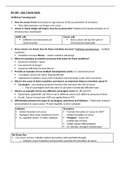
Chapter 4- study Guide
1. What are the 4 tissue types?
Epithelial, Connective, Muscle and Nervous
2. What are the two main forms of epithelial tissue?
Covering and lining epithelia and glandular epithelia
3. What are the major functions of epithelial tissue?
Protection, absorption, filtration, excretion, secretion, and sensory reception
4. What are the five special characteristics of epithelial tissue?
Polarity, Specialized contacts, Supported by connective tissue, Avascular, and High regenerative capacity
5. List and explain the characteristics that are used to classify epithelial tissue?
First name indicates number of cell layers-
Simple epithelia are a single layer thick
Stratified epithelia are two or more layers thick and involved in protection (example: skin)
Second name indicates shape of cells-
Squamous: flattened and scale-like
Cuboidal: box-like, cube
Columnar: tall, column-like
6. For each epithelial tissue, list its appearance (study micrographs in textbook), special features if present,
function, and location.
a. Simple Squamous- Flattened scale-like cells, with oval-shaped, flattened nuclei.
b. Simple Cuboidal- Rounded cube-like cells
c. Simple Columnar- Column-like structures
d. Stratified Squamous- Multiple layers of cells with the outermost layer consisting of flat, squamous cells,
while the deeper layers are more cuboidal or columnar.
e. Stratified Cuboidal- Multiple layers of cube-shaped cells
f. Stratified Columnar- Multiple layers of cells with the apical layer composed of tall, column-shaped cells.
g. Pseudostratified Columnar- column-like cells of varying heights.
, h. Transitional- A multi-layered tissue with cells that are round or pear-shaped but flatten when stretched.
7. What is a gland? Describe the differences between an endocrine and an exocrine gland.
One or more cells that makes and secretes an aqueous fluid called a secretion.
Endocrine: internally secreting (example: hormones)
Exocrine: externally secreting (example: sweat)
8. Describe and give an example of a unicellular exocrine gland.
Single celled gland. Goblet cells.
9. Multicellular exocrine glands are classified by their structure and mode of secretion. List and describe the
different possible structures and modes of secretion. Provide examples for each.
Simple exocrine glands have unbranched ducts, but compound glands have branched ducts
In a tubular gland, secretory cells form a duct, whereas in alveolar glands, secretory cells form sacs
Tubuloalveolar glands have both types.
Merocrine: most secrete products by exocytosis as secretions are produced (sweat, pancreas)
Holocrine: accumulate products within, then rupture (sebaceous oil glands)
Apocrine: accumulate products within, but only apex ruptures; whether this type exists in humans is
controversial (maybe mammary cells?)
10. What are the 4 main classes of connective tissue?
Connective tissue proper
Cartilage
Bone
Blood
11. What are three characteristics common to connective tissues?
-All have common embryonic origin: all arise from mesenchyme tissue as their tissue of origin
-Have varying degrees of vascularity (cartilage is avascular, bone is highly vascularized)
-Cells are suspended/embedded in extracellular matrix (ECM) (protein-sugar mesh)
12. List and describe in detail the three structural elements (and all of their types) that are found in connective
tissue?
Ground substance: Unstructured gel-like material that fills space between cells
Fibers: provide support
Collagen- Strongest and most abundant type
Elastic fibers- Networks of long, thin, elastin fibers that allow for stretch and recoil
Reticular-
Short, fine, highly branched collagenous fibers
Cells:
“Blast” cells- Immature form of cell that actively secretes ground substance and ECM fibers
Fibroblasts- found in connective tissue proper
Chondroblasts- found in cartilage
Osteoblasts- found in bone
Hematopoietic- stem cells in bone marrow
1. What are the 4 tissue types?
Epithelial, Connective, Muscle and Nervous
2. What are the two main forms of epithelial tissue?
Covering and lining epithelia and glandular epithelia
3. What are the major functions of epithelial tissue?
Protection, absorption, filtration, excretion, secretion, and sensory reception
4. What are the five special characteristics of epithelial tissue?
Polarity, Specialized contacts, Supported by connective tissue, Avascular, and High regenerative capacity
5. List and explain the characteristics that are used to classify epithelial tissue?
First name indicates number of cell layers-
Simple epithelia are a single layer thick
Stratified epithelia are two or more layers thick and involved in protection (example: skin)
Second name indicates shape of cells-
Squamous: flattened and scale-like
Cuboidal: box-like, cube
Columnar: tall, column-like
6. For each epithelial tissue, list its appearance (study micrographs in textbook), special features if present,
function, and location.
a. Simple Squamous- Flattened scale-like cells, with oval-shaped, flattened nuclei.
b. Simple Cuboidal- Rounded cube-like cells
c. Simple Columnar- Column-like structures
d. Stratified Squamous- Multiple layers of cells with the outermost layer consisting of flat, squamous cells,
while the deeper layers are more cuboidal or columnar.
e. Stratified Cuboidal- Multiple layers of cube-shaped cells
f. Stratified Columnar- Multiple layers of cells with the apical layer composed of tall, column-shaped cells.
g. Pseudostratified Columnar- column-like cells of varying heights.
, h. Transitional- A multi-layered tissue with cells that are round or pear-shaped but flatten when stretched.
7. What is a gland? Describe the differences between an endocrine and an exocrine gland.
One or more cells that makes and secretes an aqueous fluid called a secretion.
Endocrine: internally secreting (example: hormones)
Exocrine: externally secreting (example: sweat)
8. Describe and give an example of a unicellular exocrine gland.
Single celled gland. Goblet cells.
9. Multicellular exocrine glands are classified by their structure and mode of secretion. List and describe the
different possible structures and modes of secretion. Provide examples for each.
Simple exocrine glands have unbranched ducts, but compound glands have branched ducts
In a tubular gland, secretory cells form a duct, whereas in alveolar glands, secretory cells form sacs
Tubuloalveolar glands have both types.
Merocrine: most secrete products by exocytosis as secretions are produced (sweat, pancreas)
Holocrine: accumulate products within, then rupture (sebaceous oil glands)
Apocrine: accumulate products within, but only apex ruptures; whether this type exists in humans is
controversial (maybe mammary cells?)
10. What are the 4 main classes of connective tissue?
Connective tissue proper
Cartilage
Bone
Blood
11. What are three characteristics common to connective tissues?
-All have common embryonic origin: all arise from mesenchyme tissue as their tissue of origin
-Have varying degrees of vascularity (cartilage is avascular, bone is highly vascularized)
-Cells are suspended/embedded in extracellular matrix (ECM) (protein-sugar mesh)
12. List and describe in detail the three structural elements (and all of their types) that are found in connective
tissue?
Ground substance: Unstructured gel-like material that fills space between cells
Fibers: provide support
Collagen- Strongest and most abundant type
Elastic fibers- Networks of long, thin, elastin fibers that allow for stretch and recoil
Reticular-
Short, fine, highly branched collagenous fibers
Cells:
“Blast” cells- Immature form of cell that actively secretes ground substance and ECM fibers
Fibroblasts- found in connective tissue proper
Chondroblasts- found in cartilage
Osteoblasts- found in bone
Hematopoietic- stem cells in bone marrow