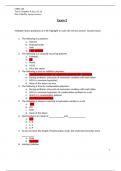
CSTR EXAM LATEST 2025 REAL EXAM UPDATE
180 QUESTIONS CORRECTLY ANSWERED
(VERIFIED EXAM) A+ GRADE
1. What is the primary purpose of threat intelligence in security operations?
To identify, analyze, and respond to potential security threats before they
impact the organization.
Threat intelligence helps organizations proactively detect and mitigate risks by
understanding emerging threats and attacker tactics.
2. Which security principle ensures that data is not altered or tampered with
during transmission?
Integrity
Integrity guarantees that information remains unchanged and trustworthy
throughout its lifecycle.
3. What type of attack involves an attacker intercepting communication
between two parties without their knowledge?
Man-in-the-Middle (MITM) attack
In a MITM attack, the attacker secretly relays or alters communications
between two parties who believe they are directly communicating.
4. Which device is commonly used to segment a network into multiple
broadcast domains?
,Router
Routers separate broadcast domains and route traffic between different IP
networks, enhancing network segmentation.
5. What is the primary function of a Security Information and Event
Management (SIEM) system?
To collect, analyze, and correlate security events from multiple sources in real-
time.
SIEM solutions provide centralized monitoring and alerting by aggregating logs
and detecting anomalies or attacks.
6. Which protocol is commonly used to secure remote administration of
network devices?
SSH (Secure Shell)
SSH provides encrypted communication for secure remote management,
replacing less secure protocols like Telnet.
7. What does the CIA triad stand for in cybersecurity?
Confidentiality, Integrity, and Availability
These three core principles guide security policies and controls to protect
information systems.
8. Which method is most effective for preventing SQL Injection attacks?
Using parameterized queries or prepared statements
Parameterized queries ensure user input is treated as data, not executable code,
preventing injection of malicious SQL.
9. What is a zero-day vulnerability?
, A security flaw that is unknown to the vendor and has no available patch.
Zero-day vulnerabilities are dangerous because attackers can exploit them
before developers create fixes.
10.What is the role of a firewall in network security?
To filter incoming and outgoing traffic based on predefined security rules.
Firewalls enforce access control policies by allowing or blocking network traffic
to protect the internal network.
11.Which type of malware encrypts user data and demands payment for its
release?
Ransomware
Ransomware restricts access to data and demands a ransom, typically in
cryptocurrency, for decryption keys.
12.What is social engineering in the context of cybersecurity?
Manipulating individuals to divulge confidential information or perform actions
compromising security.
Social engineering exploits human psychology rather than technical
vulnerabilities.
13.What does multi-factor authentication (MFA) require?
Two or more verification factors from different categories (something you
know, have, or are).
MFA increases security by requiring multiple independent credentials to verify a
user's identity.
14.What is a botnet?
180 QUESTIONS CORRECTLY ANSWERED
(VERIFIED EXAM) A+ GRADE
1. What is the primary purpose of threat intelligence in security operations?
To identify, analyze, and respond to potential security threats before they
impact the organization.
Threat intelligence helps organizations proactively detect and mitigate risks by
understanding emerging threats and attacker tactics.
2. Which security principle ensures that data is not altered or tampered with
during transmission?
Integrity
Integrity guarantees that information remains unchanged and trustworthy
throughout its lifecycle.
3. What type of attack involves an attacker intercepting communication
between two parties without their knowledge?
Man-in-the-Middle (MITM) attack
In a MITM attack, the attacker secretly relays or alters communications
between two parties who believe they are directly communicating.
4. Which device is commonly used to segment a network into multiple
broadcast domains?
,Router
Routers separate broadcast domains and route traffic between different IP
networks, enhancing network segmentation.
5. What is the primary function of a Security Information and Event
Management (SIEM) system?
To collect, analyze, and correlate security events from multiple sources in real-
time.
SIEM solutions provide centralized monitoring and alerting by aggregating logs
and detecting anomalies or attacks.
6. Which protocol is commonly used to secure remote administration of
network devices?
SSH (Secure Shell)
SSH provides encrypted communication for secure remote management,
replacing less secure protocols like Telnet.
7. What does the CIA triad stand for in cybersecurity?
Confidentiality, Integrity, and Availability
These three core principles guide security policies and controls to protect
information systems.
8. Which method is most effective for preventing SQL Injection attacks?
Using parameterized queries or prepared statements
Parameterized queries ensure user input is treated as data, not executable code,
preventing injection of malicious SQL.
9. What is a zero-day vulnerability?
, A security flaw that is unknown to the vendor and has no available patch.
Zero-day vulnerabilities are dangerous because attackers can exploit them
before developers create fixes.
10.What is the role of a firewall in network security?
To filter incoming and outgoing traffic based on predefined security rules.
Firewalls enforce access control policies by allowing or blocking network traffic
to protect the internal network.
11.Which type of malware encrypts user data and demands payment for its
release?
Ransomware
Ransomware restricts access to data and demands a ransom, typically in
cryptocurrency, for decryption keys.
12.What is social engineering in the context of cybersecurity?
Manipulating individuals to divulge confidential information or perform actions
compromising security.
Social engineering exploits human psychology rather than technical
vulnerabilities.
13.What does multi-factor authentication (MFA) require?
Two or more verification factors from different categories (something you
know, have, or are).
MFA increases security by requiring multiple independent credentials to verify a
user's identity.
14.What is a botnet?