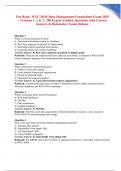
WGU D426 Data Management Foundations
Exam 2025 – Versions 1, 2, & 3: 100+ Expert
Questions with Verified Answers and
Rationales
Databases (20 Questions)
Question 1: Multiple-Choice
Which requirement in large, complex databases ensures users have limited access to the
database?
A. Recovery
B. Performance
C. Authorization
D. Confidentiality
Correct Answer: C
Rationale: Authorization (C) restricts user access to specific data, ensuring security in large
databases. Recovery (A) restores data, performance (B) optimizes speed, and confidentiality (D)
protects data privacy but is not specific to access control.
Question 2: Select-All-That-Apply
Which components are essential to a database management system (DBMS)? (Select all that
apply.)
A. Query processor
B. Data storage
C. Operating system
D. Transaction manager
Correct Answers: A, B, D
Rationale: A DBMS includes the query processor (A) for executing queries, data storage (B) for
holding data, and transaction manager (D) for ensuring transaction integrity. The operating
system (C) supports the DBMS but is not a component.
Question 3: Case Study (6 Questions)
Case Study: A company designs a database to track customer orders. The database uses MySQL
and requires secure data management.
Question 3.1: Multiple-Choice
,Which design type specifies database requirements without regard to a specific DBMS?
A. Physical design
B. Conceptual design
C. Logical design
D. Abstract design
Correct Answer: B
Rationale: Conceptual design (B) defines requirements independent of a specific DBMS,
focusing on entities and relationships. Physical design (A) specifies storage, logical design (C)
maps to a DBMS model, and abstract design (D) is not a standard term.
Question 3.2: Matrix
Match the SQL sublanguage with its function:
Sublanguage Function
A. Manages data
DML
manipulation
B. Defines database
DDL
structure
C. Controls access
DCL
and permissions
Correct Answers: DML: A, DDL: B, DCL: C
Rationale: DML (A) handles data manipulation (e.g., INSERT,
UPDATE), DDL (B) defines structures (e.g., CREATE TABLE), and
DCL (C) manages access (e.g., GRANT).
Question 3.3: Select-All-That-Apply
Which SQL commands are part of DML? (Select all that apply.)
A. SELECT
B. CREATE
C. UPDATE
D. GRANT
Correct Answers: A, C
Rationale: DML includes SELECT (A) for retrieving data and UPDATE (C) for modifying data.
CREATE (B) is DDL, and GRANT (D) is DCL.
Question 3.4: Multiple-Choice
What characterizes the rules of relational databases?
A. They are logical constraints ensuring data validity
B. They represent rapidly changing data structures
C. They are based on business policy
D. They embody the SQL language foundation
Correct Answer: A
Rationale: Relational database rules (A) are logical constraints (e.g., primary keys, referential
integrity) ensuring valid data. Business policies (C) influence design, not rules, and (B, D) are
incorrect.
, Question 3.5: Multiple-Choice
Which event results in an error code in MySQL?
A. Incorrect server installation
B. Syntactically incorrect SQL statement
C. Using a Mac OS shortcut on Windows
D. Entering an SQL statement to locate errors
Correct Answer: B
Rationale: A syntactically incorrect SQL statement (B) triggers an error code in MySQL.
Incorrect installation (A) affects functionality, not queries, and (C, D) are irrelevant.
Question 3.6: Multiple-Choice
What is the role of a database administrator (DBA)?
A. Writes application code
B. Secures the database system
C. Designs user interfaces
D. Manages network hardware
Correct Answer: B
Rationale: A DBA (B) secures the database, manages access, and ensures availability.
Application code (A), interfaces (C), and hardware (D) are outside their scope.
Question 4: Multiple-Choice
Which data type should be used to store whole integer values, such as age?
A. VARCHAR
B. INT
C. DECIMAL
D. DATE
Correct Answer: B
Rationale: INT (B) stores whole integers like age. VARCHAR (A) is for strings, DECIMAL (C)
for precise decimals, and DATE (D) for dates.
Data Structures (20 Questions)
Question 5: Multiple-Choice
What is a determining characteristic of unstructured data?
A. Follows a strict data model
B. Stored in relational tables
C. Lacks internal hierarchy
D. Uses primary keys
Correct Answer: C
Rationale: Unstructured data (C) lacks a predefined model or hierarchy, unlike relational data.
Options (A, B, D) describe structured data.
Question 6: Select-All-That-Apply
Exam 2025 – Versions 1, 2, & 3: 100+ Expert
Questions with Verified Answers and
Rationales
Databases (20 Questions)
Question 1: Multiple-Choice
Which requirement in large, complex databases ensures users have limited access to the
database?
A. Recovery
B. Performance
C. Authorization
D. Confidentiality
Correct Answer: C
Rationale: Authorization (C) restricts user access to specific data, ensuring security in large
databases. Recovery (A) restores data, performance (B) optimizes speed, and confidentiality (D)
protects data privacy but is not specific to access control.
Question 2: Select-All-That-Apply
Which components are essential to a database management system (DBMS)? (Select all that
apply.)
A. Query processor
B. Data storage
C. Operating system
D. Transaction manager
Correct Answers: A, B, D
Rationale: A DBMS includes the query processor (A) for executing queries, data storage (B) for
holding data, and transaction manager (D) for ensuring transaction integrity. The operating
system (C) supports the DBMS but is not a component.
Question 3: Case Study (6 Questions)
Case Study: A company designs a database to track customer orders. The database uses MySQL
and requires secure data management.
Question 3.1: Multiple-Choice
,Which design type specifies database requirements without regard to a specific DBMS?
A. Physical design
B. Conceptual design
C. Logical design
D. Abstract design
Correct Answer: B
Rationale: Conceptual design (B) defines requirements independent of a specific DBMS,
focusing on entities and relationships. Physical design (A) specifies storage, logical design (C)
maps to a DBMS model, and abstract design (D) is not a standard term.
Question 3.2: Matrix
Match the SQL sublanguage with its function:
Sublanguage Function
A. Manages data
DML
manipulation
B. Defines database
DDL
structure
C. Controls access
DCL
and permissions
Correct Answers: DML: A, DDL: B, DCL: C
Rationale: DML (A) handles data manipulation (e.g., INSERT,
UPDATE), DDL (B) defines structures (e.g., CREATE TABLE), and
DCL (C) manages access (e.g., GRANT).
Question 3.3: Select-All-That-Apply
Which SQL commands are part of DML? (Select all that apply.)
A. SELECT
B. CREATE
C. UPDATE
D. GRANT
Correct Answers: A, C
Rationale: DML includes SELECT (A) for retrieving data and UPDATE (C) for modifying data.
CREATE (B) is DDL, and GRANT (D) is DCL.
Question 3.4: Multiple-Choice
What characterizes the rules of relational databases?
A. They are logical constraints ensuring data validity
B. They represent rapidly changing data structures
C. They are based on business policy
D. They embody the SQL language foundation
Correct Answer: A
Rationale: Relational database rules (A) are logical constraints (e.g., primary keys, referential
integrity) ensuring valid data. Business policies (C) influence design, not rules, and (B, D) are
incorrect.
, Question 3.5: Multiple-Choice
Which event results in an error code in MySQL?
A. Incorrect server installation
B. Syntactically incorrect SQL statement
C. Using a Mac OS shortcut on Windows
D. Entering an SQL statement to locate errors
Correct Answer: B
Rationale: A syntactically incorrect SQL statement (B) triggers an error code in MySQL.
Incorrect installation (A) affects functionality, not queries, and (C, D) are irrelevant.
Question 3.6: Multiple-Choice
What is the role of a database administrator (DBA)?
A. Writes application code
B. Secures the database system
C. Designs user interfaces
D. Manages network hardware
Correct Answer: B
Rationale: A DBA (B) secures the database, manages access, and ensures availability.
Application code (A), interfaces (C), and hardware (D) are outside their scope.
Question 4: Multiple-Choice
Which data type should be used to store whole integer values, such as age?
A. VARCHAR
B. INT
C. DECIMAL
D. DATE
Correct Answer: B
Rationale: INT (B) stores whole integers like age. VARCHAR (A) is for strings, DECIMAL (C)
for precise decimals, and DATE (D) for dates.
Data Structures (20 Questions)
Question 5: Multiple-Choice
What is a determining characteristic of unstructured data?
A. Follows a strict data model
B. Stored in relational tables
C. Lacks internal hierarchy
D. Uses primary keys
Correct Answer: C
Rationale: Unstructured data (C) lacks a predefined model or hierarchy, unlike relational data.
Options (A, B, D) describe structured data.
Question 6: Select-All-That-Apply