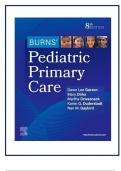
,ESSENTIAL PEDIATRIC PRIMARY CARE
Q&A: BASED ON BURNS’ 8TH EDITION
Unit 1 & 2: Pediatric Primary Care & Health Supervision
Unit / Section Content
1. Pediatric Primary Care - Primary Care vs Primary Prevention - Unique Issues in
Pediatrics - Caring for Children and Youth With Special Healthcare Needs - Additional
Resources 2. Global and National Influences on Child Health Status - COVID-19 and
Unit 1. Pediatric Global Health Status - Climate Change & Inequality - US Child Health Status -
Primary Care Advocacy 3. Environmental Influences on Pediatric Health - Principles of
Environmental Health - Epidemiologic Model & Risk - Additional Resources 4. Justice,
Equity, Inclusion, and Diversity - History of Racism in Healthcare - Adverse Childhood
Experiences - Health Equity: Current & Future - Additional Resources
5. Pediatric and Family Assessment - Pediatric & Family Assessment - Shared Decision
Unit 2. Pediatric Making - Additional Resources 6. Behavioral and Mental Health Promotion -
Health Foundations & Assessment - Management Strategies - Caregiving Challenges -
Supervision Additional Resources 7. Sexuality and Gender Identity - Patterns & Assessment -
Fostering Healthy Sexuality - Altering Factors - Additional Resources
Section 2A–2C: Growth, Development, Promotion & Protection
Section / Topic Content
8. Developmental Principles and Theories 9. Newborn & Neonate Development 10.
2A. Growth &
Infant Development 11. Early Childhood Development 12. Middle Childhood
Development
Development 13. Adolescent Development
2B. Health 14. Nutrition 15. Breastfeeding 16. Sleep 17. Elimination 18. Physical Activity and
Promotion Sports
2C. Health 19. Immunizations 20. Dental and Oral Health 21. Pediatric Injury Prevention 22.
Protection Child Maltreatment
Unit 3: Disease Management
,Section / Unit Content
3A. General 23. Prescribing Therapies 24. Pain and Fever Management 25. Injuries and Toxic
Management Exposure 26. Palliative Care
27. Congenital & Inherited Disorders 28. Neonatal Disorders 29. Neurodivergence &
Behavioral Health 30. Eye & Vision Disorders 31. Ear & Hearing Disorders 32.
Respiratory Disorders 33. Cardiovascular Disorders 34. Gastrointestinal Disorders 35.
3B. Disease
Infectious Diseases 36. Inflammatory Disorders 37. Dermatologic Disorders 38.
Management
Hematologic Disorders 39. Endocrine & Metabolic Disorders 40. Musculoskeletal
Disorders 41. Neurologic Disorders 42. Genitourinary Disorders 43. Gynecology and
Reproductive Health
,Unit 1 – Pediatric Primary Care
Based on Burns’ Pediatric Primary Care, 8th Edition (2025)
1. A 6-month-old infant presents for a well-child visit. The
family describes their role in coordinating care among
specialists and community resources. Which statement
best reflects the APN’s role in family-centered pediatric
primary care?
A. Prescribing all specialist referrals directly without
involving the family
B. Encouraging the family to follow the APN’s plan without
question
C. Collaborating with the family to set goals, share
information, and support decision-making (Correct)
D. Delegating all coordination tasks to a social worker
Answer: C Rationale: APNs engage families as partners,
sharing information and supporting decision-making; this
is central to family-centered care. A is incorrect because
referrals should be a shared decision. B is incorrect—
families should be empowered, not passive. D undervalues
the APN’s role in coordination.
,2. During a community outreach program, an APN educates
parents about immunization schedules to prevent
disease. Which aspect of care is being emphasized?
A. Primary care (Correct)
B. Secondary prevention
C. Tertiary prevention
D. Palliative care
Answer: A Rationale: Primary care encompasses health
promotion and disease prevention, such as immunizations.
B and C refer to screening and complication management
respectively. D is end-of-life.
3. A 3-year-old with cerebral palsy requires adaptive
equipment. In the context of CYSHCN principles, which
approach best exemplifies developmentally appropriate
care?
A. Providing adult-sized mobility devices
B. Selecting equipment based solely on insurance coverage
C. Choosing adaptive devices that match the child's size,
motor skills, and interests (Correct)
D. Waiting until adolescence to introduce mobility aids
Answer: C Rationale: Developmentally appropriate care
tailors interventions to the child’s age, abilities, and
, preferences. A is inappropriate, B ignores clinical needs, D
delays beneficial support.
4. An adolescent with asthma and social anxiety avoids
school. Which strategy aligns with primary prevention?
A. Prescribing high-dose inhaled steroids
B. Implementing a school-based anxiety screening and
counseling program (Correct)
C. Referring to psychiatric inpatient care
D. Offering palliative breathing support
Answer: B Rationale: Primary prevention aims to prevent
onset of problems; school-based screening addresses
anxiety before escalation. A is treatment, C is tertiary level,
D is palliative.
5. In assessing a 9-year-old’s health history, the APN asks
about family routines and cultural practices. This best
demonstrates which element of care?
A. Evidence-based practice
B. Culturally sensitive, family-centered care (Correct)
C. Primary prevention
D. Tertiary prevention
, Answer: B Rationale: Gathering family and cultural
information supports culturally sensitive, family-centered
care. A refers to research utilization. C and D relate to
disease stages.
6. Which statement distinguishes primary prevention from
primary care?
A. Primary prevention focuses on early disease detection,
while primary care is treatment of chronic conditions
B. Primary prevention aims to prevent disease onset,
whereas primary care provides continuous,
comprehensive health services (Correct)
C. They are synonymous concepts
D. Primary care is only immunizations
Answer: B Rationale: Primary prevention is disease
prevention; primary care covers broad health services. A is
wrong definitions, C is false, D is too narrow.
7. A 2-week-old infant born at 32 weeks is scheduled for a
developmental follow-up. Which aspect is unique to
pediatric primary care?
A. Exclusive focus on acute illness
, B. Tracking growth and developmental milestones over
time (Correct)
C. Limiting contact to annual visits
D. Applying adult immunization schedules
Answer: B Rationale: Pediatric care uniquely monitors
growth and development longitudinally. A and C
undervalue continuity; D misapplies adult protocols.
8. A child with spina bifida requires ongoing
multidisciplinary care. Which principle guides care for
CYSHCN?
A. Episodic specialist visits only
B. Single-provider model
C. Coordinated, comprehensive care across settings
(Correct)
D. Family exclusion from planning
Answer: C Rationale: CYSHCN principles emphasize
comprehensive, coordinated services. A and B fragment
care; D contradicts family-centeredness.
9. During a visit, an APN uses play-based assessment to
gauge a child’s motor skills. This reflects developmentally
appropriate care by:
, A. Using adult assessment tools
B. Forcing standard tests outside play
C. Embedding evaluation in the child’s natural activities
(Correct)
D. Ignoring developmental stage
Answer: C Rationale: Assessments integrated into play
respect developmental needs. A and B are inappropriate
tools. D neglects stage-specifics.
10. Which health promotion activity demonstrates
primary prevention rather than primary care?
A. Conducting newborn metabolic screening
B. Educating on car seat safety to prevent injury (Correct)
C. Managing acute otitis media
D. Treating type 1 diabetes
Answer: B Rationale: Car seat education prevents injuries
(primary prevention). A is secondary prevention, C and D
are treatment.
11. A nurse practitioner seeks to incorporate evidence-
based guidelines into well-child visits. The first step is to:
A. Implement the newest intervention immediately
, B. Formulate a clear clinical question using PICO (Correct)
C. Discard all existing protocols
D. Survey patients for anecdotes only
Answer: B Rationale: PICO framing is the first evidence-
based practice step. A skips appraisal. C is impractical. D
lacks scientific rigor.
12. Parents of a culturally diverse family request
traditional remedies alongside vaccines. The APN’s best
response is to:
A. Insist on vaccines without discussion
B. Dismiss traditional practices
C. Explore family beliefs and negotiate a mutually
acceptable plan (Correct)
D. Cancel the visit
Answer: C Rationale: Culturally sensitive care involves
understanding beliefs and collaborating. A/B disregard
family context. D is non-therapeutic.
13. Which scenario exemplifies continuity of care in
pediatric primary care?
A. Referral to a specialist without follow-up
Q&A: BASED ON BURNS’ 8TH EDITION
Unit 1 & 2: Pediatric Primary Care & Health Supervision
Unit / Section Content
1. Pediatric Primary Care - Primary Care vs Primary Prevention - Unique Issues in
Pediatrics - Caring for Children and Youth With Special Healthcare Needs - Additional
Resources 2. Global and National Influences on Child Health Status - COVID-19 and
Unit 1. Pediatric Global Health Status - Climate Change & Inequality - US Child Health Status -
Primary Care Advocacy 3. Environmental Influences on Pediatric Health - Principles of
Environmental Health - Epidemiologic Model & Risk - Additional Resources 4. Justice,
Equity, Inclusion, and Diversity - History of Racism in Healthcare - Adverse Childhood
Experiences - Health Equity: Current & Future - Additional Resources
5. Pediatric and Family Assessment - Pediatric & Family Assessment - Shared Decision
Unit 2. Pediatric Making - Additional Resources 6. Behavioral and Mental Health Promotion -
Health Foundations & Assessment - Management Strategies - Caregiving Challenges -
Supervision Additional Resources 7. Sexuality and Gender Identity - Patterns & Assessment -
Fostering Healthy Sexuality - Altering Factors - Additional Resources
Section 2A–2C: Growth, Development, Promotion & Protection
Section / Topic Content
8. Developmental Principles and Theories 9. Newborn & Neonate Development 10.
2A. Growth &
Infant Development 11. Early Childhood Development 12. Middle Childhood
Development
Development 13. Adolescent Development
2B. Health 14. Nutrition 15. Breastfeeding 16. Sleep 17. Elimination 18. Physical Activity and
Promotion Sports
2C. Health 19. Immunizations 20. Dental and Oral Health 21. Pediatric Injury Prevention 22.
Protection Child Maltreatment
Unit 3: Disease Management
,Section / Unit Content
3A. General 23. Prescribing Therapies 24. Pain and Fever Management 25. Injuries and Toxic
Management Exposure 26. Palliative Care
27. Congenital & Inherited Disorders 28. Neonatal Disorders 29. Neurodivergence &
Behavioral Health 30. Eye & Vision Disorders 31. Ear & Hearing Disorders 32.
Respiratory Disorders 33. Cardiovascular Disorders 34. Gastrointestinal Disorders 35.
3B. Disease
Infectious Diseases 36. Inflammatory Disorders 37. Dermatologic Disorders 38.
Management
Hematologic Disorders 39. Endocrine & Metabolic Disorders 40. Musculoskeletal
Disorders 41. Neurologic Disorders 42. Genitourinary Disorders 43. Gynecology and
Reproductive Health
,Unit 1 – Pediatric Primary Care
Based on Burns’ Pediatric Primary Care, 8th Edition (2025)
1. A 6-month-old infant presents for a well-child visit. The
family describes their role in coordinating care among
specialists and community resources. Which statement
best reflects the APN’s role in family-centered pediatric
primary care?
A. Prescribing all specialist referrals directly without
involving the family
B. Encouraging the family to follow the APN’s plan without
question
C. Collaborating with the family to set goals, share
information, and support decision-making (Correct)
D. Delegating all coordination tasks to a social worker
Answer: C Rationale: APNs engage families as partners,
sharing information and supporting decision-making; this
is central to family-centered care. A is incorrect because
referrals should be a shared decision. B is incorrect—
families should be empowered, not passive. D undervalues
the APN’s role in coordination.
,2. During a community outreach program, an APN educates
parents about immunization schedules to prevent
disease. Which aspect of care is being emphasized?
A. Primary care (Correct)
B. Secondary prevention
C. Tertiary prevention
D. Palliative care
Answer: A Rationale: Primary care encompasses health
promotion and disease prevention, such as immunizations.
B and C refer to screening and complication management
respectively. D is end-of-life.
3. A 3-year-old with cerebral palsy requires adaptive
equipment. In the context of CYSHCN principles, which
approach best exemplifies developmentally appropriate
care?
A. Providing adult-sized mobility devices
B. Selecting equipment based solely on insurance coverage
C. Choosing adaptive devices that match the child's size,
motor skills, and interests (Correct)
D. Waiting until adolescence to introduce mobility aids
Answer: C Rationale: Developmentally appropriate care
tailors interventions to the child’s age, abilities, and
, preferences. A is inappropriate, B ignores clinical needs, D
delays beneficial support.
4. An adolescent with asthma and social anxiety avoids
school. Which strategy aligns with primary prevention?
A. Prescribing high-dose inhaled steroids
B. Implementing a school-based anxiety screening and
counseling program (Correct)
C. Referring to psychiatric inpatient care
D. Offering palliative breathing support
Answer: B Rationale: Primary prevention aims to prevent
onset of problems; school-based screening addresses
anxiety before escalation. A is treatment, C is tertiary level,
D is palliative.
5. In assessing a 9-year-old’s health history, the APN asks
about family routines and cultural practices. This best
demonstrates which element of care?
A. Evidence-based practice
B. Culturally sensitive, family-centered care (Correct)
C. Primary prevention
D. Tertiary prevention
, Answer: B Rationale: Gathering family and cultural
information supports culturally sensitive, family-centered
care. A refers to research utilization. C and D relate to
disease stages.
6. Which statement distinguishes primary prevention from
primary care?
A. Primary prevention focuses on early disease detection,
while primary care is treatment of chronic conditions
B. Primary prevention aims to prevent disease onset,
whereas primary care provides continuous,
comprehensive health services (Correct)
C. They are synonymous concepts
D. Primary care is only immunizations
Answer: B Rationale: Primary prevention is disease
prevention; primary care covers broad health services. A is
wrong definitions, C is false, D is too narrow.
7. A 2-week-old infant born at 32 weeks is scheduled for a
developmental follow-up. Which aspect is unique to
pediatric primary care?
A. Exclusive focus on acute illness
, B. Tracking growth and developmental milestones over
time (Correct)
C. Limiting contact to annual visits
D. Applying adult immunization schedules
Answer: B Rationale: Pediatric care uniquely monitors
growth and development longitudinally. A and C
undervalue continuity; D misapplies adult protocols.
8. A child with spina bifida requires ongoing
multidisciplinary care. Which principle guides care for
CYSHCN?
A. Episodic specialist visits only
B. Single-provider model
C. Coordinated, comprehensive care across settings
(Correct)
D. Family exclusion from planning
Answer: C Rationale: CYSHCN principles emphasize
comprehensive, coordinated services. A and B fragment
care; D contradicts family-centeredness.
9. During a visit, an APN uses play-based assessment to
gauge a child’s motor skills. This reflects developmentally
appropriate care by:
, A. Using adult assessment tools
B. Forcing standard tests outside play
C. Embedding evaluation in the child’s natural activities
(Correct)
D. Ignoring developmental stage
Answer: C Rationale: Assessments integrated into play
respect developmental needs. A and B are inappropriate
tools. D neglects stage-specifics.
10. Which health promotion activity demonstrates
primary prevention rather than primary care?
A. Conducting newborn metabolic screening
B. Educating on car seat safety to prevent injury (Correct)
C. Managing acute otitis media
D. Treating type 1 diabetes
Answer: B Rationale: Car seat education prevents injuries
(primary prevention). A is secondary prevention, C and D
are treatment.
11. A nurse practitioner seeks to incorporate evidence-
based guidelines into well-child visits. The first step is to:
A. Implement the newest intervention immediately
, B. Formulate a clear clinical question using PICO (Correct)
C. Discard all existing protocols
D. Survey patients for anecdotes only
Answer: B Rationale: PICO framing is the first evidence-
based practice step. A skips appraisal. C is impractical. D
lacks scientific rigor.
12. Parents of a culturally diverse family request
traditional remedies alongside vaccines. The APN’s best
response is to:
A. Insist on vaccines without discussion
B. Dismiss traditional practices
C. Explore family beliefs and negotiate a mutually
acceptable plan (Correct)
D. Cancel the visit
Answer: C Rationale: Culturally sensitive care involves
understanding beliefs and collaborating. A/B disregard
family context. D is non-therapeutic.
13. Which scenario exemplifies continuity of care in
pediatric primary care?
A. Referral to a specialist without follow-up