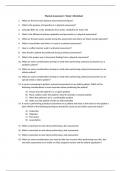
Physical Assessment / Week 1 Worksheet
1. What are the four basic physical assessment techniques?
2. What is the purpose of inspection in a physical assessment?
3. Calculate BMI/ wt. in lbs. divided by ht in inches divided by ht times 703
4. What is the difference between palpation and percussion in a physical assessment?
5. What are the percussion sounds during the assessment and where are these sounds expected?
6. What is auscultation and when is it used in a physical assessment?
7. How is a reflex hammer used in a physical assessment?
8. How should a patient be positioned during a physical assessment?
9. What is the proper way to document findings from a physical assessment?
10. What are some considerations to keep in mind when performing a physical assessment on a
pediatric patient?
11. What are some considerations to keep in mind when performing a physical assessment on an
elderly patient?
12. What are some considerations to keep in mind when performing a physical assessment on an
special needs or obese patient?
13. A nurse is preparing to perform a physical assessment on an elderly patient. Which of the
following considerations is most important when positioning the patient?
A) Ensure that the patient is in a supine position
B) Place a pillow under the patient's head to maintain a neutral position
C) Allow the patient to sit in a comfortable position
D) Make sure the patient's limbs are fully extended
14. A nurse is performing a physical assessment on a patient and notes a skin lesion on the patient's
back. Which of the following techniques should the nurse use to further assess the lesion?
A) Inspection
B) Palpation
C) Percussion
D) Auscultation
15. What is important to note when performing a skin assessment:
16. What is important to note when performing a hair assessment:
17. What is important to note when performing a nail assessment:
18. What are some considerations you need to take into account when performing your skin, hair
and nails assessment on an infant or child, pregnant woman and the elderly population?
, A) Infants and Children:
B) Pregnant Women:
C) Older Adults:
19. Complete the Table below, include examples of each primary lesion:
Type of Lesion Characteristics Visual Representation & Example
Macule
Patch
Papule
Plaque
Elevated, solid lesion, > 1 cm in diameter and
Nodule
deeper than a papule
Tumor Elevated, solid lesion, > 2 cm in diameter
Vesicle
Bulla Elevated, fluid-filled lesion, > 1 cm in diameter
Pustule Elevated, pus-filled lesion Acne,
Wheal Allergic Reaction,
Elevated, encapsulated lesion containing fluid
Cyst
or semisolid material
1. What are the four basic physical assessment techniques?
2. What is the purpose of inspection in a physical assessment?
3. Calculate BMI/ wt. in lbs. divided by ht in inches divided by ht times 703
4. What is the difference between palpation and percussion in a physical assessment?
5. What are the percussion sounds during the assessment and where are these sounds expected?
6. What is auscultation and when is it used in a physical assessment?
7. How is a reflex hammer used in a physical assessment?
8. How should a patient be positioned during a physical assessment?
9. What is the proper way to document findings from a physical assessment?
10. What are some considerations to keep in mind when performing a physical assessment on a
pediatric patient?
11. What are some considerations to keep in mind when performing a physical assessment on an
elderly patient?
12. What are some considerations to keep in mind when performing a physical assessment on an
special needs or obese patient?
13. A nurse is preparing to perform a physical assessment on an elderly patient. Which of the
following considerations is most important when positioning the patient?
A) Ensure that the patient is in a supine position
B) Place a pillow under the patient's head to maintain a neutral position
C) Allow the patient to sit in a comfortable position
D) Make sure the patient's limbs are fully extended
14. A nurse is performing a physical assessment on a patient and notes a skin lesion on the patient's
back. Which of the following techniques should the nurse use to further assess the lesion?
A) Inspection
B) Palpation
C) Percussion
D) Auscultation
15. What is important to note when performing a skin assessment:
16. What is important to note when performing a hair assessment:
17. What is important to note when performing a nail assessment:
18. What are some considerations you need to take into account when performing your skin, hair
and nails assessment on an infant or child, pregnant woman and the elderly population?
, A) Infants and Children:
B) Pregnant Women:
C) Older Adults:
19. Complete the Table below, include examples of each primary lesion:
Type of Lesion Characteristics Visual Representation & Example
Macule
Patch
Papule
Plaque
Elevated, solid lesion, > 1 cm in diameter and
Nodule
deeper than a papule
Tumor Elevated, solid lesion, > 2 cm in diameter
Vesicle
Bulla Elevated, fluid-filled lesion, > 1 cm in diameter
Pustule Elevated, pus-filled lesion Acne,
Wheal Allergic Reaction,
Elevated, encapsulated lesion containing fluid
Cyst
or semisolid material