EJPME 1 Mod 5 || with Certified Answers.
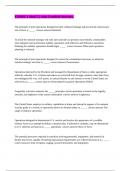
The principle of joint operations designed to limit collateral damage and prevent the unnecessary
use of force is _____. correct answers Restraint
To reach the national strategic end state and conclude an operation successfully, commanders
must integrate and synchronize stability operations with offensive and defensive operations.
Planning for stability operations should begin _____. correct answers When joint operation
planning is initiated
The principle of joint operations designed to ensure the commitment necessary to attain the
national strategic end state is _____. correct answers Perseverance
Operations directed by the President and managed by Department of State or other appropriate
authority whereby U.S. civilians and others are extracted from foreign countries when their lives
are endangered by war, civil unrest, or natural disaster to safe havens or to the United States are
referred to as _____. correct answers Noncombat Evacuation Operations (NEO)
Frequently a decisive element, the _____ principle of joint operations is based on the legality,
morality, and rightness of the actions undertaken. correct answers Legitimacy
The United States employs its military capabilities at home and abroad in support of its national
security goals in a variety of operations known in doctrine today as _____. correct answers The
range of military operations
Operations designed to demonstrate U.S. resolve and involve the appearance of a credible
military force in an attempt to defuse a situation that, if allowed to continue, may be detrimental
to U.S. interests are known as _____ operations. correct answers Show of force
The essential processes required to transition arriving personnel, equipment, and materiel in
theater into forces capable of meeting operational requirements are collectively known as _____.
correct answers Joint reception, staging, onward movement, and integration
The principle of joint operations designed to limit collateral damage and prevent the unnecessary
use of force is _____. correct answers Restraint
To reach the national strategic end state and conclude an operation successfully, commanders
must integrate and synchronize stability operations with offensive and defensive operations.
Planning for stability operations should begin _____. correct answers When joint operation
planning is initiated
The principle of joint operations designed to ensure the commitment necessary to attain the
national strategic end state is _____. correct answers Perseverance
Operations directed by the President and managed by Department of State or other appropriate
authority whereby U.S. civilians and others are extracted from foreign countries when their lives
are endangered by war, civil unrest, or natural disaster to safe havens or to the United States are
referred to as _____. correct answers Noncombat Evacuation Operations (NEO)
Frequently a decisive element, the _____ principle of joint operations is based on the legality,
morality, and rightness of the actions undertaken. correct answers Legitimacy
The United States employs its military capabilities at home and abroad in support of its national
security goals in a variety of operations known in doctrine today as _____. correct answers The
range of military operations
Operations designed to demonstrate U.S. resolve and involve the appearance of a credible
military force in an attempt to defuse a situation that, if allowed to continue, may be detrimental
to U.S. interests are known as _____ operations. correct answers Show of force
The essential processes required to transition arriving personnel, equipment, and materiel in
theater into forces capable of meeting operational requirements are collectively known as _____.
correct answers Joint reception, staging, onward movement, and integration