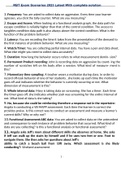
OSU CSE 2221 Final Review | 65 Questions with 100%
Correct Answers | Verified | Latest Update 2024
The correct syntax for the "main" method signature is: !@#$%%%%%
%%%%%%
*a.* private static void main(String[] args)
*b.* public static String main(String[] args)
*c.* public static void main(String[] args)
*d.* public void main(String[] args)
*e.* none of the above - (ANSWERS)c
The Java compiler does the following:
*a.* checks a bytecode program in a ".class" file for run-time errors and if there are none, it
generates source code for that program in a ".java" file
*b.* checks a source code program in a ".java" file for run-time errors and if there are none, it
generates bytecode for that program in a ".class" file
*c.* checks a source code program in a ".java" file for compile-time errors and, if there are none,
it generates bytecode for that program in a ".class" file
*d.* checks a bytecode program in a ".class" file for compile-time errors and if there are none, it
generates source code for that program in a ".java" file
*e.* none of the above - (ANSWERS)c
Which statement correctly defines a java constant?
*a.* const SPECIAL = 1234;
*b.* int SPECIAL = 1234;
*c.* int final SPECIAL = 1234;
*d.* final int SPECIAL = 1234;
*e.* const int SPECIAL = 1234; - (ANSWERS)d
What is the value of s after the following statement:
String s = (!True) + " : " + (10 + 4) + " is 104";
*a.* "!True : 104 is 104"
*b.* "false : 104 is 104"
*c.* "!True : 14 is 104"
*d.* "false : 14 is 104"
*e.* This is a compile-time error - (ANSWERS)d
The Checkstyle plugin for Eclipse is useful because:
*a.* it warns you of potential compile-time errors
*b.* it helps you make your code understandable for yourself and other programmers
,OSU CSE 2221 Final Review | 65 Questions with 100%
Correct Answers | Verified | Latest Update 2024
*c.* it prevents your code from making errors caught by assert statements !@#$%%%%%
*d.* it tells you when code you have written does not obey its contract %%%%%%
*e.* none of the above - (ANSWERS)b
If x is an int variable, when does the boolean expression evaluate to true?
((x % 5 != 0) && (x % 2 != 0))
*a.* when x is divisible by 5 or by 2 but not by both
*b.* when x is divisible by 10
*c.* when x is not divisible by 10
*d.* when x is neither divisible by 5 nor by 2
*e.* when x is either divisible by 5 or by 2 - (ANSWERS)d
The nextdouble( ) method of r, a variable of type Random, returns a double in a range of [0,1).
Which of these expressions would you use to create a random number in the range of [-3,3)?
*a.* r.nextdouble( ) * 3.0 - 3.0
*b.* (r.nextdouble( ) - 0.5) * 6.0
*c.* r.nextdouble( ) * 6.0 + 3.0
*d.* r.nextdouble( ) * 6.0 + 0.5
*e.* (r.nextdouble( ) - 3.0) * 6.0 - (ANSWERS)b
Consider the following code fragment:
Int x = 8;
While ((x / 3) != 2) { x = x - 1; }
How many times will the body of the loop execute?
*a.* 0
*b.* 1
*c.* 2
*d.* 3
*e.* the loop will never terminate - (ANSWERS)a
Consider the following method signature:
Private static int examscore(int studentnum) {...}
Here, studentnum is called:
, OSU CSE 2221 Final Review | 65 Questions with 100%
Correct Answers | Verified | Latest Update 2024
*a.* distinguished variable !@#$%%%%%
*b.* an argument %%%%%%
*c.* a formal parameter
*d.* an index
*e.* none of the above - (ANSWERS)c
What is the value of x after this statement?
Double x = ;
*a.* 0.0
*b.* 0.5
*c.* 1.0
*d.* 2.0 - (ANSWERS)a
Consider the following method and the client code. What is true after the client code executes?
Private static int m(int x, int y) {
Y = x;
X = 0;
Return y;
}
Int num1 = 4, num 2 = 9;
Num2 = m (num1, num2);
*a.* num1 = 0, num2 = 4
*b.* num1 = 0, num2 = 9
*c.* num1 = 4, num2 = 4
*d.* num1 = 4, num2 = 9 - (ANSWERS)c
Consider the following array declaration and initialization. What is the value of the expression
(a[1] + a[3])?
String [ ] a = {"A", "B", "C", "D" };
*a.* "AC"
*b.* "BD"
*c.* "ABC"
*d.* "CD" - (ANSWERS)b
Correct Answers | Verified | Latest Update 2024
The correct syntax for the "main" method signature is: !@#$%%%%%
%%%%%%
*a.* private static void main(String[] args)
*b.* public static String main(String[] args)
*c.* public static void main(String[] args)
*d.* public void main(String[] args)
*e.* none of the above - (ANSWERS)c
The Java compiler does the following:
*a.* checks a bytecode program in a ".class" file for run-time errors and if there are none, it
generates source code for that program in a ".java" file
*b.* checks a source code program in a ".java" file for run-time errors and if there are none, it
generates bytecode for that program in a ".class" file
*c.* checks a source code program in a ".java" file for compile-time errors and, if there are none,
it generates bytecode for that program in a ".class" file
*d.* checks a bytecode program in a ".class" file for compile-time errors and if there are none, it
generates source code for that program in a ".java" file
*e.* none of the above - (ANSWERS)c
Which statement correctly defines a java constant?
*a.* const SPECIAL = 1234;
*b.* int SPECIAL = 1234;
*c.* int final SPECIAL = 1234;
*d.* final int SPECIAL = 1234;
*e.* const int SPECIAL = 1234; - (ANSWERS)d
What is the value of s after the following statement:
String s = (!True) + " : " + (10 + 4) + " is 104";
*a.* "!True : 104 is 104"
*b.* "false : 104 is 104"
*c.* "!True : 14 is 104"
*d.* "false : 14 is 104"
*e.* This is a compile-time error - (ANSWERS)d
The Checkstyle plugin for Eclipse is useful because:
*a.* it warns you of potential compile-time errors
*b.* it helps you make your code understandable for yourself and other programmers
,OSU CSE 2221 Final Review | 65 Questions with 100%
Correct Answers | Verified | Latest Update 2024
*c.* it prevents your code from making errors caught by assert statements !@#$%%%%%
*d.* it tells you when code you have written does not obey its contract %%%%%%
*e.* none of the above - (ANSWERS)b
If x is an int variable, when does the boolean expression evaluate to true?
((x % 5 != 0) && (x % 2 != 0))
*a.* when x is divisible by 5 or by 2 but not by both
*b.* when x is divisible by 10
*c.* when x is not divisible by 10
*d.* when x is neither divisible by 5 nor by 2
*e.* when x is either divisible by 5 or by 2 - (ANSWERS)d
The nextdouble( ) method of r, a variable of type Random, returns a double in a range of [0,1).
Which of these expressions would you use to create a random number in the range of [-3,3)?
*a.* r.nextdouble( ) * 3.0 - 3.0
*b.* (r.nextdouble( ) - 0.5) * 6.0
*c.* r.nextdouble( ) * 6.0 + 3.0
*d.* r.nextdouble( ) * 6.0 + 0.5
*e.* (r.nextdouble( ) - 3.0) * 6.0 - (ANSWERS)b
Consider the following code fragment:
Int x = 8;
While ((x / 3) != 2) { x = x - 1; }
How many times will the body of the loop execute?
*a.* 0
*b.* 1
*c.* 2
*d.* 3
*e.* the loop will never terminate - (ANSWERS)a
Consider the following method signature:
Private static int examscore(int studentnum) {...}
Here, studentnum is called:
, OSU CSE 2221 Final Review | 65 Questions with 100%
Correct Answers | Verified | Latest Update 2024
*a.* distinguished variable !@#$%%%%%
*b.* an argument %%%%%%
*c.* a formal parameter
*d.* an index
*e.* none of the above - (ANSWERS)c
What is the value of x after this statement?
Double x = ;
*a.* 0.0
*b.* 0.5
*c.* 1.0
*d.* 2.0 - (ANSWERS)a
Consider the following method and the client code. What is true after the client code executes?
Private static int m(int x, int y) {
Y = x;
X = 0;
Return y;
}
Int num1 = 4, num 2 = 9;
Num2 = m (num1, num2);
*a.* num1 = 0, num2 = 4
*b.* num1 = 0, num2 = 9
*c.* num1 = 4, num2 = 4
*d.* num1 = 4, num2 = 9 - (ANSWERS)c
Consider the following array declaration and initialization. What is the value of the expression
(a[1] + a[3])?
String [ ] a = {"A", "B", "C", "D" };
*a.* "AC"
*b.* "BD"
*c.* "ABC"
*d.* "CD" - (ANSWERS)b