Toward Healthy Aging
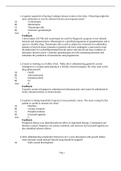
1. The nurse is caring for an older client who experienced a hip replacement
surgery 10 hours ago. Which intervention will help minimize this client's risk of
developing delirium?
a. Requesting that staff offer fluids each time they interact with the client
b. Medicating the client to best facilitate restorative sleep
c. Encouraging the client to remain still and thus minimize pain
d. Suggesting that visitors are limited to family members only - (correct Answer) -
ANS: A
Encouraging fluid intake will help prevent dehydration, which is a major
contributor to the development of delirium. Avoid use of sleeping medications�use
music, warm milk, or noncaffeinated herbal tea to alleviate discomfort and
encourage sleep. Avoid excessive bed rest; institute early mobilization as
appropriate. It is appropriate to have family and visitors available to the client,
within reason, since doing so will help stimulate the client cognitively
2. Which intervention best addresses the principle that is the basis for
communicating with a client experiencing postsurgical delirium?
a. Reminding the client that delirium is generally acute and reversible
b. Assuming that the client's statements are an attempt to express needs
c. Allowing the client sufficient time to formulate an answer to questions
d. Using nonverbal communication techniques to communicate with the client -
(correct Answer) - ANS: B
Assuming that communication and behavior are meaningful and an attempt to tell us
something or express needs is vital to effective care planning for the delirious
client. The acute and reversible nature of the disorder does not have impact on the
need for effective communication. The remaining options focus on the client's
communication and not the greater issue of effective intercommunication between
client and staff.
4. An older client diagnosed with dementia resides with his daughter. When the
homecare nurse visits, the daughter tearfully tells the nurse that her father
scratched her hand and cursed at her when she was attempting to feed him. She
states, "I don't know why he hates me and wants to hurt me. I try so hard to take
good care of him. I love him." How will the nurse respond to the client's daughter?
- (correct Answer) - a. "Let's think about what you may have done to anger your
father?"
b. "Let's try to figure out what your father was trying to say with his behavior."
c. "Scratching is usually a sign of untreated pain. Do you think your father is in
pain?"
d. "Maybe you should consider having a home health care provider take over
responsibility for your father's physical care."
Part 2 of #4, an older client diagnosed with dementia
ANS: B
Dementia often interferes with the person's communication and the ability to
understand and express thoughts and feelings. The focus needs to be on what the
person is attempting to communicate through behavior. Behavioral manifestations are
not necessarily signs of anger in persons with dementia. Although behavioral
manifestations frequently are seen in persons with untreated pain, this is not
always true. The issue here is not necess - (correct Answer) -
5. A nurse is caring for a patient with a diagnosis of delirium. Which of the
following is an expected assessment finding for this patient?
a. Normal attention span
b. Fluctuation in symptoms
c. Normal sleep cycle
d. Increased appetite - (correct Answer) - ANS: B
1. The nurse is caring for an older client who experienced a hip replacement
surgery 10 hours ago. Which intervention will help minimize this client's risk of
developing delirium?
a. Requesting that staff offer fluids each time they interact with the client
b. Medicating the client to best facilitate restorative sleep
c. Encouraging the client to remain still and thus minimize pain
d. Suggesting that visitors are limited to family members only - (correct Answer) -
ANS: A
Encouraging fluid intake will help prevent dehydration, which is a major
contributor to the development of delirium. Avoid use of sleeping medications�use
music, warm milk, or noncaffeinated herbal tea to alleviate discomfort and
encourage sleep. Avoid excessive bed rest; institute early mobilization as
appropriate. It is appropriate to have family and visitors available to the client,
within reason, since doing so will help stimulate the client cognitively
2. Which intervention best addresses the principle that is the basis for
communicating with a client experiencing postsurgical delirium?
a. Reminding the client that delirium is generally acute and reversible
b. Assuming that the client's statements are an attempt to express needs
c. Allowing the client sufficient time to formulate an answer to questions
d. Using nonverbal communication techniques to communicate with the client -
(correct Answer) - ANS: B
Assuming that communication and behavior are meaningful and an attempt to tell us
something or express needs is vital to effective care planning for the delirious
client. The acute and reversible nature of the disorder does not have impact on the
need for effective communication. The remaining options focus on the client's
communication and not the greater issue of effective intercommunication between
client and staff.
4. An older client diagnosed with dementia resides with his daughter. When the
homecare nurse visits, the daughter tearfully tells the nurse that her father
scratched her hand and cursed at her when she was attempting to feed him. She
states, "I don't know why he hates me and wants to hurt me. I try so hard to take
good care of him. I love him." How will the nurse respond to the client's daughter?
- (correct Answer) - a. "Let's think about what you may have done to anger your
father?"
b. "Let's try to figure out what your father was trying to say with his behavior."
c. "Scratching is usually a sign of untreated pain. Do you think your father is in
pain?"
d. "Maybe you should consider having a home health care provider take over
responsibility for your father's physical care."
Part 2 of #4, an older client diagnosed with dementia
ANS: B
Dementia often interferes with the person's communication and the ability to
understand and express thoughts and feelings. The focus needs to be on what the
person is attempting to communicate through behavior. Behavioral manifestations are
not necessarily signs of anger in persons with dementia. Although behavioral
manifestations frequently are seen in persons with untreated pain, this is not
always true. The issue here is not necess - (correct Answer) -
5. A nurse is caring for a patient with a diagnosis of delirium. Which of the
following is an expected assessment finding for this patient?
a. Normal attention span
b. Fluctuation in symptoms
c. Normal sleep cycle
d. Increased appetite - (correct Answer) - ANS: B