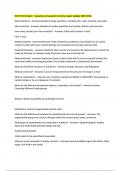
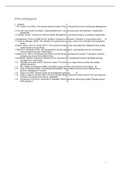
Software quality assurance 2 UPDATED ACTUAL Exam Questions
and CORRECT Answers
Chapter 6 - Development and Quality plan -
Objectives of having a development and quality plan - recruit team members, decide if waterfall
or agile, resolve dev risks, milestones, sprint lengths, give mgmt data for project control
Elements of plan for devs - specify deliverables, define project interfaces, methodolity and tools,
milestones, map of dev process, cost estimate
element of plan for software quality - list of quality goals, review activities, software tests,
accepptance tests for external software, procedures and dates for versions
Classes of software dev risks - scheduling/timing risks, system functionality risks, subcontracting
risks, requirement mgmt risk, resource usage and performance risk, personnel mgmt risk. must
prioritize risks!
boehm and ross's top 10 software risk items - developing wrong functions, unrealistic schedule
and budget, wrong interface for user, gold plating, continuous stream of req changes, personnel
shortfalls
Chapter 7 - Intergrating quality activities in project lifecycle -
factors that affect required intensity of sqa activities - project factors (technical complexity and
difficulty, severity of failure outcomes, project magnitude), team factors (professional
qualification of team members, availability, experience, familiarity (new team members)),
verification process - does the product satisfy conditions at the start of the phase
, validation process - does product satisfy specified requirements
qualification process - is system or component suitible for operational use
model's quantitiative result for DRE - measure total effectiveness at removing defects, and the
total costs to remove defects
Defect Removal Efficiency - gives a measure of the development team ability to remove defects
prior to release. It is calculated as a ratio of defects resolved to total number of defects found. It
is typically measured prior and at the moment of release.
What is the inverted v diagram - dev activity - requirements, system/HLD, architecture design,
module design
Coding
unit testing, integration testing, system testing, UAT
Calculating DRE V1 - steps - assume 100% defects, get average % of defects originating in each
phase, calculate cost of each plan via matrix
Phases of software development RDU ID SO - Requirmenents, design, unit coding, integration,
documentation, system testing,operation
Calculating DRE v2 - steps - 1) take req% and place in ID box for D_req.
ID * (1 - % of FE (given)) = PD.
ID - PD = RD
sum to get totals per row
POD - phase originated defect
and CORRECT Answers
Chapter 6 - Development and Quality plan -
Objectives of having a development and quality plan - recruit team members, decide if waterfall
or agile, resolve dev risks, milestones, sprint lengths, give mgmt data for project control
Elements of plan for devs - specify deliverables, define project interfaces, methodolity and tools,
milestones, map of dev process, cost estimate
element of plan for software quality - list of quality goals, review activities, software tests,
accepptance tests for external software, procedures and dates for versions
Classes of software dev risks - scheduling/timing risks, system functionality risks, subcontracting
risks, requirement mgmt risk, resource usage and performance risk, personnel mgmt risk. must
prioritize risks!
boehm and ross's top 10 software risk items - developing wrong functions, unrealistic schedule
and budget, wrong interface for user, gold plating, continuous stream of req changes, personnel
shortfalls
Chapter 7 - Intergrating quality activities in project lifecycle -
factors that affect required intensity of sqa activities - project factors (technical complexity and
difficulty, severity of failure outcomes, project magnitude), team factors (professional
qualification of team members, availability, experience, familiarity (new team members)),
verification process - does the product satisfy conditions at the start of the phase
, validation process - does product satisfy specified requirements
qualification process - is system or component suitible for operational use
model's quantitiative result for DRE - measure total effectiveness at removing defects, and the
total costs to remove defects
Defect Removal Efficiency - gives a measure of the development team ability to remove defects
prior to release. It is calculated as a ratio of defects resolved to total number of defects found. It
is typically measured prior and at the moment of release.
What is the inverted v diagram - dev activity - requirements, system/HLD, architecture design,
module design
Coding
unit testing, integration testing, system testing, UAT
Calculating DRE V1 - steps - assume 100% defects, get average % of defects originating in each
phase, calculate cost of each plan via matrix
Phases of software development RDU ID SO - Requirmenents, design, unit coding, integration,
documentation, system testing,operation
Calculating DRE v2 - steps - 1) take req% and place in ID box for D_req.
ID * (1 - % of FE (given)) = PD.
ID - PD = RD
sum to get totals per row
POD - phase originated defect