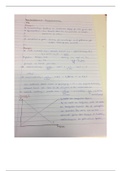
Chapter 14 – Chemical Kinetics
Section 14.1 – Reaction Rates and Section 14.2 –
Collision Theory of Chemical Reactions
What is chemical kinetics? the study of how fast reactions take place
During a chemical reaction, reactants
are______________
consumed and products are ______________.
formed
Chemical reactions generally occur as a result of
_________________
collisions between reacting molecules. More
frequent _________________
collisions usually leads to a higher
reaction rate.
Consider the reaction A + B → products. If the
concentration of A is doubled, the number of collisions
between A and B would __________,
double and the rate of the
reaction would increase by a factor of ________.
2
What is an effective collision? A collision that does result in a reaction
What is activation energy (E )?The minimum amount of energy
a
to
begin a chemical reaction
How does kinetic energy of the colliding reactant
molecules determine whether or not a collision is
effective? Without this minimum amount of energy at impact,
a collision will be ineffective I will not result in a reaction
For the reaction Cl + NOCl → Cl + NO, explain why no2
reaction occurs when the free Cl atom collides with the N
end of NOCl. For an effective collision to take place the free Cl atom ,
must directly collide w/the Cl in NOCI Otherwise.
,
the reactants bounce
off one another and the collision is ineffective so no rxn will occu
, What is a transition state (aka activated complex)? a transition
species that forms when2 molecules collide in an effective collision
Section 14.3 – Measuring Reaction Progress and
Expressing Reaction Rate
We can follow the progress of a reaction by monitoring
either ___________________________
the decrease in concentration
_____________________________
of the reactants or
____________________________________________.
the increase in the concentrations of the products
The rate of a reaction is the change in
____________________________
concentration of reactants or products divided by change in
___________________.
time
For the reaction A → B, express the rate of the reaction in
terms of the concentration of A:
For the reaction A → B, express the rate of the reaction in
terms of the concentration of B:
rate of uxn =
Rate is always a ( positive / negative ) quantity.
The rate of a reaction changes over time. This is why a
plot of the concentration of the reactant or product as a
function of time is a ___________
curve rather than a
_________________.
straight line
What is an instantaneous rate? the rate for a specific instant in time
What is a rate constant (k)? proportionality constant in a rate law
For the reaction aA + bB → cC + dD, express the rate in
terms of the concentration of each component (equation
14.1):
rate =
--
Section 14.1 – Reaction Rates and Section 14.2 –
Collision Theory of Chemical Reactions
What is chemical kinetics? the study of how fast reactions take place
During a chemical reaction, reactants
are______________
consumed and products are ______________.
formed
Chemical reactions generally occur as a result of
_________________
collisions between reacting molecules. More
frequent _________________
collisions usually leads to a higher
reaction rate.
Consider the reaction A + B → products. If the
concentration of A is doubled, the number of collisions
between A and B would __________,
double and the rate of the
reaction would increase by a factor of ________.
2
What is an effective collision? A collision that does result in a reaction
What is activation energy (E )?The minimum amount of energy
a
to
begin a chemical reaction
How does kinetic energy of the colliding reactant
molecules determine whether or not a collision is
effective? Without this minimum amount of energy at impact,
a collision will be ineffective I will not result in a reaction
For the reaction Cl + NOCl → Cl + NO, explain why no2
reaction occurs when the free Cl atom collides with the N
end of NOCl. For an effective collision to take place the free Cl atom ,
must directly collide w/the Cl in NOCI Otherwise.
,
the reactants bounce
off one another and the collision is ineffective so no rxn will occu
, What is a transition state (aka activated complex)? a transition
species that forms when2 molecules collide in an effective collision
Section 14.3 – Measuring Reaction Progress and
Expressing Reaction Rate
We can follow the progress of a reaction by monitoring
either ___________________________
the decrease in concentration
_____________________________
of the reactants or
____________________________________________.
the increase in the concentrations of the products
The rate of a reaction is the change in
____________________________
concentration of reactants or products divided by change in
___________________.
time
For the reaction A → B, express the rate of the reaction in
terms of the concentration of A:
For the reaction A → B, express the rate of the reaction in
terms of the concentration of B:
rate of uxn =
Rate is always a ( positive / negative ) quantity.
The rate of a reaction changes over time. This is why a
plot of the concentration of the reactant or product as a
function of time is a ___________
curve rather than a
_________________.
straight line
What is an instantaneous rate? the rate for a specific instant in time
What is a rate constant (k)? proportionality constant in a rate law
For the reaction aA + bB → cC + dD, express the rate in
terms of the concentration of each component (equation
14.1):
rate =
--