General
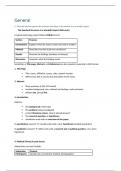
1. Describe and recognize the elements that have to be present in a scientific report.
📚 The Standard Structure of a Scientific Report (APA-style)
A typical psychology report follows IMRaD format:
Section Purpose
Introduction Explains what the study is about and why it matters
Method Describes how the study was conducted
Results Presents the findings (numbers or themes)
Discussion Interprets what the findings mean
Sometimes a Title page, Abstract, and References are also required, especially in APA format.
1. Title Page
Title, name, affiliation, course, date, student number
APA format: title is concise but descriptive of the study
2. Abstract
Short summary (±150–250 words)
Includes background, aim, method, key findings, and conclusion
Written last, placed first
3. Introduction
Explains:
The background of the topic
The problem being investigated
A short literature review: what is already known?
The research question or hypotheses
Sometimes ends with an overview of the paper
In quantitative research :Usually ends with a clear hypothesis (testable prediction)
In qualitative research :Often ends with a research aim or guiding question, not a strict
hypothesis
4. Method (always in past tense)
Subsections you must include:
Subsection Content
Participants Sample size, recruitment method, demographics
, Materials Questionnaires, interview guides, software used
Procedure Step-by-step explanation of what was done
Data analysis What statistical tests (quant) or coding procedures (qual) were used
Tips:
Must be detailed enough for replication
Quantitative reports often use passive voice, but clarity comes first
5. Results
Quantitative:
Descriptive statistics (e.g., means, SDs)
Inferential statistics (e.g., t-test, ANOVA, regression)
APA style for numbers and tables (e.g., t(28) = 2.35, p < .05)
Do not interpret or explain results here — just report them
Qualitative:
Report themes/codes
Include illustrative quotes
Often structured per code, with headings and definitions
Make sure you clearly show how codes relate to the research question
6. Discussion
Interpret the findings
Compare with prior literature
Discuss strengths and limitations
Give suggestions for future research
End with a conclusion that restates the key finding
Tips:
Don’t introduce new results in this section
Use critical reflection: be honest about limitations and possible bias
7. References
APA Style 7th edition
All sources cited in-text must be included in the list
Example:
Smith, J. A., & Jones, R. (2020). Understanding emotions. Psychology Press.
8. Appendices
(optional)
Include full surveys, interview guides, coding schemes, etc.
Refer to them in the main text like: (see Appendix A)
,Tips Based on the Practice Exam
MC questions will test whether you can recognize which info goes in which section
E.g., “In which section should inferential statistics be reported?” → Results
Know style conventions:
o Write in the past tense
o Use formal, academic language
o Passive voice is common, but clarity matters more
o First-person (“we”) is sometimes acceptable in qualitative papers, but less so in
quantitative
Know the difference between qualitative and quantitative reports:
Feature Quantitative Qualitative
Results section Descriptive + inferential stats Thematic codes + quotes
Hypotheses Yes Often no (uses research aims)
Discussion style Confirm/contradict hypotheses Interpret and reflect
Structure More fixed More flexible, but still systematic
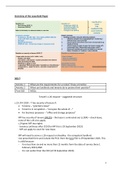
Summary Table: Key Elements of a Scientific Report
Section Key Content
Title Page Title, name, affiliation
Abstract Summary of aim, method, results, conclusion
Introductio Background, literature, aim/hypotheses
n
Method Participants, materials, procedure, analysis
Results Statistics or codes with quotes
Discussion Interpretation, limitations, conclusions
References All cited work in APA 7 format
Appendices Full materials, if needed
2. Describe and recognize the research designs most common in psychological research.
You need to:
, 1. Identify and describe the most commonly used research designs in psychology
2. Understand their structure, purpose, and logic
3. Critically reflect on their strengths, weaknesses, and suitability for answering different
research questions
Common Research Designs in Psychology
We distinguish between quantitative, qualitative, and mixed methods designs. Below are the
essential ones you must know.
I. Quantitative Research Designs
These designs aim to test hypotheses and measure variables numerically. They’re typically analyzed
using statistical methods.
1. Experimental Design (True Experiment)
The researcher manipulates one or more independent variables (IVs) to observe their effect on a
dependent variable (DV), using random assignment to conditions.
Key Features:
Random allocation of participants to conditions
Manipulation of IV(s)
Control of extraneous variables (high internal validity)
Goal: Establish causal relationships
Example: Does sleep deprivation cause slower reaction times?
Strengths:
High internal validity (cause-effect conclusions possible)
Replicable
Weaknesses:
Often low ecological validity
Can be unethical or impractical in some domains (e.g., inducing trauma)
2. Quasi-Experimental Design
Similar to experimental, but without random assignment.
Key Features:
1. Describe and recognize the elements that have to be present in a scientific report.
📚 The Standard Structure of a Scientific Report (APA-style)
A typical psychology report follows IMRaD format:
Section Purpose
Introduction Explains what the study is about and why it matters
Method Describes how the study was conducted
Results Presents the findings (numbers or themes)
Discussion Interprets what the findings mean
Sometimes a Title page, Abstract, and References are also required, especially in APA format.
1. Title Page
Title, name, affiliation, course, date, student number
APA format: title is concise but descriptive of the study
2. Abstract
Short summary (±150–250 words)
Includes background, aim, method, key findings, and conclusion
Written last, placed first
3. Introduction
Explains:
The background of the topic
The problem being investigated
A short literature review: what is already known?
The research question or hypotheses
Sometimes ends with an overview of the paper
In quantitative research :Usually ends with a clear hypothesis (testable prediction)
In qualitative research :Often ends with a research aim or guiding question, not a strict
hypothesis
4. Method (always in past tense)
Subsections you must include:
Subsection Content
Participants Sample size, recruitment method, demographics
, Materials Questionnaires, interview guides, software used
Procedure Step-by-step explanation of what was done
Data analysis What statistical tests (quant) or coding procedures (qual) were used
Tips:
Must be detailed enough for replication
Quantitative reports often use passive voice, but clarity comes first
5. Results
Quantitative:
Descriptive statistics (e.g., means, SDs)
Inferential statistics (e.g., t-test, ANOVA, regression)
APA style for numbers and tables (e.g., t(28) = 2.35, p < .05)
Do not interpret or explain results here — just report them
Qualitative:
Report themes/codes
Include illustrative quotes
Often structured per code, with headings and definitions
Make sure you clearly show how codes relate to the research question
6. Discussion
Interpret the findings
Compare with prior literature
Discuss strengths and limitations
Give suggestions for future research
End with a conclusion that restates the key finding
Tips:
Don’t introduce new results in this section
Use critical reflection: be honest about limitations and possible bias
7. References
APA Style 7th edition
All sources cited in-text must be included in the list
Example:
Smith, J. A., & Jones, R. (2020). Understanding emotions. Psychology Press.
8. Appendices
(optional)
Include full surveys, interview guides, coding schemes, etc.
Refer to them in the main text like: (see Appendix A)
,Tips Based on the Practice Exam
MC questions will test whether you can recognize which info goes in which section
E.g., “In which section should inferential statistics be reported?” → Results
Know style conventions:
o Write in the past tense
o Use formal, academic language
o Passive voice is common, but clarity matters more
o First-person (“we”) is sometimes acceptable in qualitative papers, but less so in
quantitative
Know the difference between qualitative and quantitative reports:
Feature Quantitative Qualitative
Results section Descriptive + inferential stats Thematic codes + quotes
Hypotheses Yes Often no (uses research aims)
Discussion style Confirm/contradict hypotheses Interpret and reflect
Structure More fixed More flexible, but still systematic
Summary Table: Key Elements of a Scientific Report
Section Key Content
Title Page Title, name, affiliation
Abstract Summary of aim, method, results, conclusion
Introductio Background, literature, aim/hypotheses
n
Method Participants, materials, procedure, analysis
Results Statistics or codes with quotes
Discussion Interpretation, limitations, conclusions
References All cited work in APA 7 format
Appendices Full materials, if needed
2. Describe and recognize the research designs most common in psychological research.
You need to:
, 1. Identify and describe the most commonly used research designs in psychology
2. Understand their structure, purpose, and logic
3. Critically reflect on their strengths, weaknesses, and suitability for answering different
research questions
Common Research Designs in Psychology
We distinguish between quantitative, qualitative, and mixed methods designs. Below are the
essential ones you must know.
I. Quantitative Research Designs
These designs aim to test hypotheses and measure variables numerically. They’re typically analyzed
using statistical methods.
1. Experimental Design (True Experiment)
The researcher manipulates one or more independent variables (IVs) to observe their effect on a
dependent variable (DV), using random assignment to conditions.
Key Features:
Random allocation of participants to conditions
Manipulation of IV(s)
Control of extraneous variables (high internal validity)
Goal: Establish causal relationships
Example: Does sleep deprivation cause slower reaction times?
Strengths:
High internal validity (cause-effect conclusions possible)
Replicable
Weaknesses:
Often low ecological validity
Can be unethical or impractical in some domains (e.g., inducing trauma)
2. Quasi-Experimental Design
Similar to experimental, but without random assignment.
Key Features: