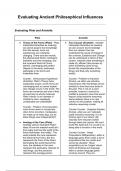
Evaluating Ancient Philosophical Influences
Evaluating Plato and Aristotle:
Plato Aristotle
● Theory of the Forms (Plato) - Plato ● Four Causes (Aristotle) - Aristotle
interpreted Heraclitus as meaning interpreted Heraclitus as meaning
we cannot acquire true knowledge we can uncover true knowledge
from the senses, since our from our senses if we can
experiences are constantly understand the cause of change in
changing. There exist two worlds, the universe. Existence and Change
the phenomenal World, contingent, can be understood in terms of four
imperfect and ever-changing, and causes: material (what something is
the noumena World of Forms, made of), efficient (the process by
eternal, unchanging and perfect. which something came to be),
Objects in the world, particulars, formal (the characteristics of the
participate in the forms and thing), and final (why something
instantiate them. exists).
Counter : Unnecessary Hypothesis Counter : Problem of Induction
(Aristotle), Plato’s Theory lacks (Hume), we often use inductive
explanatory power, as the forms are reasoning to infer that things will act
unchanging and so cannot explain similarly to how they have acted in
why change occurs in the world. The the past. This is not an a priori
forms are nonsense and even if they principle, however it cannot be
do exist they’re wholly irrelevant. justified a posteriori since that would
Plato’s theory is an example of require using inductive reasoning.
Ockham's razor, needlessly Hume believes there is no real
complicated and unfalsifiable solution to this problem, making all
inductive reasoning circular
Counter : Problem of Incorporation,
some forms seem to incorporate Counter Counter : Sceptical Solution
other forms into them. Centipedes (Hume), while we can’t rationally
are made up of many legs, but do justify inductive reasoning, it is an
these things exist independently? intrinsic part of our nature. We
naturally form inductive beliefs
● Analogy of the Cave (Plato) - through habit and custom. We can’t
Analogy used to represent Plato’s avoid this habit and it is crucial to us
ideas of how the material world isn’t being able to function in the world.
true reality and how the world of the
forms illuminates ‘true reality’. The Counter Counter : Hinge
world outside the cave represents Propositions (Wittgenstein), within a
the World of the Forms, the Sun language game there exists a set of
represents the Form of the Good, propositions that are certain and
illuminating the world beyond the cannot be doubted. These
cave, the shadows in the cave propositions act as ‘hinges’ about
represent the particulars, illusions of which all thinking and language
real things, and the prisoners within a certain language game
represent the average person revolves around. They are
Evaluating Plato and Aristotle:
Plato Aristotle
● Theory of the Forms (Plato) - Plato ● Four Causes (Aristotle) - Aristotle
interpreted Heraclitus as meaning interpreted Heraclitus as meaning
we cannot acquire true knowledge we can uncover true knowledge
from the senses, since our from our senses if we can
experiences are constantly understand the cause of change in
changing. There exist two worlds, the universe. Existence and Change
the phenomenal World, contingent, can be understood in terms of four
imperfect and ever-changing, and causes: material (what something is
the noumena World of Forms, made of), efficient (the process by
eternal, unchanging and perfect. which something came to be),
Objects in the world, particulars, formal (the characteristics of the
participate in the forms and thing), and final (why something
instantiate them. exists).
Counter : Unnecessary Hypothesis Counter : Problem of Induction
(Aristotle), Plato’s Theory lacks (Hume), we often use inductive
explanatory power, as the forms are reasoning to infer that things will act
unchanging and so cannot explain similarly to how they have acted in
why change occurs in the world. The the past. This is not an a priori
forms are nonsense and even if they principle, however it cannot be
do exist they’re wholly irrelevant. justified a posteriori since that would
Plato’s theory is an example of require using inductive reasoning.
Ockham's razor, needlessly Hume believes there is no real
complicated and unfalsifiable solution to this problem, making all
inductive reasoning circular
Counter : Problem of Incorporation,
some forms seem to incorporate Counter Counter : Sceptical Solution
other forms into them. Centipedes (Hume), while we can’t rationally
are made up of many legs, but do justify inductive reasoning, it is an
these things exist independently? intrinsic part of our nature. We
naturally form inductive beliefs
● Analogy of the Cave (Plato) - through habit and custom. We can’t
Analogy used to represent Plato’s avoid this habit and it is crucial to us
ideas of how the material world isn’t being able to function in the world.
true reality and how the world of the
forms illuminates ‘true reality’. The Counter Counter : Hinge
world outside the cave represents Propositions (Wittgenstein), within a
the World of the Forms, the Sun language game there exists a set of
represents the Form of the Good, propositions that are certain and
illuminating the world beyond the cannot be doubted. These
cave, the shadows in the cave propositions act as ‘hinges’ about
represent the particulars, illusions of which all thinking and language
real things, and the prisoners within a certain language game
represent the average person revolves around. They are