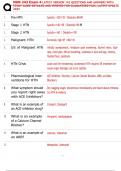
TNCC 9TH EDITION TEST EXAM QUESTIONS AND CORRECT DETAILED ANSWERS WITH RATIONALES
TNCC 9TH EDITION TEST EXAM QUESTIONS AND CORRECT DETAILED ANSWERS WITH RATIONALES What are the late signs of breathing compromise? - ANSWER-- Tracheal deviation - JVD What are signs of ineffective breathing? - ANSWER-- AMS - Cyanosis, especially around the mouth - Asymmetric expansion of chest wall - Paradoxical movement of the chest wall during inspiration and expiration - Use of accessory muscles or abdominal muscles or both or diaphragmatic breathing - Sucking chest wounds - Absent or diminished breath sounds - Administer O2 via NRB or assist ventilations with a bag-mask device, as indicated - Anticipate definitive airway management to support ventilation. Upon initial assessment, what type of oxygen should be used for a pt breathing effectively? - ANSWER-A tight-fitting nonrebreather mask at 12-15 lpm. What intervention should be done if a pt presents with effective circulation? - ANSWER-- Insert 2 large caliber IV's - Administer warmed isotonic crystalloid solution at an appropriate rate What are signs of ineffective circulation? - ANSWER-- Tachycardia - AMS - Uncontrolled external bleeding - Pale, cool, moist skin - Distended or abnormally flattened external jugular veins - Distant heart sounds What are the interventions for Effective/Ineffective Circulation? - ANSWER-- Control any uncontrolled external bleeding by: - Applying direct pressure over bleeding site - Elevating bleeding extremity - Applying pressure over arterial pressure points - Using tourniquet (last resort). - Cannulate 2 large-caliber IV's and initiate infusions of an isotonic crystalloid solution - Use warmed solution - Use pressure bags to increase speed of IVF infusion - Use blood administration tubing for possible administration of blood - Use rapid infusion device based on protocol - Use NS 0.9% in same tubing as blood product - IV = surgical cut-down, central line, or both. - Blood sample to determine ABO and Rh group - IO in sternum, legs, arms or pelvis - Administer blood products - PASG (without interfering with fluid resuscitation) What are factors that contribute to ineffective ventilation? - ANSWER-- AMS - LOC - Neurologic injury - Spinal Cord Injury - Intracranial Injury - Blunt trauma - Pain caused by rib fractures - Penetrating Trauma - Preexisting hx of respiratory diseases - Increased age What medications are used during intubation? - ANSWER-LOAD Mnemonic: L = Lidocaine O = Opioids A = Atropine D = Defasciculating agents What are the Rapid Sequence Intubation Steps? - ANSWER-PREPARATION: - gather equipment, staffing, etc. PREOXYGENATION: - Use 100% O2 (prevent risk of aspiration). PRETREATMENT: - Decrease S/E's of intubation PARALYSIS WITH INDUCTION: - Pt has LOC, then administer neuromuscular blocking agent PROTECTION AND POSITIONING: - Apply pressure over cricoid cartilage (minimizes likelihood of vomiting and aspiration PLACEMENT WITH PROOF - Each attempt NOT to exceed 30 seconds, max of 3 attempts. Ventilate pt 30-60 seconds between attempts. - After intubation, inflate the cuff - Confirm tube placement w/exhaled CO2 detector. POSTINTUBATION MANAGEMENT: - Secure ET tube - Set ventilator settings - Obtain Chest x-ray - Continue to medicate continues...
Escuela, estudio y materia
- Institución
- TNCC
- Grado
- TNCC
Información del documento
- Subido en
- 19 de junio de 2025
- Número de páginas
- 22
- Escrito en
- 2024/2025
- Tipo
- Examen
- Contiene
- Preguntas y respuestas
Temas
-
tncc
-
tncc 9th edition
-
2025
-
2026
-
breathing compromise
-
initial assessment
-
tachycardia
-
intubation
-
combitube
-
laryngeal mask airway
-
needle cricothyrotomy
-
dope
-
hypovolemic shock
-
cardiogenic shock
-
obstructiv