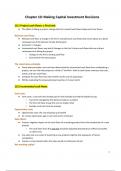
Chapter 10: Making Capital Investment Decisions
10.1 Project cash flows: a first look
● The effect of taking a project: change the firm's overall cash flows today and in the future
Relevant cash flows
● Relevant cash flow: a change in the firm's overall future cash flows that comes about as a direct
consequences of the decision to take that project
● Increment = changes
● Incremental cash flows: any and all changes in the firm's future cash flows that are a direct
consequence of taking the project
○ changes in the firm's existing cash flow
○ Exist only for the new project
The stand-alone principle
● Stand-alone principle: once we have determined the incremental cash flows form undertaking a
project, we can view that project as a kind of "minifirm" with its own future revenues and costs,
assets, and own cash flows.
● Compare the cash flow from the minifirm to the cost of acquiring it
● Will be evaluating the proposed project purely on its own merits
10.2 Incremental cash flows
Sunk costs
● Sunk costs: a cost we have already paid or have already incurred the liability to pay
○ Cannot be changed by the decision today on a project
○ The firm will have to pay this cost no matter what
○ Exclude sunk cost from the analysis
Opportunity costs
● Opportunity costs: the cost of giving up a benefit
● Ex: money spent years ago is sunk costs and is irrelevant
Side effects
● Erosion: negative impact on the cash flows of an existing product form the introduction of a new
product
○ The cash flows from the new line should be adjusted downward too reflect lost profits
on other lines
● Any sales lost as a result of launching a new product might be lost anyway bc of future
competition
● Erosion is only relevant when the sales would not otherwise be lost
Net working capital
1
, ● The project will need initial investment in inventories and accounts receivable (to cover credit
sales)
● NWC = CA - CL
● Every time undertaking a project, we need:
○ Inventory
■ Accounts payable
○ accounts receivable
● Beg of the project: NWC is negative = cash outflow
● End of the project: NWC is positive = cash inflow (you get the NWC back at the end)
● Need more current assets and current liabilities when undertaking a project
● When the project have ended, will have least CA and CL and sell any that are left
● Some of the financing will be in the form of amounts owed to suppliers (account payable)
● The balance represents the investment in NWC
● As a project winds down, inventories are sold, receivables are collected, bills are paid, and cash
balances can be drawn downs
● The activities frees up the net working capital originally invested
● The firm supplies working capital at the beginning and recovers it toward the end
Financing costs
● Financing costs = How are we raising cash for the project
○ It is ignored for the purpose of the project
○ Not operating cost
● Will not included interest paid or any other financing costs such as dividends or principal repaid
● Interest paid is a component of cash flow to creditors, not cash flow from assets
● The goal in project evaluation is to compare the cash flow from a project to the cost of acquiring
that project in order to estimate NPV
● How we finance the project is not relevant to the project itself bc it is a managerial decision
Other issues
● Interested in measuring cash flow (not accrued)
● Interested in measuring when it actually occurs,
● Interested in after tax cash flow bc tax are definitely a cash outflow
● When writing incremental cash flow = after-tax incremental cash flow
● Tax is paid in cash so it is not relevant
10.3 pro forma financial statements and project cash flows
1. Prepare Financial statement
2. Get cash flow (from OCF) from financial statement
3. Work on NV, IRR, ARR
Pro forma
● To prepare a pro forma financial statement, need estimates of quantities of
2
, ○ Unit sales
○ Selling price per unit
○ Variable cost per unit
○ Total fixed costs
○ Total investment required
● No interest expense
● Ex:
Project cash flows
● Cash flow from assets has 3 components:
○ Operating cash flow
○ Capital spending
○ Changes in NWC
● To evaluate a project (minifirm), we need to estimate each
● Then calculate cash flow for the entire firm
● Project cash flow = project operating cash flow - project change in NWC - project capital
spending
● Projected operating cash flow
○ Operating cash flow = earnings before interest and taxes (EBIT) + depreciation - taxes
○ Ex:
3
10.1 Project cash flows: a first look
● The effect of taking a project: change the firm's overall cash flows today and in the future
Relevant cash flows
● Relevant cash flow: a change in the firm's overall future cash flows that comes about as a direct
consequences of the decision to take that project
● Increment = changes
● Incremental cash flows: any and all changes in the firm's future cash flows that are a direct
consequence of taking the project
○ changes in the firm's existing cash flow
○ Exist only for the new project
The stand-alone principle
● Stand-alone principle: once we have determined the incremental cash flows form undertaking a
project, we can view that project as a kind of "minifirm" with its own future revenues and costs,
assets, and own cash flows.
● Compare the cash flow from the minifirm to the cost of acquiring it
● Will be evaluating the proposed project purely on its own merits
10.2 Incremental cash flows
Sunk costs
● Sunk costs: a cost we have already paid or have already incurred the liability to pay
○ Cannot be changed by the decision today on a project
○ The firm will have to pay this cost no matter what
○ Exclude sunk cost from the analysis
Opportunity costs
● Opportunity costs: the cost of giving up a benefit
● Ex: money spent years ago is sunk costs and is irrelevant
Side effects
● Erosion: negative impact on the cash flows of an existing product form the introduction of a new
product
○ The cash flows from the new line should be adjusted downward too reflect lost profits
on other lines
● Any sales lost as a result of launching a new product might be lost anyway bc of future
competition
● Erosion is only relevant when the sales would not otherwise be lost
Net working capital
1
, ● The project will need initial investment in inventories and accounts receivable (to cover credit
sales)
● NWC = CA - CL
● Every time undertaking a project, we need:
○ Inventory
■ Accounts payable
○ accounts receivable
● Beg of the project: NWC is negative = cash outflow
● End of the project: NWC is positive = cash inflow (you get the NWC back at the end)
● Need more current assets and current liabilities when undertaking a project
● When the project have ended, will have least CA and CL and sell any that are left
● Some of the financing will be in the form of amounts owed to suppliers (account payable)
● The balance represents the investment in NWC
● As a project winds down, inventories are sold, receivables are collected, bills are paid, and cash
balances can be drawn downs
● The activities frees up the net working capital originally invested
● The firm supplies working capital at the beginning and recovers it toward the end
Financing costs
● Financing costs = How are we raising cash for the project
○ It is ignored for the purpose of the project
○ Not operating cost
● Will not included interest paid or any other financing costs such as dividends or principal repaid
● Interest paid is a component of cash flow to creditors, not cash flow from assets
● The goal in project evaluation is to compare the cash flow from a project to the cost of acquiring
that project in order to estimate NPV
● How we finance the project is not relevant to the project itself bc it is a managerial decision
Other issues
● Interested in measuring cash flow (not accrued)
● Interested in measuring when it actually occurs,
● Interested in after tax cash flow bc tax are definitely a cash outflow
● When writing incremental cash flow = after-tax incremental cash flow
● Tax is paid in cash so it is not relevant
10.3 pro forma financial statements and project cash flows
1. Prepare Financial statement
2. Get cash flow (from OCF) from financial statement
3. Work on NV, IRR, ARR
Pro forma
● To prepare a pro forma financial statement, need estimates of quantities of
2
, ○ Unit sales
○ Selling price per unit
○ Variable cost per unit
○ Total fixed costs
○ Total investment required
● No interest expense
● Ex:
Project cash flows
● Cash flow from assets has 3 components:
○ Operating cash flow
○ Capital spending
○ Changes in NWC
● To evaluate a project (minifirm), we need to estimate each
● Then calculate cash flow for the entire firm
● Project cash flow = project operating cash flow - project change in NWC - project capital
spending
● Projected operating cash flow
○ Operating cash flow = earnings before interest and taxes (EBIT) + depreciation - taxes
○ Ex:
3